
AI Commerce: Selling Through ChatGPT, Google AI Mode and Agents
AI agents can now find your product, compare it and shortlist it. Most of them still send the buyer to your page to decide. Here's where ChatGPT, Google AI Mode, Perplexity, Shopify and Amazon actually stand in 2026, and what to fix first.

Here's the short answer. AI commerce is selling through assistants that shop for people: ChatGPT, Google AI Mode and Gemini, Perplexity, Microsoft Copilot and Amazon's Rufus. In 2026 those agents are very good at finding products, comparing them and building a shortlist of two or three. They're still bad at closing. The biggest attempt at buying inside the chat, ChatGPT's Instant Checkout, got scaled back in March, and most AI shopping clicks now land on the merchant's own page to decide.
So the job has two halves. Get shortlisted by the machine. Then win the sale on a page a human reads.
Most founders I talk to are only working on the first half. They're asking how to "rank in ChatGPT" while the page the agent sends people to still reads like a spec sheet from 2019.
The agent is the scout. Your product page is the closer. Nobody ever won a deal by hiring a better scout and sending him to a closer who can't talk.
This guide is the hub for everything we've written on the subject. It covers where each platform actually stands this month (checked against their own announcements on September 28, 2026), what the agents read, how to measure whether any of it is working, and a checklist you can run this week. And it ends with an admission about our own numbers that I'd rather not make, but it's the most useful thing on the page.
What is agentic commerce, and where does it stand in 2026?
Agentic commerce means an AI agent does part of the shopping for the person. It reads the request ("quiet cordless vacuum for a small apartment, under $300"), searches catalogs, compares options, summarizes reviews and, on some platforms, completes the checkout.
Twelve months ago the story was simple. Checkout was moving into the chat. OpenAI launched Instant Checkout with the Agentic Commerce Protocol on September 29, 2025, starting with U.S. Etsy sellers and saying over a million Shopify merchants were "coming soon." Everyone wrote the same headline: the product page is dead, the agent buys now.
That isn't what happened.
Here's where things actually stand, platform by platform. I pulled every row from the platform's own page, not from a vendor recap.
| Platform | How your products get in | Where the buyer checks out today | What a Shopify brand should do |
|---|---|---|---|
| ChatGPT shopping | Shopify Catalog for Shopify merchants, plus direct feeds through the Agentic Commerce Protocol for approved partners | Mostly on your own store checkout, in an in-app browser or a new tab | Leave the ChatGPT channel on, fix product data, make the landing page close fast |
| Google AI Mode and Gemini | The Shopping Graph, fed by Merchant Center and the Google and YouTube channel | UCP-powered checkout with Google Pay for eligible merchants, or a cart transfer to your site | Clean the Merchant Center feed, add conversational attributes, watch the direct checkout rollout in your admin |
| Perplexity shopping | Product cards ranked on authority and relevance, favoring merchants with availability, reviews, pricing and specs | Instant Buy for compatible merchants (U.S.), otherwise a click to your site | Make specs, price and stock readable; earn third-party reviews |
| Shopify agentic storefronts | The pipe, not a destination: Shopify Catalog syndicates your catalog to the AI channels you turn on | Depends on the channel: referral for ChatGPT, direct checkout for Google, Copilot and Meta where active | Check Sales channels, then Agentic, and map any product data stored in metafields |
| Amazon (Rufus and Shop Direct) | Your Amazon listing for FBA sellers; product feeds through Feedonomics, Salsify or CEDCommerce for off-Amazon stores | On Amazon, or "Buy for Me," where Amazon's agent buys from your site | FBA: write listings Rufus can answer from. DTC: decide whether you want Shop Direct at all |
Sources for every row are linked in the sections below. If a platform changes its terms next month, the row changes. The pattern underneath won't.
And the pattern is this: every platform is racing to own discovery, and most of them have quietly admitted the purchase goes smoother on the merchant's side. Google is the exception pushing hardest on native checkout, and even Google offers a transfer to the merchant site.
In 2026 the agents learned to shop. They didn't learn to sell.
ChatGPT shopping: what happened to Instant Checkout?
On March 24, 2026, OpenAI published Powering Product Discovery in ChatGPT. Buried in the middle is the sentence that changed the plan: OpenAI said the first version of Instant Checkout "did not offer the level of flexibility that we aspire to provide," so it's letting merchants use their own checkout while it focuses on product discovery.
Read that twice. The company with the biggest AI shopping audience looked at buying inside the chat and chose to send the buyer back to the store.
What they built instead is a better shortlist. The March update added visual browsing, side-by-side comparison with price, reviews and features, and it expanded the Agentic Commerce Protocol to carry product feeds and promotions for discovery. OpenAI named Target, Sephora, Nordstrom, Lowe's, Best Buy, The Home Depot and Wayfair as retailers already integrated for discovery, and Walmart got its own in-ChatGPT app with account linking and Walmart payments.
For you, the line that matters is this one from the same page: for merchants on Shopify, product data is already integrated into ChatGPT through Shopify Catalog, and no additional work is required from individual merchants.
Shopify's help center spells out what that means in practice. It describes ChatGPT as a discovery-focused referrer: the buyer completes the purchase on your online store checkout, inside a ChatGPT in-app browser or in a new tab on the web.
One honest footnote. OpenAI's own help page on shopping with ChatGPT search still says some eligible merchants may show an Instant Checkout option. So it isn't gone everywhere. But for a Shopify brand doing $40,000 a month, the working model is clear: ChatGPT picks, your page sells.
How does ChatGPT choose which products to show?
The same help page lists what ChatGPT weighs: structured metadata from first-party and third-party providers (price, product description), other third-party content, and the conversation itself. It says merchants are ranked on availability, price, quality and whether they're the maker or primary seller of the item. It also says ChatGPT may rewrite titles and descriptions into simplified versions, and that review summaries come from public websites.
That last part should make you uncomfortable. The words the buyer reads about your product inside ChatGPT may not be your words at all. They're a summary of your feed plus whatever the internet says about you.
And OpenAI's feed best practices for Agentic Commerce Protocol partners ask for "concise, factual copy." Not adjectives. Facts.
I think the Instant Checkout pullback is the best news a product page owner got all year. For six months everyone assumed the agent would swallow the sale and the page would become plumbing. Then the numbers came in and OpenAI routed the buyer back to you. That buyer arrives with a shortlist and very little patience, which is exactly why we wrote a whole playbook on how to write a Shopify product page for ChatGPT traffic.
ChatGPT stopped trying to close your sale. It handed the job back to your page. Make sure the page can do it.
What do Shopify agentic storefronts actually do?
Shopify announced Agentic Storefronts on December 10, 2025: one setup in the admin, and Shopify Catalog syndicates your products to AI chats. At launch Shopify named ChatGPT, Perplexity and Microsoft Copilot, "with others coming soon."
A month later, on January 11, 2026, Shopify announced the Universal Commerce Protocol, co-developed with Google, plus selling inside AI Mode in Google Search and the Gemini app, an embedded Copilot Checkout, and a new Agentic plan that opens Shopify Catalog to brands that don't run a Shopify store at all.
Today, Shopify's help center describes it like this:
- Agentic storefronts is active by default for eligible stores.
- You manage channels under Sales channels, then Agentic, in your admin.
- The channels listed are ChatGPT, Google AI Mode and Gemini, Microsoft Copilot and Meta.
- Google AI Mode and Gemini get your products through the Google and YouTube sales channel or Merchant Center, not through Catalog.
- For Google, Copilot and Meta surfaces, if direct checkout is active, the buyer can finish inside the AI channel on Shopify-powered checkout.
- Orders from AI channels show in your admin with channel or referrer attribution.
Notice Perplexity is in the December announcement but not in the current help center list. I can't tell you from Shopify's own pages whether that's a rename, a change, or a documentation gap. Check your own admin before you assume anything.
What does Shopify Catalog send, and what can you control?
The Catalog and product discovery page is the most useful document in this whole space, and almost nobody reads it. Four things stood out.
First, Catalog sends your title, description, options, images, price, availability and other key attributes, and keeps inventory and pricing current. If your real product data lives in metafields, metaobjects or tag prefixes, there's a Catalog Mapping tool so the right fields get used. A lot of stores with fancy themes store the good stuff in metafields. Catalog will ignore it unless you map it.
Second, blocking AI crawlers in robots.txt doesn't stop Catalog. Robots rules only affect open-web crawling. Your products still go to every agentic channel you've switched on.
Third, every Shopify store now serves /agents.md, /llms.txt and /llms-full.txt automatically. Shopify calls /agents.md the canonical agent discovery file, and you can edit it with an agents.md.liquid template. You don't need an app to generate an llms.txt file. If someone is selling you one, ask what it does that your store isn't already doing.
Fourth, opting out of Catalog doesn't hide you. If a product shows up in a Google search, it can show up in Gemini. The only full hide is setting the product to Unlisted, which also pulls it from Google and your own store search.
So the practical read is simple. Shopify made the distribution automatic. It can't make your product data good. That part is still yours.
Shopify gave every store a pipe into the agents. What flows through the pipe is whatever you typed into the product page three years ago.
How do Google AI Mode and the Shopping Graph pick products?
Google's shopping answers run on the Shopping Graph, which Google describes in its Universal Cart announcement (May 19, 2026) as a catalog of over 60 billion product listings, with people shopping across Google more than a billion times a day.
That same post laid out the agentic plan. Universal Cart is a shopping cart that works across merchants and across Search, Gemini, YouTube and Gmail. It tracks price drops, flags incompatible parts and knows your card perks. When the buyer is ready, the Universal Commerce Protocol handles checkout with Google Pay for many brands, or transfers the items to the merchant's site. Google says the brand stays the merchant of record either way. Universal Cart was set to roll out across Search and the Gemini app in the U.S. this summer.
Then on September 16, 2026, Google published its holiday agentic commerce update. Three parts of it matter to a Shopify brand:
- UCP checkout is real and wide. Google says UCP already enables direct checkout for "hundreds of thousands of brands and retailers" across Google, and merchants using the UCP hub in Merchant Center can now also turn on cart transfer to their own site.
- Your feed is the lever. Google says merchants adopting core Merchant Center feed best practices see a 5% increase in conversions the following month, on average.
- Conversational attributes get used. In testing with lululemon, conversational attributes the brand submitted were used 50% of the time in relevant product recommendations in AI Mode.
That third number is the one I'd tape to the monitor. Half the time, the words the brand wrote about who the product is for ended up inside the AI's answer. Nobody wrote those words for a human. They were written for the machine, and the machine used them.
Google also made a new Merchant Center report generally available in the U.S. and four other countries. It compares your brand's share of voice with other brands across AI Mode and AI Overviews. If you have Merchant Center, that's the first free AI visibility number you should pull.
Shopify's help center notes that Google AI Mode and Gemini are still rolling out to eligible stores through agentic storefronts, and direct checkout for Google users might not be in your store yet. Check before you plan around it.
Here's the part that hasn't changed. A Google AI Mode shopper still sees your image, your price and three alternatives before they click. That click is a verdict, the same as a Google Shopping click, and it deserves the same page. We broke that page down in the Shopify product page for Google Shopping traffic.
Product data, schema and feeds agents can read
Every platform above says the same thing in different words. OpenAI wants "concise, factual copy." Perplexity says its answer engine is more likely to recommend merchants who provide availability, reviews, pricing and specifications. Google rewards feed hygiene and conversational attributes. Shopify maps your fields.
None of them says "write something exciting."
So here's how I'd split the work. Four layers, in order of what breaks most often.
Layer 1: the feed. Your Shopify product data and your Merchant Center feed. Titles that say what the thing is (material, size, count, who it's for). Complete variants with their own price, image and availability. GTINs where you have them. Category set properly. If your size chart, ingredients or compatibility list lives in a metafield, map it in Shopify Catalog. This layer feeds ChatGPT, Copilot, Google and Amazon's Shop Direct.
Layer 2: structured data on the page. Google's product structured data guide splits it into product snippets (for review pages) and merchant listings (for pages where you can buy). It says providing both structured data and a Merchant Center feed "maximizes your eligibility" and helps Google verify your data. Most Shopify themes output basic Product schema. Few output shipping details, return policy or review data correctly. Test yours.
Layer 3: the words on the page. This is where AI shoppers and human shoppers want the same thing. Specific, checkable facts in plain text: dimensions, weight, materials, compatibility, warranty length, return window, and who the product is wrong for. "Fits most car seats" gives an agent nothing. "Fits Britax and Chicco adapters" gives it a quote.
Layer 4: the questions. Conversational attributes in Google, the Knowledge Base App in Shopify, an FAQ block on the page. Write the answers to the questions buyers type into assistants: "Is this safe for a 3-year-old?" "Will it fit a queen bed with a 14-inch mattress?" "What's the difference between this and the $49 one?"
Watch what happens when a store gets layer 3 wrong. The assistant reads a description that says "premium, luxurious, thoughtfully designed," finds nothing to compare, and quotes the competitor who wrote "400 thread count, 100% long-staple cotton, fits mattresses up to 16 inches." You didn't lose on price. You lost on nouns.
This is also where AI-written copy bites back. If every store in a category generated its descriptions from the same prompt, they all read the same, and there's nothing for an agent to distinguish. We covered the six ways that goes wrong in do AI product descriptions hurt Shopify conversion rate, and what separates a useful tool from a thesaurus in the best AI product description generator for Shopify.
Images carry the same risk. Agents show your images inside the comparison. A hero shot that looks generated gets judged next to three real photos, and our breakdown of whether AI-generated product images hurt Shopify conversion rate shows where the trust line sits.
An agent can't be charmed. It can only compare. Give it numbers and nouns, or it'll quote the brand that did.
Reviews, press and Reddit: why do off-site signals matter so much?
On September 28, 2026 we ran a small check on ourselves. It's a first-party spot check, not a study, and I'd rather show it than describe it.
We asked 25 real buyer questions that our customers type ("How do I increase average order value on Shopify without discounting?", "How do I get my products recommended by ChatGPT shopping?", "Should I move my Amazon FBA products to my own Shopify store?") to three engines with web search on: Perplexity Sonar, a GPT model with web search, and Gemini with web search. That's 75 answers. Then we counted which domains each answer cited.
Here's what came back.
25 buyer questions x Perplexity Sonar, GPT with web search and Gemini with web search. One small first-party check, not a study.
Shopify's own four properties were cited 58 times across 75 answers. Reddit showed up 4 times. No single brand, agency or app-vendor blog showed up in more than 5 of the 75 answers. Fourteen Gemini citations came through Google's own redirect links, so the true source behind those is hidden from us.
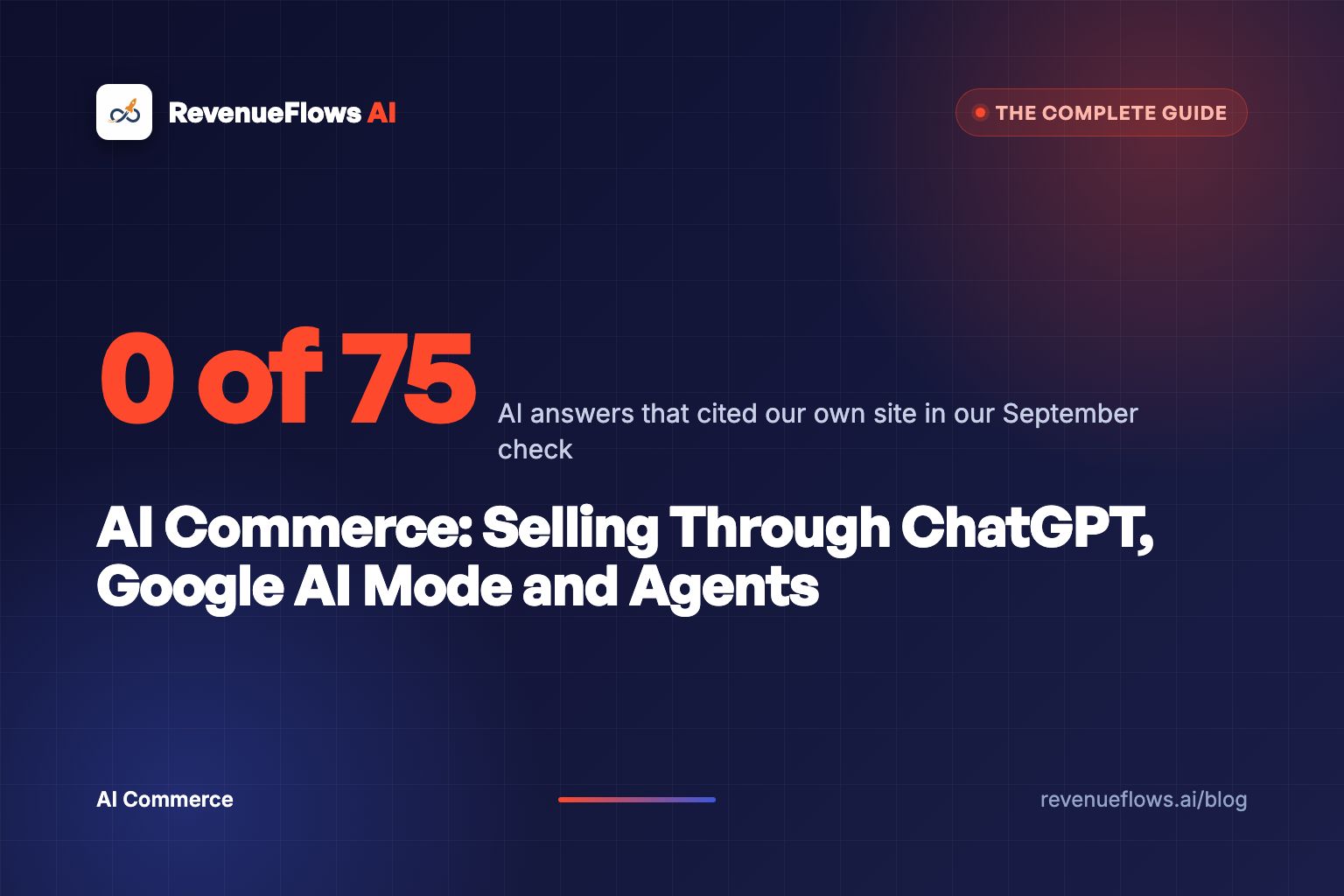
And our own site? Cited in zero of 75 answers. Named once, by Perplexity.
I'll be honest, that stung. We've published hundreds of posts on this exact subject. The engines went to Shopify's help center, Shopify's app store, Shopify's community forum and Reddit instead.
Here's the thing. More posts won't fix that, because the gap is trust. The engines cite places where someone other than the brand is talking: the platform's documentation, a forum thread with 40 replies, a review site. A brand's blog praising itself is the least credible page on the internet, and the models seem to know it.
For product recommendations, the same logic runs even harder. ChatGPT's help page says review summaries come from public websites. Perplexity says it analyzes reviews across multiple sites. So the signals that get you shortlisted mostly live off your store:
- Reviews on your product pages, with enough detail to summarize. "Love it!" can't be quoted. "Fits my 2019 Tacoma bed with the liner still in" can. Our research roundup on whether product reviews increase Shopify conversion rate covers why specificity beats volume.
- Third-party reviews and "best of" lists from people who actually used the product.
- Reddit and forum threads where real buyers discuss your category. You can't fake these and you shouldn't try. But you can be the brand whose founder answers questions honestly in a thread. And when Reddit does send someone, they're the most skeptical visitor you'll ever get, so read how to write a Shopify product page for Reddit traffic before they arrive.
- Brand search demand. When people search your brand name and "reviews," it signals you're a real option, and it's the kind of signal a shortlist leans on.
I've watched this pattern before, in a different costume. Years ago I had a top-selling Amazon product and a suspension wiped it out for days. I learned then that renting a shelf feels safe until the landlord changes the rules. AI channels are a new shelf with a new landlord. The only asset you fully own is the page they send buyers to, and the reputation you've built in places you don't control.
Agents don't trust what you say about yourself. They trust what everyone else says about you, then check it against your page.
How do you measure AI visibility and AI referral traffic?
Two separate questions. Are you being named? And when you're named, does the click turn into money?
Are you being named?
Start with the free numbers you already have access to:
- Merchant Center's AI share-of-voice report. Google made it generally available in the U.S. in September. It compares your brand with others across AI Mode and AI Overviews.
- Your own prompt panel. Write 15 to 25 questions your buyers really ask, in their words, and run them through ChatGPT, Gemini and Perplexity once a month. Log whether you're named, whether you're linked, and who's cited instead. It's the same method as our check above, and it's the most honest AI visibility number you'll get.
- A quick outside read. Our free checker gives you a directional score and the fixes, so you know where to start before you build a panel.
Does the click turn into money?
Shopify's help center says orders from AI channels show in your admin with channel or referrer attribution. That's your first stop. After that:
- In your analytics, build a segment for referral sources like chatgpt.com, perplexity.ai, gemini.google.com and copilot.microsoft.com.
- Expect some AI clicks to land in "direct" with no referrer, especially from apps. Treat your AI numbers as a floor, not a total.
- If you send a feed directly to OpenAI, its best practices suggest adding feed attribution parameters to your product URLs, for example
utm_medium=feed.
Then judge the channel the same way you judge every other channel: revenue per visitor, which is conversion rate times average order value.
Here's the math on a hypothetical store. Say AI referrals land on a standard page and convert at 1.4% with an average order value of $88. That's $1.23 per visitor. On 2,000 AI-referred visitors a month, that's $2,464. Rebuild the landing page so the first screen confirms what the agent promised, and say it converts at 2.6% with an average order value of $112. That's $2.91 per visitor, or $5,824 on the same 2,000 visitors. Same agent, same shortlist, $3,360 more a month. A hypothetical, but every number recomputes.
Getting named is the start. The page decides what the name is worth.
A citation you can't convert is a compliment. A citation you can convert is a channel.
AI on your own store: chatbots and assistants
There's a second meaning of AI commerce that gets mixed up with the first: putting an AI assistant on your own store. A chat bubble that answers questions, recommends products or builds bundles.
Shopify is pushing this too. Its agentic storefronts announcement mentions a Knowledge Base App for your policies, FAQs and brand voice, so agents have the right answers about your store. Google now offers a Business Agent in Search, and in September opened a beta that puts it inside YouTube ads.
Should you add one? My honest answer is: maybe, after the page is fixed, and only if you test it properly.
The vendor stats on on-site assistants are almost all selection bias. The shoppers who open a chat were already more engaged, so of course they convert better. The only fair test is a holdout: half your traffic sees the assistant, half doesn't, and you compare revenue per visitor across the whole group, not just the chatters. We laid out that test step by step in do AI shopping assistants increase Shopify conversion rate.
And there's a simpler point. A chatbot answering "does this fit a queen bed?" 400 times a month is telling you something. That answer belongs on the page, in plain text, above the reviews, where every buyer (and every agent) reads it without asking. Most of the questions a good assistant answers are questions a better page would have answered first.
If you want AI working on your own store, point it at the page itself. That's the job our AI product page builder for Shopify post is about: using AI to write the page that answers the questions, instead of bolting a bot onto a page that doesn't.
The readiness checklist
This is everything above, in the order I'd do it for a Shopify brand doing $10,000 to $200,000 a month. Most of it takes an afternoon. None of it needs a new app.
If you only do three: check the Agentic channel settings, fix the facts on your top 10 pages, and start the monthly prompt panel. The first makes you findable, the second makes you quotable, the third tells you if it's working.
Why does the product page still close the sale?
Everything in this guide points to the same place.
OpenAI tried to own checkout and handed it back. Google built native checkout and still offers cart transfer to your site. Amazon's "Buy for Me" buys from your site. Shopify sends the ChatGPT buyer to your checkout. Every road the agents built ends at a page you own.
And that buyer is different from the one you're used to. They've read a summary. They've seen you side by side with two competitors. They have a price in their head and one or two doubts left. Your page doesn't need to introduce the product. It needs to confirm the choice and remove the last doubt, fast.
That's a solvable problem, and it's the one we've spent years on. On a real bedding brand we rebuilt three hero product pages. Conversion rate went from 1.0% to 3.5%, average order value from $125 to $231, and revenue per visitor from $1.25 to $8.10. On 10,000 visitors, that's $12,500 before and $81,000 after. See the full case study numbers. Real client numbers, not typical results, and not a promise of what your store will do.
None of that came from an agent. It came from a page that answered the buyer's real questions in the right order. The agents just make that page matter more, because now every buyer who lands on it has already been told you might be the one. For the organic side of the same page, our guide to writing a Shopify product page that ranks and converts shows how the same facts serve Google and the buyer at once.
Frequently asked questions
What is AI commerce? Selling through AI assistants and agents that search, compare and sometimes buy for the shopper: ChatGPT, Google AI Mode and Gemini, Perplexity, Copilot and Amazon's Rufus. The agent builds the shortlist. Most purchases in 2026 still finish on the merchant's own checkout.
Can customers still buy directly inside ChatGPT? Mostly not. OpenAI said in March 2026 that the first version of Instant Checkout didn't offer enough flexibility and moved to letting merchants use their own checkout. Shopify now calls ChatGPT a discovery-focused referrer.
How do I get my Shopify products into ChatGPT and Google AI Mode? It's likely already on. Agentic storefronts is active by default for eligible stores. Catalog feeds ChatGPT and Copilot, and Google reads from the Google and YouTube channel or Merchant Center. Check Sales channels, then Agentic.
What's the difference between the Agentic Commerce Protocol and the Universal Commerce Protocol? The Agentic Commerce Protocol is OpenAI's standard, built with Stripe, now focused on feeding product data into ChatGPT. The Universal Commerce Protocol was co-developed by Shopify and Google and powers checkout in AI Mode and Gemini.
Does schema markup help with AI shopping? Yes, as one input. Google says structured data plus a Merchant Center feed maximizes eligibility. But agents also read your feed, reviews and third-party mentions, so schema can't rescue vague product facts.
How do I track sales from ChatGPT and other AI assistants? Start with the AI channel attribution in your Shopify admin, add a referral segment for AI sources in analytics, and run a monthly prompt panel to see if you're named at all.
Start here: the full reading list
Everything we've written on AI commerce, in the order I'd read it.
Getting found by agents
- How to write a Shopify product page for ChatGPT traffic: the first screen for a buyer who arrives with a shortlist.
- The Shopify product page for Google Shopping traffic: winning a comparison the buyer already started, which is what AI Mode clicks look like too.
- Writing a Shopify product page for comparison shoppers: putting the scoreboard on your page before the agent builds one without you.
Off-site trust
- How to write a Shopify product page for Reddit traffic: the most skeptical visitor online, and one of the sources AI engines cite.
- Do product reviews increase Shopify conversion rate?: why specific reviews beat review counts.
Using AI to build the page
- AI product page builder for Shopify: what to look for
- The best AI product description generator for Shopify
- Do AI product descriptions hurt Shopify conversion rate?
- Do AI-generated product images hurt Shopify conversion rate?
AI on your own store
- Do AI shopping assistants increase Shopify conversion rate?: the holdout test that tells you if your chatbot earns its keep.
The number that judges all of it
What to do next
Open your Shopify admin today, go to Sales channels, then Agentic, and write down which AI channels are live. Then open your best seller on your phone and read only the first screen. Ask one question: if an AI had just told a buyer this was the best option under $150, would this screen confirm it in 10 seconds?
If the answer is no, the agents are doing their half of the job and your page isn't doing the other half.
Book Your Profit Audit
AI agents are about to send you buyers who've already compared you, so the page they land on has to close. Get your free profit audit and we'll show you exactly where your hero page is leaking revenue per visitor, then show you how to rebuild a high-converting product sales page in less than 15 minutes.
Or go here to check it out → revenueflows.ai
P.S. The agent is the scout. It can put you on the shortlist, but it can't make the sale. That's still your page's job.
Frequently asked questions
What is AI commerce?
AI commerce is selling through AI assistants and agents that search, compare and sometimes buy on a shopper's behalf, such as ChatGPT, Google AI Mode and Gemini, Perplexity, Microsoft Copilot and Amazon's Rufus. The agent builds the shortlist. In most cases in 2026, the buyer still finishes on the merchant's own checkout.
Can customers still buy directly inside ChatGPT?
Mostly not. In March 2026 OpenAI said the first version of Instant Checkout didn't offer the flexibility it wanted and moved to letting merchants use their own checkout. Shopify now describes ChatGPT as a discovery-focused referrer, with the purchase completed on your store's checkout in an in-app browser or a new tab.
How do I get my Shopify products into ChatGPT and Google AI Mode?
For most Shopify stores it's already on. Agentic storefronts is active by default for eligible stores, Shopify Catalog sends your products to ChatGPT and Copilot, and Google AI Mode and Gemini read from the Google and YouTube channel or Merchant Center. Check Sales channels, then Agentic, in your Shopify admin.
What is the difference between the Agentic Commerce Protocol and the Universal Commerce Protocol?
The Agentic Commerce Protocol is OpenAI's open standard, built with Stripe, and in 2026 it mainly carries product feeds and discovery data into ChatGPT. The Universal Commerce Protocol was co-developed by Shopify and Google and powers checkout inside Google AI Mode and the Gemini app. Shopify handles both for its merchants.
Does schema markup help with AI shopping?
Yes, as one input. Google says giving both on-page product structured data and a Merchant Center feed maximizes eligibility and helps it verify your data. Agents also read your feed, your reviews and what other sites say about you, so schema without clear, specific product facts won't carry you.
How do I track sales from ChatGPT and other AI assistants?
Start in your Shopify admin, which shows orders from AI channels with channel or referrer attribution. Add referral checks in your analytics for chatgpt.com, perplexity.ai and gemini.google.com, and run the same buyer questions through the assistants every month to see whether you're named.