
llms.txt Shopify Apps: Do They Help AI Visibility?
Apps sell llms.txt as the fix for AI visibility. Shopify already gives you one for free, and no major assistant has said it reads it. Here's where the effort should go instead.

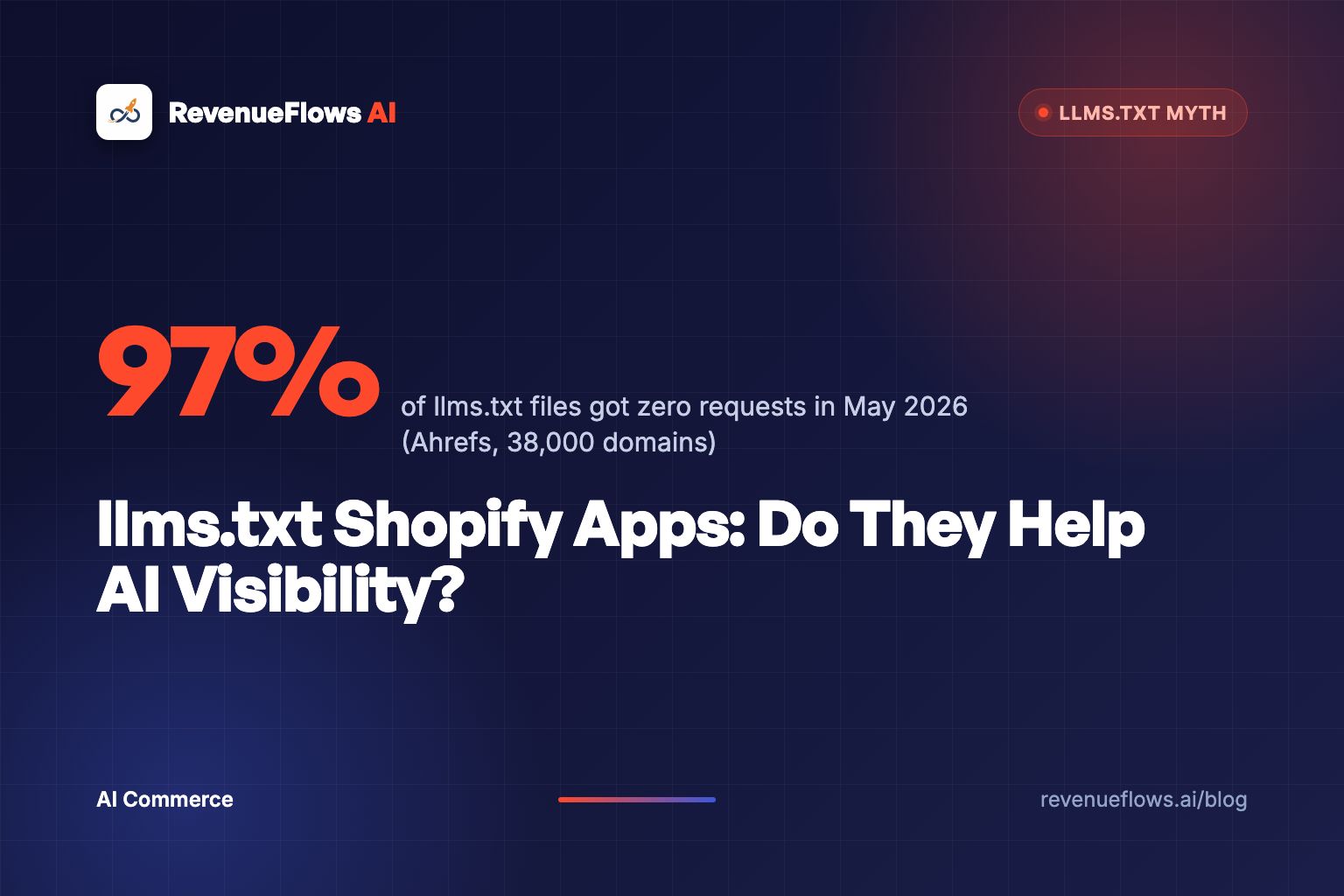
Here's the short answer on llms.txt Shopify apps: they don't move AI visibility in any way an AI company has confirmed. As of October 2026, Google says its Search features ignore llms.txt. OpenAI, Anthropic and Perplexity document robots.txt rules for their crawlers, and none of them say they read your llms.txt to pick products. And here's the part the app listings leave out: Shopify already serves an llms.txt on your store, for free.
So if you're about to pay a monthly fee for one, stop. Put that hour into your product feed, your product schema and the page buyers land on.
I'll admit something. We publish an llms.txt on revenueflows.ai. Our build script writes it automatically every time the blog updates. It costs us nothing, so it stays. But I've never once told a founder it would get their products recommended, because nobody who runs an AI assistant has said that.
What is llms.txt, and why are Shopify apps selling it?
llms.txt is a plain markdown file at the root of a site. Jeremy Howard proposed it in September 2024, and the spec says it was built mainly for inference: an AI agent reading a short, curated summary instead of crawling a whole site. Think of it as a sign taped to the front door for robots.
Then the sales pitch showed up. Search the app store and you'll find generators promising to get you "mentioned" by ChatGPT, Claude and Perplexity. Yoast added an llms.txt toggle to its Shopify app in March. The pages I opened while researching this post had one thing in common: zero statements from an AI company saying they read the file.
Founders feel the gap. In a Shopify Community thread on llms.txt, the worries were exactly the right ones: no proof the crawlers honor it, and a hand-written file going stale the moment your hero product changes.
Has any AI assistant confirmed it reads llms.txt?
I checked each vendor's own documentation today, October 7, 2026. Not blog roundups. The vendor pages.
| Platform | What its own docs say controls visibility | Says it reads your llms.txt? |
|---|---|---|
| Google (AI Overviews, AI Mode) | Core Search ranking, Merchant Center feeds, structured data for rich results | No. Says Search doesn't use it |
| OpenAI (ChatGPT search and shopping) | robots.txt rules for OAI-SearchBot and GPTBot, product feeds | No mention |
| Anthropic (Claude) | robots.txt rules for ClaudeBot, Claude-User, Claude-SearchBot | No mention |
| Perplexity | robots.txt for PerplexityBot, IP allowlisting | No mention |
Google is the only one that went on the record. Its guide to generative AI features in Search says you don't need new machine-readable files or AI text files to appear, because Google Search doesn't use them. They won't help you and they won't hurt you.
The other three are quieter, but their silence is telling. OpenAI's crawler page explains that sites blocking OAI-SearchBot won't show in ChatGPT search answers, and the lever it hands you is robots.txt. Anthropic's crawler page covers its three bots and robots.txt, with no word about llms.txt. Perplexity's bot docs say the same kind of thing.
Funny detail: OpenAI and Perplexity both publish llms.txt files for their own developer docs. That's a doc index for coders. It isn't a promise that their shopping systems read yours.
No AI company has said llms.txt decides which products get recommended. Google said the opposite, in writing.
Does anyone actually request these files?
Almost nobody. Ahrefs looked at 137,000 domains in its web analytics. About 38,000 had a valid llms.txt. 97% of those got zero requests in May 2026. No bots. No humans. Google's John Mueller summed it up in the same piece: "AFAIK none of the AI services have said they're using LLMs.TXT."
Source: Ahrefs study of 137,000 domains, published June 2026. Share of valid llms.txt files by whether anything requested them.
A file nobody opens can't sell anything.
Do you already have an llms.txt on Shopify?
Probably, yes. This is the update most llms.txt Shopify guides still miss.
On May 28, 2026, Shopify's developer changelog confirmed that online stores now include a default agents.md file, and that /llms.txt and /llms-full.txt point to the same content. Shopify's llms.txt template docs describe it as an agent-discovery file. Want custom content? Add a templates/llms.txt.liquid file to your theme. No app needed.
I pulled Allbirds' llms.txt this morning to see what Shopify actually serves. It's an instruction sheet for shopping agents: where the Universal Commerce Protocol discovery endpoint lives, the MCP endpoint for search, cart and checkout, the product JSON paths, and a firm rule that checkout needs the buyer's approval.
Read that again. Shopify's default file isn't a marketing summary written to charm a chatbot. It's a set of directions for an agent that's already standing in your store. It helps the agent buy. It doesn't get the agent to show up.
So the question was never "should I add llms.txt?" You have one. The question is what actually gets you invited in.
What actually gets Shopify products into AI answers?
The front door sign is free and already hung. Here's what the platforms themselves say moves the needle, in the order I'd fix it.
1. Your product feed. Shopify's agentic storefronts push your catalog to ChatGPT, Google AI Mode and Gemini, Microsoft Copilot and Meta through Shopify Catalog, or through Google Merchant Center for Google's surfaces. Google's guide says Merchant Center feeds help products show in AI responses. If your titles say "Sheet Set - Gray - Q" and your variants are missing prices, the machine has nothing to quote. I broke down the channel setup in our guide to Shopify agentic storefronts.
2. Product structured data. Google says that providing structured data and a Merchant Center feed together maximizes eligibility and helps it verify your data. Price, availability, shipping, returns, ratings. Facts a model can lift without guessing.
3. Clean, specific product facts. OpenAI's commerce best practices center on the basics: title, URL, description, media, availability, price and variant options, kept accurate per variant. Boring fields. They do the heavy lifting.
4. Crawler access. Check robots.txt. Blocking OAI-SearchBot keeps you out of ChatGPT search answers. A blanket "block all bots" rule some security app added two years ago can quietly erase you.
5. Reviews and third-party mentions. Assistants lean on what other people say about you. I covered why in how to rank products in ChatGPT, and the conversion side in whether product reviews lift Shopify conversion rate.
llms.txt is a sign on the door. Your feed and your schema are the directions that get the AI to the door in the first place.
For the full map of where AI shopping traffic comes from, start with the AI commerce guide, then the platform deep dives on Google AI Mode shopping and Perplexity shopping.
Why does the page matter more than the file?
Here's the thing nobody selling llms.txt tells you. Say the AI does recommend you. The buyer clicks. Now they're on your product page, and that page either closes them or it doesn't.
Here's the math. The example on our homepage runs like this: a page converting 1% of visitors at a $50 average order value earns $0.50 per visitor. Rebuild it to convert 3% at an $80 average order value and revenue per visitor becomes $2.40. That's 4.8x the revenue from the same traffic.
Now run that on 1,000 visitors a month from AI answers (a hypothetical store, not a client result).
Conversion rate x average order value x visitors: 1% x $50 x 1,000 versus 3% x $80 x 1,000.
$500 versus $2,400. Same visitors. Same AI recommendation. An llms.txt file can't touch that number, because it never meets the buyer.
So when someone asks me whether to spend the afternoon on llms.txt or on the product page, I don't hesitate. One is a sign almost nobody reads. The other is the place where every channel (ads, email, Google, ChatGPT) either turns into revenue or leaks out. If you're writing for the AI click specifically, read how to write a Shopify product page for Google Shopping traffic. The same fact-first structure works for AI answers. And if you're deciding who rebuilds that page, AI product page generator vs copywriter puts the cost and the results side by side.
When is a custom llms.txt worth it?
There are two cases where I'd spend 20 minutes on it.
First, if Shopify's default file describes your store badly. Open yourstore.com/llms.txt. If it's fine, leave it. If you want a one-line brand summary and your top collections listed in priority order, add the theme template and write it once.
Second, if you run a headless store. Shopify's default comes from the Online Store renderer, so Hydrogen builds have to generate the file themselves. Even then, treat it as cheap insurance for agents, never as a visibility plan.
What I wouldn't do: pay a monthly app fee, or let anyone tell you it's the reason you're missing from ChatGPT.
Frequently asked questions
Does llms.txt help my Shopify store show up in ChatGPT or Google AI Mode? Not in any way the AI companies have confirmed. Google says its Search features ignore it, and the other big assistants document robots.txt, not llms.txt. Your feed, schema and crawler access matter far more.
Does Shopify create an llms.txt file automatically? Yes. Since May 28, 2026, online stores serve a default agents.md, and /llms.txt mirrors it. A theme template lets you override it without an app.
Should I pay for an llms.txt app on Shopify? I wouldn't. Shopify serves the file for free and 97% of llms.txt files got zero requests in May 2026, per Ahrefs.
What's the difference between llms.txt and robots.txt? robots.txt is the file AI crawlers say they obey, and it decides whether they can read your store at all. llms.txt is a voluntary summary that no major assistant has confirmed using to rank products.
Can llms.txt hurt my store? No. Google says it neither helps nor hurts. The real cost is the time you didn't spend on your feed and your page.
What to do next
Open a new tab and type your domain followed by /llms.txt. If a file loads, you're done with llms.txt. Close the tab, cancel the app if you have one, and spend the next hour on your best seller's product title, its feed data and the page it sends buyers to.
Book Your Profit Audit
AI assistants can send you the buyer, but no text file will close them once they land. Get your free profit audit and we'll show you where your top product page is leaking those buyers, then show you how to rebuild a high-converting product sales page in less than 15 minutes.
Or go here to check it out → revenueflows.ai
P.S. The sign on the door is already hung, for free. What's behind the door decides whether the AI's recommendation turns into an order or a bounce.
Frequently asked questions
Does llms.txt help my Shopify store show up in ChatGPT or Google AI Mode?
Not in any way the AI companies have confirmed. Google says its Search features ignore llms.txt, and OpenAI, Anthropic and Perplexity document robots.txt rules for their crawlers, not llms.txt. Your product feed, structured data and crawler access matter far more.
Does Shopify create an llms.txt file automatically?
Yes. Since Shopify's May 28, 2026 changelog, online stores serve a default agents.md file, and /llms.txt and /llms-full.txt mirror it. You can override any of the three with a theme template, so you don't need an app to have one.
Should I pay for an llms.txt app on Shopify?
I wouldn't. Shopify already serves the file for free, and Ahrefs found 97% of llms.txt files got zero requests in May 2026. Spend that money and time on your product feed, product schema and the product page itself.
What is the difference between llms.txt and robots.txt?
robots.txt is the file AI crawlers say they obey: it decides whether bots like OAI-SearchBot or Claude-SearchBot can read your store. llms.txt is a voluntary summary file that no major assistant has confirmed using to pick or rank products.
Can llms.txt hurt my Shopify store?
No. Google says it neither helps nor hurts Search visibility. The only risk is wasted time, or a hand-written file that goes stale when your hero products change.