
Why AI Shopping Agents Skip Your Products: 8 Data Gaps
AI shopping agents would rather skip your product than risk a wrong answer. Here are the 8 data gaps that get you skipped, and the page fix that matters once you're picked.

Here's my hot take. AI shopping agents don't dislike your products. They're nervous about them.
An agent answering "best cooling sheets for a hot sleeper under $150" has one job: don't recommend the wrong thing. AI shopping agents pick products they can describe with confidence, and they skip products whose data leaves a question open. No material listed, no size, no barcode, variants that don't match, a return policy nobody can find. Each gap is a chance to be wrong. So the agent picks the store that left no gaps, and you never see the sale you lost, because it never touched your analytics.
AI shopping agents skip products for 8 data reasons: 1. No product category. 2. Vague titles. 3. Missing attributes. 4. No GTIN. 5. Messy variants. 6. Stale price or stock. 7. Hidden policies. 8. No reviews or Q&A.
Fix those, and you get shortlisted. Then a different problem shows up, and I'll get to that.
Why do AI shopping agents skip products instead of ranking them lower?
Because the feed now decides who gets considered at all.
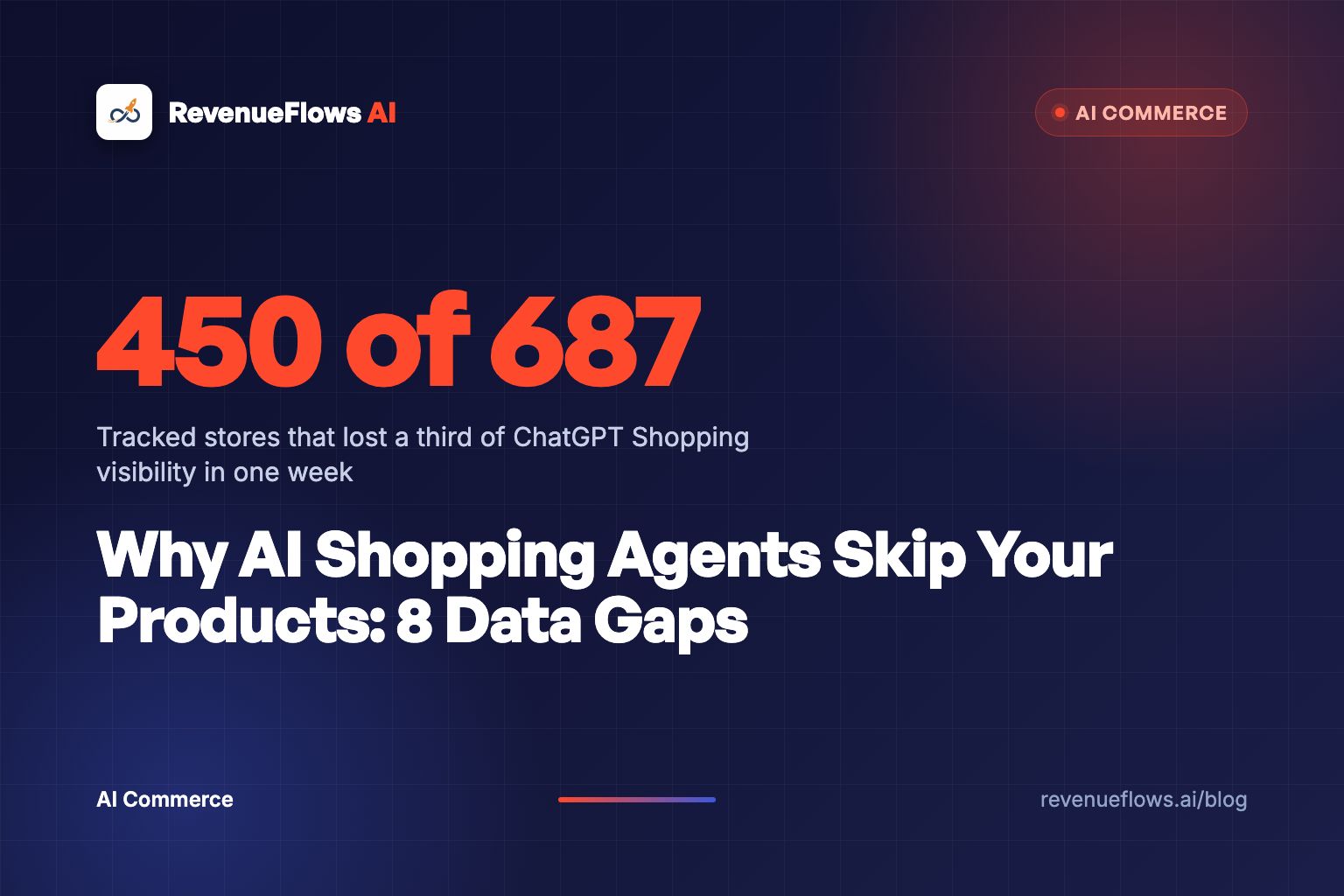
In July 2026, an AI search analytics firm tracked 1,757,723 ChatGPT Shopping prompt runs. On July 10, the share of product picks that came from integrated merchant feeds jumped from 8.26% to 61.54%, according to Search Engine Journal's write-up of the research. In the firm's 687-store sample, 450 stores lost at least a third of their Shopping visibility in that one week. The number of unique merchants referenced fell from 13,524 to 10,607. OpenAI hasn't confirmed the change itself, so treat it as third-party tracking. But the direction is hard to argue with.
Think about what that means. When an agent pulls from structured data, it isn't reading your page the way a person does. It's checking fields. An empty field is an unanswered question, and an unanswered question is a reason to move on.
The good news: the big platforms are publishing the same checklist.
| Platform | What it says it uses | Source |
|---|---|---|
| Shopify agentic storefronts | Title, description, images, type, vendor, collections, tags, variants with option names, barcode, store policies | Shopify help center |
| ChatGPT (OpenAI product feed) | Stable parent ID, unique variant IDs, variant-specific price, availability and media | OpenAI feed best practices |
| Google AI Mode and Gemini | Shopping Graph data plus optional Q&A, variant option and related product attributes | Merchant Center help |
| Perplexity Instant Buy | Availability, reviews, pricing and specifications | Perplexity help center |
And on Shopify, you're probably already in the game. Shopify's agentic storefronts page says the feature is active by default for eligible stores and lists ChatGPT, Google AI Mode and Gemini, Microsoft Copilot and Meta. Being eligible and being picked are two different things. (Setup details live in our Shopify agentic storefronts guide.)
What are the 8 data gaps that get products skipped?
Here they are, in the order I'd fix them.
1. No product category
This one is a hard stop. Shopify's Catalog requirements list "uncategorized products" as ineligible, alongside things like alcohol and weapons. If your product category field is blank, you may not be in the catalog the AI channels read. Open your admin and filter by uncategorized. I'd bet you find some.
2. Titles that don't say what the thing is
"The Cloud" is a brand name. "Cooling Bamboo Sheet Set, Queen, for Hot Sleepers" is a product. Agents match words in the shopper's question to words in your data. A cute title gives them nothing to match.
3. Missing attributes
Google's merchant listing documentation recommends size, color and material, and says to provide as much product information as you have. Shoppers ask agents attribute questions: "100% cotton," "fits a 14-inch mattress," "dishwasher safe." If the attribute isn't in your data, the agent can't say yes. So it doesn't.
4. No GTIN or barcode
Google says to "include all applicable global identifiers" and use the most specific GTIN. Shopify lists the barcode field (UPC, GTIN, ISBN) in its AI channel guidance. The identifier lets an agent confirm your product is the same item a review site or comparison table is talking about. Without it, you're a stranger.
5. Messy variants
This is the gap I see most on stores with lots of sizes and colors. OpenAI's feed guidance says to use a stable ID for the parent product, a unique ID for every purchasable option, and variant-specific title, price, availability and media when they differ. Google added "item group title" and "variant option" as conversational attributes for the same reason.
Picture what goes wrong otherwise, a hypothetical. The navy queen set is $139 and in stock. The sage king set is $169 and sold out. Your feed shows one price and one stock status for everything. The agent tells a shopper "$139, in stock," the shopper clicks the king, and it's sold out at $169. The agent was wrong because of you. Agents are built to avoid that moment. (If your catalog is variant-heavy, read how to write a product page with many variants.)
6. Stale price or stock
Google said in May 2026 that its Shopping Graph holds over 60 billion product listings. That same announcement put agentic checkout in front of Shopify merchants. When an agent can buy on the shopper's behalf, a wrong price is more than a bad answer. It's a failed order. Sync price and inventory as often as your platform allows.
7. Return and shipping policies nobody can read
Shopify tells merchants to make sure store policies are "complete and up-to-date" so AI agents can reference them. Google's return policy help page calls return policy "a key factor for people who are making a purchasing decision." When a shopper asks "can I return it if it doesn't fit?" and your policy is a PDF link in the footer, the agent has no answer. Put the window, the cost and the conditions in plain text, in your policy settings and on the page.
8. No reviews, no Q&A
Perplexity's help center says its answer engine "is more likely to recommend merchants who provide deeper product details such as availability, reviews, pricing, and specifications." Google added a question-and-answer attribute to Merchant Center for AI Mode. Reviews that mention a use case ("I run hot and these kept me cool") answer the exact question shoppers type. Star counts alone don't. If you're still choosing the app that collects them, Loox vs Judge.me compares the two most common on Shopify.
An empty field is an unanswered question. And an agent that can't answer a question picks the store that can.
Which gap should you fix first?
Fix the ones that stop you from being considered, then the ones that cost you trust.
Gap 1 first, because uncategorized products may be out of the catalog completely. Then gaps 5 and 6, because wrong prices and wrong stock make the agent look bad, and that's the outcome it's built to avoid. Then 3, 4 and 7. Reviews and Q&A last, only because they take weeks to build.
What happens after an agent picks you?
Here's the thing nobody selling feed tools says out loud. Clean data gets you shortlisted. It doesn't get you paid.
The shopper still clicks through to a product page, or checks out on data you wrote. If that page reads like a spec sheet and never answers why this product at this price, the agent did its job and you dropped the ball.
Run the math on a store like this, a hypothetical. A cast iron cookware brand gets 10,000 AI-referred visitors a month. Conversion rate 1.4%, average order value $68. Revenue per visitor is $0.95 (1.4% x $68 = $0.952). That's $9,520 a month.
Same visitors, rebuilt page. Conversion rate 2.9%, average order value $81. Revenue per visitor $2.35 (2.9% x $81 = $2.349). That's $23,490 a month.
Conversion rate x average order value x visitors. 1.4% x $68 before, 2.9% x $81 after. Not a client result.
Now the real numbers. For a bedding client, the Cooling Bamboo Sheets page went from a 1.0% conversion rate and $125 average order value to 4.3% and $254. Revenue per visitor moved from $1.25 to $10.92. On 10,000 visitors, that's $109,200 instead of $12,500. See the full case study numbers. Real client numbers, not typical results, and not a promise of what your store will do.
I'll admit something. When AI shopping first got loud, I thought the feed was the whole game. It's half. The feed decides whether you're in the conversation. The page decides whether the conversation turns into money. (I went deeper on that second half in do AI shopping assistants increase Shopify conversion rate.)
Is this different for ChatGPT, Google and Perplexity?
The doors are different. The data is the same.
ChatGPT leans on merchant feeds and, for Shopify stores, agentic storefronts (see how to rank products in ChatGPT). Google pulls from the Shopping Graph and Merchant Center (see Google AI Mode shopping). Perplexity reads specs, reviews and availability. Do the 8 fixes once and every channel gets better data. The full channel map is in our AI commerce guide.
What should you do this week?
One action: export your product catalog to a spreadsheet and sort by the product category column. Every blank row is a product that may be invisible to the AI channels right now. That's a 20-minute job, and it's the only gap on this list that can knock you out completely.
Then work through the rest.
Book Your Profit Audit
Clean product data gets AI shopping agents to pick you, but the page they send shoppers to still has to close the sale. Book a free profit audit and we'll find where your revenue per visitor is leaking, then show you how to rebuild a high-converting product sales page in less than 15 minutes.
Or go here to check it out → revenueflows.ai
P.S. An agent skips a product with gaps to avoid being wrong. A shopper skips a page with gaps for the same reason. Fix both.
Frequently asked questions
Why don't my products show up in AI shopping agents?
Usually because the agent can't answer the shopper's question from your data. Missing attributes, no category, no barcode, messy variants, stale stock or a vague return policy all make your product a risky pick, so the agent recommends a store whose data is complete.
What product data do AI shopping agents need?
A clear title, a product category, size, color and material where they apply, a GTIN or barcode, clean variant data with variant-level price and stock, current availability, shipping and return policies, and reviews. Shopify, Google and OpenAI all point merchants at this same list.
Do AI shopping agents use my product feed or my website?
Both, but feeds are winning. Third-party tracking reported by Search Engine Journal found feed-integrated picks in ChatGPT Shopping jumped from 8.26% to 61.54% on July 10, 2026. Your feed decides if you're picked; your page decides if you get paid.
Can Shopify stores get into ChatGPT and Google AI Mode without an app?
Yes. Shopify's help center says agentic storefronts are active by default for eligible stores and lists ChatGPT, Google AI Mode and Gemini, Microsoft Copilot and Meta. Products still have to meet Shopify Catalog requirements, which exclude uncategorized products.
Does fixing product data increase sales by itself?
It gets you shortlisted. It doesn't close the sale. The shopper still lands on a page or a checkout built from your words, so a store converting 1.4% of AI-referred visitors keeps leaking until the page answers the buying question.