
What Is Agentic Commerce? A Plain Guide for Store Owners
Agentic commerce means an AI agent finds, compares and increasingly buys products for a shopper. Here's what that means for your store, in plain English, and why the fight just moved to your product data.

I'll admit it. The first time someone said "agentic commerce" to me on a call, I rolled my eyes. It sounded like another conference word built to sell decks.
Then I looked at what it actually means for a store doing $40,000 a month on Shopify, and I stopped rolling my eyes.
So here's the plain answer to what is agentic commerce: it's online shopping where an AI agent does the work a shopper used to do. The shopper says what they want. The agent searches, compares products across stores, checks price and stock, builds the cart and, in a growing number of channels, starts or finishes checkout. The human sets the goal and the limits. The software does the clicking.
That one shift changes who you're selling to first. Before a human ever sees your page, a machine reads your product data and decides whether you make the shortlist.
What is agentic commerce, in plain English?
Agentic commerce is a model of buying where AI agents act for a shopper: they research, compare and complete purchases inside limits the shopper sets. A shopper who types "find me cooling sheets under $200 that ship this week" gets a shortlist, a recommendation and, in some channels, a checkout button without ever opening a browser tab.
That's the definition worth quoting. IBM puts it almost the same way: agentic commerce is an approach where AI agents act on behalf of consumers or businesses to research, negotiate and complete purchases.
The word that matters is "act." A shopping assistant suggests. An agent executes.
Search engines gave you a ranking. Agents give the shopper a decision. You're either in the decision or you're invisible.
How does agentic commerce actually work?
It comes down to four moves.
- The shopper states a goal. "A waterproof hiking boot, wide fit, under $180."
- The agent pulls product data. It reads feeds, catalogs and pages from many stores at once.
- The agent compares and shortlists. Price, stock, shipping time, reviews, specs, return policy.
- The agent moves toward checkout. Sometimes it hands the shopper a link. Sometimes it completes the purchase inside the chat.
Here's the plumbing underneath, as of today. OpenAI's developer docs describe the Agentic Commerce Protocol as three parts: agentic checkout, delegated payment and product feeds, and the first step they tell merchants to take is sharing a structured product feed. Google co-developed the Universal Commerce Protocol with Shopify, Amazon, Walmart, Target, Etsy and others, and its spec covers catalog search, carts, checkout, payments and order tracking.
We broke the two down in Agentic Commerce Protocol vs Universal Commerce Protocol if you want the detail. The one thing to notice: both start with your product data.
How is agentic ecommerce different from the store you run today?
Your current store was built for a human with a thumb and eight seconds of patience. Agentic ecommerce adds a second reader who never gets bored and never skims.
| Traditional ecommerce | Agentic ecommerce | |
|---|---|---|
| Who searches | The shopper, one tab at a time | An AI agent, across many stores at once |
| What gets you found | Ads, SEO rankings, brand recall | Structured product data the agent can read and trust |
| Who compares | The shopper, reading pages | The agent, reading feeds, specs, reviews and policies |
| Where the sale closes | Your checkout | Your checkout, or a checkout inside the AI channel |
| What loses the sale | A page that doesn't answer the buying question | Vague data that drops you off the shortlist, then the same weak page |
| Your first reader | A human | A machine, then a human |
Here's the thing. Most founders hear "AI agents shopping" and assume the product page is about to die. The table says the opposite. You now need to win two readers, and the page has to work for both.
Are AI agents shopping for real buyers yet?
Yes. Early, but real, and growing fast.
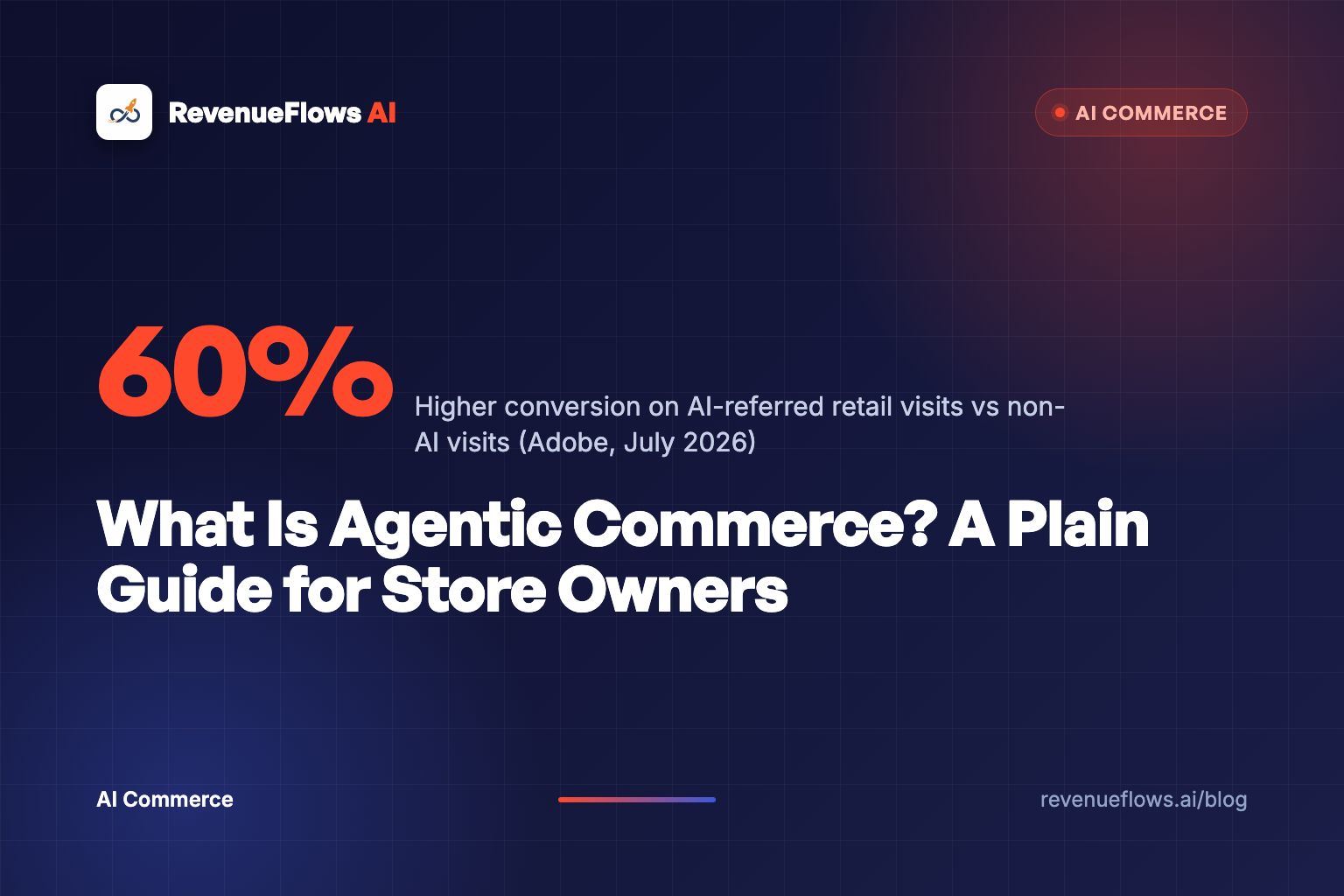
Adobe tracks more than 1 trillion visits to US retail sites. In July 2026, AI-referral traffic to US retail sites was up 62% year over year, and those visits converted 60% higher than non-AI traffic, with 53% more revenue per visit. That was the 11th straight month AI traffic out-converted everything else.
Shopify sees the same thing from the merchant side. In the second quarter of 2026, AI-driven traffic to Shopify stores grew 197% year over year, and orders from AI-powered searches grew three times.
And the forecast is big. McKinsey estimates agentic commerce could orchestrate up to $1 trillion in US retail revenue by 2030, and $3 trillion to $5 trillion globally. That's a forecast, not a fact. I'd hold it loosely.
What's live right now for a Shopify store matters more. Shopify's agentic storefronts let shoppers discover and buy your products in ChatGPT, Google AI Mode and Gemini, Microsoft Copilot and Meta surfaces. ChatGPT shoppers finish on your own store checkout, in an in-app browser or a new tab. On Google, Microsoft and Meta, if you turn on direct checkout, the shopper can buy without leaving the AI channel. Our Shopify agentic storefronts setup guide walks through the switches.
AI shoppers already convert better than everyone else. The question is whether they convert on your page or on the competitor the agent picked instead.
Why does agentic commerce shift the fight to product data?
Because the agent can't fall in love with your brand video.
A human scrolls past a vague title and still buys because the photo is gorgeous. An agent asked for "wide fit, waterproof, under $180" reads your title, attributes, price, stock and policy text. If "wide fit" lives only inside a lifestyle image, the agent doesn't know it exists. You're off the shortlist before the race starts.
So the old fight was for attention. The new fight is for clarity.
Run the math on two stores like this, a hypothetical. Same boot, same $180 price. Store A's data says "Trail Boot, Brown." Store B's says "Waterproof Wide-Fit Hiking Boot, Brown, Sizes 7-14, Ships in 2 Days, 60-Day Returns." Ask an agent for a wide-fit waterproof boot that ships fast. Which one gets named?
Store B. Every time. And Store A will never see the lost sale in any report, because the visitor never arrived.
That's what makes this sneaky. A broken checkout shows up in your analytics. A missing attribute shows up as nothing at all.
Shopify's own advice lines up with this: its agentic commerce guide tells merchants to audit and enrich their structured product data first. If you want the ranking side in depth, read how to rank products in ChatGPT shopping results. On Google's side, the same data lives in your Merchant Center feed, and these 14 Google Shopping feed fixes are the place to start.
Does your product page still matter if an agent does the shopping?
More than ever. And this is where I part ways with most of the agentic commerce hype.
The agent gets the shopper to your door. In plenty of channels, the human still walks in, reads your page and decides. That's the moment you either print money or bleed it.
Watch what happens with the same traffic. Run the math on a store like this, a hypothetical: 1,000 agent-referred visitors a month, $90 average order value.
- Weak page: conversion rate 1.2%, average order value $90. Revenue per visitor $1.08. On 1,000 visitors that's $1,080.
- Strong page: conversion rate 3.0%, average order value $90. Revenue per visitor $2.70. On the same 1,000 visitors that's $2,700.
Conversion rate x average order value x visitors. 1.2% x $90 vs 3.0% x $90. Not a client result.
Same agent. Same shortlist. Same visitors. The page decided the outcome.
Here's a real one. A bedding brand's Copper Bamboo Sheets page went from a conversion rate of 1.0% and an average order value of $125 (revenue per visitor $1.25) to a conversion rate of 4.3% and an average order value of $221, which is revenue per visitor of $9.50. On 10,000 visitors, that's $95,000 instead of $12,500. Real client numbers, not typical results, and not a promise of what your store will do. Nothing about their ads changed. The page started answering the questions buyers were silently asking.
Agents make that page more valuable, not less. A page that spells out who the product is for, what makes it different and why it's worth the price gives the agent clean facts to quote and gives the human a reason to buy.
The agent writes the shortlist. Your page closes the sale. Lose either one and the other doesn't matter.
How do you get your store ready for AI agents shopping?
You don't need a dev team or a new protocol integration to start. You need clean data and a page that sells. On Shopify, agentic storefronts handle most of the plumbing; your job is what the plumbing carries.
If you want the bigger map of every AI channel and how they fit together, start with our AI commerce guide. And if you're wondering what happened to buying inside ChatGPT, here's the story of ChatGPT Instant Checkout.
Frequently asked questions
What is agentic commerce in simple terms?
Agentic commerce is shopping where an AI agent does the legwork for a person: it searches, compares, builds the cart and, more and more often, checks out inside limits the shopper sets. The shopper states the goal. The agent does the clicking.
Is agentic commerce the same as an AI shopping assistant?
Close, but not the same. A shopping assistant recommends. An agent acts: it can check stock, add to cart and start checkout for you. Agentic commerce is the point where the software stops suggesting and starts executing.
Do AI agents actually buy products today?
Yes, in some channels. Shopify says Google AI Mode, Gemini, Microsoft Copilot and Meta can offer a Shopify-powered direct checkout inside the channel, while ChatGPT shoppers finish the purchase on your own store checkout.
How do I get my Shopify products into agentic commerce?
Start with Shopify's agentic storefronts, which share your catalog with AI channels like ChatGPT, Gemini and Copilot. Then clean your product data: specific titles, real attributes, accurate price and stock, and answers to the questions buyers ask.
Does my product page still matter if an AI agent does the shopping?
More than before. The agent reads your page and data to decide whether to recommend you, and in many channels the human still lands on your page to buy. A page that answers the buying question wins both readers.
What to do next
Open ChatGPT today and type the exact request your best customer would type, like "best cooling sheets for hot sleepers under $200." Read the shortlist. If your product isn't on it, your data is the first fix. If it is, click through to your own page and ask one question: does this page answer why this product, at this price, over the other two the agent named?
Book Your Profit Audit
Agentic commerce sends shoppers to your page with a shortlist already in their head, so the page has to win the comparison in seconds. Book a free profit audit and we'll show you where your page is losing those buyers, then rebuild a high-converting product sales page in less than 15 minutes.
Or go here to check it out → revenueflows.ai
P.S. The agent picks the shortlist. Your page picks the winner. Feed the agent clean data and give the human a page that closes.
Frequently asked questions
What is agentic commerce in simple terms?
Agentic commerce is shopping where an AI agent does the legwork for a person: it searches, compares, builds the cart and, more and more often, checks out inside limits the shopper sets. The shopper states the goal. The agent does the clicking.
Is agentic commerce the same as an AI shopping assistant?
Close, but not the same. A shopping assistant recommends. An agent acts: it can check stock, add to cart and start checkout for you. Agentic commerce is the point where the software stops suggesting and starts executing.
Do AI agents actually buy products today?
Yes, in some channels. Shopify says Google AI Mode, Gemini, Microsoft Copilot and Meta can offer a Shopify-powered direct checkout inside the channel, while ChatGPT shoppers finish the purchase on your own store checkout.
How do I get my Shopify products into agentic commerce?
Start with Shopify's agentic storefronts, which share your catalog with AI channels like ChatGPT, Gemini and Copilot. Then clean your product data: specific titles, real attributes, accurate price and stock, and answers to the questions buyers ask.
Does my product page still matter if an AI agent does the shopping?
More than before. The agent reads your page and data to decide whether to recommend you, and in many channels the human still lands on your page to buy. A page that answers the buying question wins both readers.