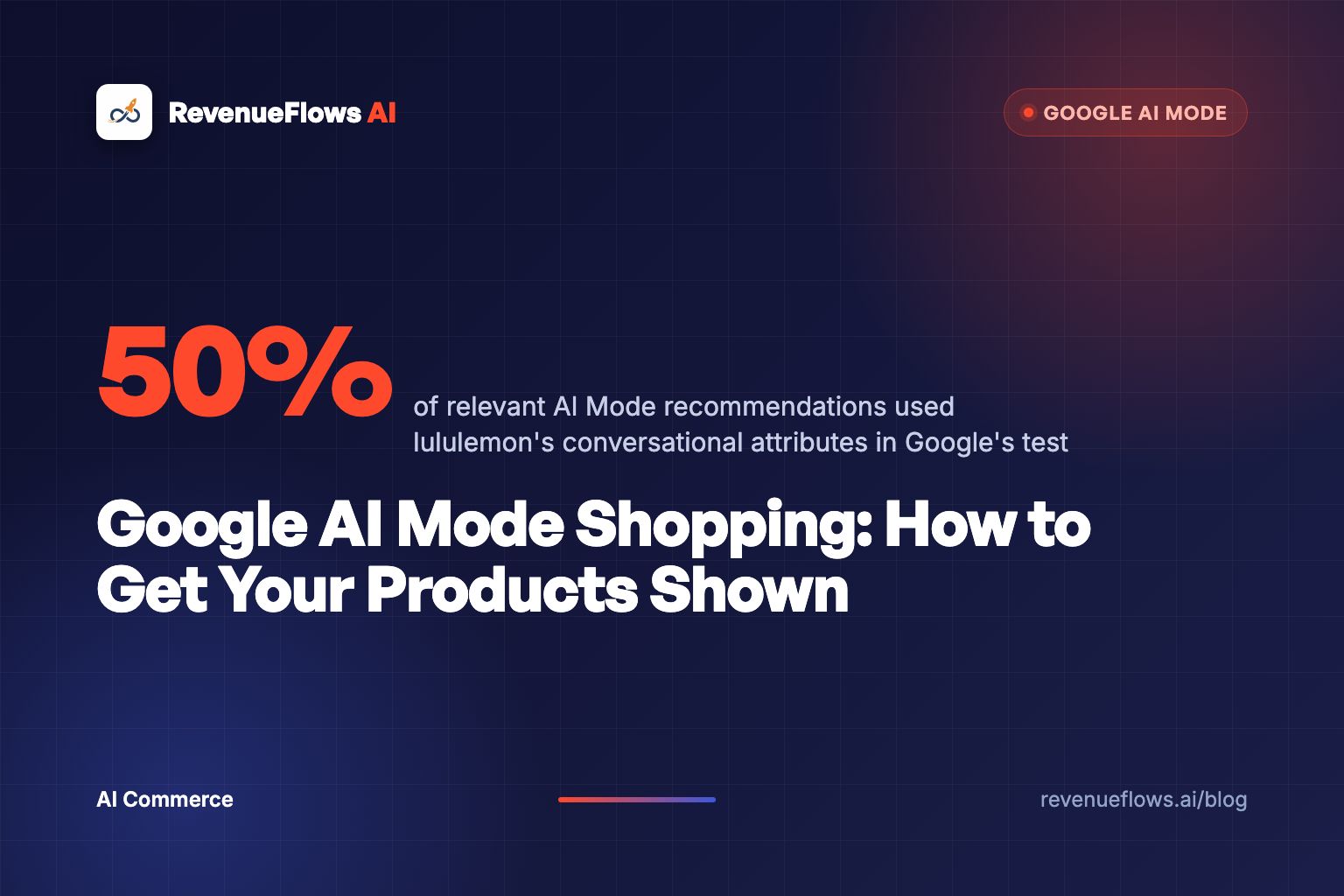
Google AI Mode Shopping: How to Get Your Products Shown
Google AI Mode shopping picks products from the Shopping Graph, and the Shopping Graph reads your product data before it reads your bid. Here's what Google says it uses, the six new attributes, and the page that still has to close the sale.

Here's my hot take on Google AI Mode shopping: the founders raising their Shopping bids to "get into AI Mode" are paying for the wrong thing.
Google AI Mode shopping works like this. A shopper describes what they want in plain words ("a linen duvet cover that won't wrinkle, under $150, ships before Friday") and AI Mode answers with products pulled from Google's Shopping Graph. Google says that graph now holds over 60 billion product listings, and back in November it said 2 billion listings are updated every hour. To get your products shown, you need three things: a clean Merchant Center feed with free listings on, product facts specific enough to match a long conversational question, and a product page that closes the click when it comes.
Notice what's missing from that list. A bigger bid.
How does Google AI Mode shopping pick products?
AI Mode doesn't read your ad. It reads your data.
When someone types a long question, AI Mode breaks it into pieces (Google calls this query fan-out) and looks for products whose facts match each piece. Linen. Wrinkle-resistant. Under $150. In stock. Ships fast. Every one of those is an attribute somebody either filled in or didn't.
Google's own Search Central page says there are "no additional requirements to appear in AI Overviews or AI Mode," and tells you to keep your Merchant Center information up to date. No secret switch. The data you already send is the entry ticket.
And that data comes from two places. Your Merchant Center feed, and the product structured data on your page. Google's product structured data guide says providing both "maximizes your eligibility to experiences and helps Google correctly understand and verify your data."
AI Mode can only recommend what it can describe. If your feed says "Duvet Cover, Grey," you just lost every shopper who asked for linen.
Do you have to pay for ads to show up in AI Mode?
No. This is the part most founders get wrong.
Google's free listings page says products can appear "at no cost on Google Search, Google Maps, Gemini, YouTube, the Shopping tab, Google Images, and Google Lens." AI Mode lives inside Search. So if free listings are switched off in your Merchant Center, you've closed the free door yourself. That's the first setting I'd check, before anything else in this post.
Ads are in there too. Google said in May 2025 that advertisers running Performance Max, Shopping and Search campaigns with broad match are eligible to appear in AI Overviews and AI Mode.
But here's the thing. An ad still runs on the same product data. You can outbid everyone and still lose the shopper who asked for linen, because your listing never told Google it's linen.
Bids buy placement. Attributes buy relevance. AI Mode rewards relevance first, because a wrong recommendation makes Google look bad.
What are conversational attributes, and should you fill them in?
Yes. They're the closest thing to an AI Mode lever Google has handed merchants.
Google's Merchant Center help center lists six conversational attributes built for "AI-driven surfaces, like AI Mode in Search." In May, Google opened them to retailers globally. In September it shared the test result that matters: with lululemon, "conversational attributes submitted from the brand were incorporated 50% of the time in relevant product recommendations in AI Mode," according to Google's holiday retail post.
| Attribute | What it tells AI Mode | What to put in it |
|---|---|---|
| question_and_answer | The questions buyers ask before they buy | Your 5 to 10 real pre-sale questions, answered plainly |
| document_link | Where the deeper facts live | Care guide, size chart or spec sheet PDF |
| related_product | What goes with this item | The matching pillowcase, refill or accessory |
| item_group_title | One name for a product with variants | "Washed Linen Duvet Cover" for every size and color |
| variant_option | What makes each variant different | Size, color, material per variant |
| popularity_rank | How well it sells against your catalog | Your best sellers ranked by share of inventory |
The question and answer attribute is the one I'd start with. Google allows up to 30 pairs per product, 1,000 characters each, and gives three rules worth taping to your monitor: don't put prices or dates in it, don't stuff keywords, and don't repeat what's already in your title or description.
Where do the questions come from? Your support inbox and your reviews.
The questions your customer service team answers every week are the exact sentences AI Mode is trying to match. Most stores keep them in a help desk where Google never sees them.
Can buyers check out inside AI Mode now?
Some can, and it's moving fast, so here's what's true as of today.
Google launched agentic checkout in November 2025 with Wayfair, Chewy, Quince and select Shopify merchants. In May 2026 it announced Universal Cart, a cart that works across merchants in Search and the Gemini app, with checkout through Google Pay over the Universal Commerce Protocol. And in September, Google said its UCP hub now supports cart transfer to a merchant site, rolling out in the U.S. first.
For a Shopify store, the details sit on Shopify's Google AI Mode and Gemini page. Products reach AI Mode through the Google and YouTube channel or Merchant Center. Direct checkout "is also rolling out to Google users and might not yet be available." Subscriptions, product bundles and customizable products aren't supported in that checkout, and upsells might not display.
One more thing worth knowing. PPC Land reported that on September 22 Google emailed Shopify merchants that their store was matched to Merchant Center, with native checkout switched on in AI Mode and Gemini and eligible products included automatically. I couldn't find a Google page confirming the email, so treat it as reported. But open Sales channels, then Agentic, in your Shopify admin and see what's on. The full settings walkthrough is in our Shopify agentic storefronts guide.
If your average order value lives in a bundle, think hard before you let a checkout that can't show bundles take the sale. That's the same lesson OpenAI taught everyone in March, covered in what happened to ChatGPT Instant Checkout.
What happens after AI Mode shows your product?
Most of the time, the shopper clicks through. And that's where the revenue is decided.
An AI Mode click is a verdict. The shopper saw your image, your price and two or three alternatives in a comparison, then picked you. Your page now has one job: confirm the choice. It's the same buyer we wrote about in the product page for Google Shopping traffic, except she's asked a sharper question first.
Here's the math on a store like this, a hypothetical. A bedding brand selling a $60 linen pillowcase set. AI Mode starts naming it for "breathable pillowcases for hot sleepers." The page converts at 1.2% with a $60 average order value. That means revenue per visitor is $0.72. On 10,000 AI Mode visitors a month, that's $7,200.
Now the page answers the question those shoppers arrived with (does linen actually sleep cooler, and how does it feel after 20 washes?) and offers the duvet cover bundle. Conversion rate moves to 2.4%, average order value to $75. Revenue per visitor is $1.80. On the same 10,000 visitors, that's $18,000.
Conversion rate x average order value x visitors. 1.2% x $60 before, 2.4% x $75 after. Not a client result.
Same Shopping Graph. Same AI Mode answer. $10,800 a month apart, decided by the page.
Now a real one. A bedding client's Cooling Bamboo Sheets page went from a conversion rate of 1.0% to 4.3%, and average order value went from $125 to $254. Revenue per visitor moved from $1.25 to $10.92. On 10,000 visitors, that's $12,500 before and $109,200 after. See the full case study numbers. Real client numbers, not typical results, and not a promise of what your store will do.
AI Mode decides who gets the click. Your page decides who gets paid. Feed the graph, then fix the page.
How do you know if it's working?
Google gave you a number for this. Use it.
The AI performance report in Merchant Center compares your brand's share of voice with brands similar to yours across Search and Gemini, shows funnel metrics, and has an attribute completeness score that flags products missing structured attributes like color, style or material. Google said in September it's now available in the U.S., Canada, Australia, India and New Zealand.
Then run your own check. Write ten questions your buyers really ask, in their words, and type them into AI Mode once a month. Log whether you're named and who's named instead. Do the same in ChatGPT; how ChatGPT picks products is a slightly different game. The wider map of every agent and where each one finishes the sale is in the AI commerce guide.
Frequently asked questions
How does Google AI Mode choose which products to show?
AI Mode answers shopping questions from Google's Shopping Graph, which Google says holds over 60 billion product listings. Your Merchant Center data, your page's product structured data and attributes like material, size and use case decide whether your product matches the question a shopper typed.
Do I need to run Google Shopping ads to appear in AI Mode?
No. Free listings in Merchant Center let products appear at no cost across Google Search, Gemini, YouTube, the Shopping tab, Images and Lens. Ads from Performance Max, Shopping and broad match Search campaigns are eligible too, but a bid can't fix a product the Shopping Graph doesn't understand.
What are conversational attributes in Google Merchant Center?
Six optional product attributes built for AI surfaces like AI Mode: question and answer, document link, related product, item group title, variant option and popularity rank. In Google's test with lululemon, the brand's conversational attributes were used 50% of the time in relevant AI Mode recommendations.
Can shoppers buy my Shopify products directly inside Google AI Mode?
Sometimes. Shopify says products reach AI Mode and Gemini through the Google and YouTube channel or Merchant Center, and direct checkout is still rolling out to eligible U.S. stores. Bundles, subscriptions and customizable products aren't supported in that checkout, and upsells might not display.
How do I see if my products show up in AI Mode?
Check the AI performance report in Merchant Center, which Google made available in the U.S., Canada, Australia, India and New Zealand in September 2026. It compares your share of voice with similar brands across AI Mode and AI Overviews and flags products missing attributes like color, style or material.
What to do next
Open Merchant Center today, confirm free listings are on, and add five real buyer questions to the question_and_answer attribute for your single best seller. One product. Thirty minutes. Then watch whether AI Mode starts naming it.
Book Your Profit Audit
Google AI Mode can put your product in front of a shopper who already asked exactly the right question, but only your page can turn that click into an order. Book a free profit audit and we'll show you what each Google visitor is worth on your store today, then rebuild a high-converting product sales page in less than 15 minutes.
Or go here to check it out → revenueflows.ai
P.S. Bids rent you a spot in the answer. Attributes earn you one. And the page is what gets you paid either way.
Frequently asked questions
How does Google AI Mode choose which products to show?
AI Mode answers shopping questions from Google's Shopping Graph, which Google says holds over 60 billion product listings. Your Merchant Center data, your page's product structured data and attributes like material, size and use case decide whether your product matches the question a shopper typed.
Do I need to run Google Shopping ads to appear in AI Mode?
No. Free listings in Merchant Center let products appear at no cost across Google Search, Gemini, YouTube, the Shopping tab, Images and Lens. Ads from Performance Max, Shopping and broad match Search campaigns are eligible too, but a bid can't fix a product the Shopping Graph doesn't understand.
What are conversational attributes in Google Merchant Center?
Six optional product attributes built for AI surfaces like AI Mode: question and answer, document link, related product, item group title, variant option and popularity rank. In Google's test with lululemon, the brand's conversational attributes were used 50% of the time in relevant AI Mode recommendations.
Can shoppers buy my Shopify products directly inside Google AI Mode?
Sometimes. Shopify says products reach AI Mode and Gemini through the Google and YouTube channel or Merchant Center, and direct checkout is still rolling out to eligible U.S. stores. Bundles, subscriptions and customizable products aren't supported in that checkout, and upsells might not display.
How do I see if my products show up in AI Mode?
Check the AI performance report in Merchant Center, which Google made available in the U.S., Canada, Australia, India and New Zealand in September 2026. It compares your share of voice with similar brands across AI Mode and AI Overviews and flags products missing attributes like color, style or material.