
Cooling Sheets Case Study: $10.92 Revenue Per Visitor
Same store, same 4.3% conversion rate as its sister product. The cooling sheets still earned $1.42 more per visitor. Here's the lever that did it, with every input shown.

Two sheet sets. Same store. Same rebuild. Same 4.3% conversion rate.
One earned $9.50 a visitor. The other earned $10.92.
This cooling sheets product page case study is about that $1.42 gap, because it answers the question I get from every bedding founder who reads our results: which lever actually did the heavy lifting? Here's the short answer. Conversion rate made the result big. Average order value made it the biggest of the three.
What did the cooling sheets product page case study measure?
One product page on a Shopify bedding store with 30+ products, stuck at a revenue ceiling of $15,000 a month. We rebuilt the top 3 hero products. The cooling bamboo sheets were product number three.
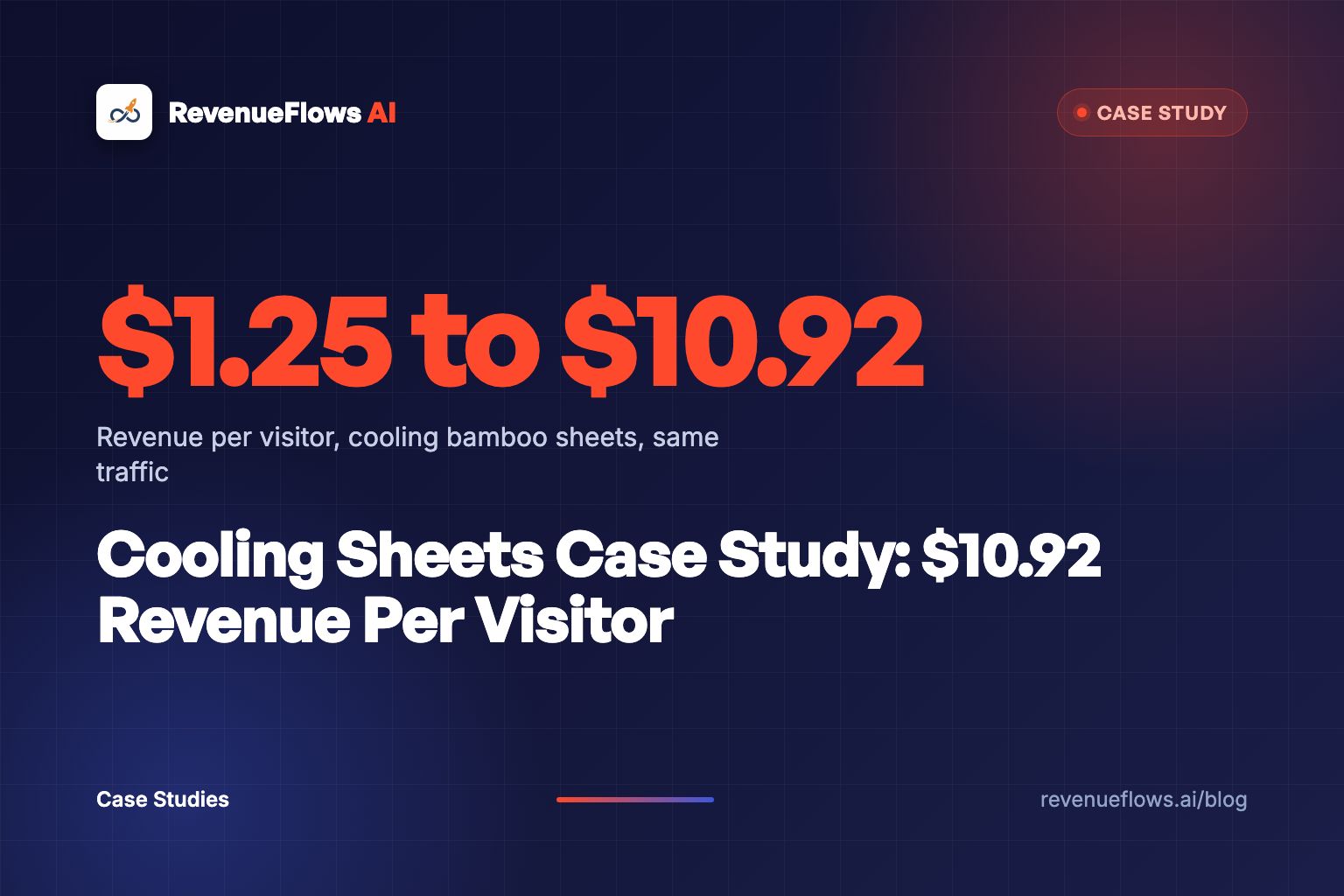
Before the rebuild: conversion rate 1.0%, average order value $125. That means revenue per visitor was $1.25. On 10,000 visitors, that's $12,500.
After the rebuild: conversion rate 4.3%, average order value $254. Revenue per visitor $10.92. On the same 10,000 visitors, that's $109,200.
That's $96,700 more from the same clicks. You can see the full case study numbers for all three products. Real client numbers, not typical results, and not a promise of what your store will do.
| Key metric | Before | After |
|---|---|---|
| Conversion rate | 1.0% | 4.3% |
| Average order value | $125 | $254 |
| Revenue per visitor (conversion rate x average order value) | $1.25 | $10.92 |
| Revenue on 10,000 clicks | $12,500 | $109,200 |
Source: the per-product table on our results page.
Source: /results. Conversion rate x average order value. 1.0% x $125 = $1.25. 4.3% x $254 = $10.92. Real client numbers, not typical results.
The cooling bamboo sheets page went from 1.0% x $125, which is $1.25 a visitor, to 4.3% x $254, which is $10.92 a visitor. Same product, same traffic, same store. On 10,000 clicks that's $109,200 instead of $12,500.
Which lever moved the most?
Pull the result apart and run each lever on its own. This is the part most product page results never show you.
Conversion rate alone. Keep the old $125 order and apply the new 4.3% conversion rate. 4.3% x $125 = $5.38 a visitor. On 10,000 visitors, $53,750.
Average order value alone. Keep the old 1.0% conversion rate and apply the new $254 order. 1.0% x $254 = $2.54 a visitor. On 10,000 visitors, $25,400.
Both together. 4.3% x $254 = $10.92 a visitor. $109,200.
Look at that last line. $53,750 plus $25,400 doesn't get you anywhere near $109,200. The levers don't add. They multiply. Conversion rate went 4.3 times higher, order value went about 2.03 times higher, and 4.3 x 2.03 is roughly 8.73 times the revenue per visitor. That's the 873% boost the results page shows.
So yes, conversion rate did more of the multiplying on this page. I'm not going to pretend otherwise. But that's only half the story, and the other half is where the money is.
Source: /results inputs. Before: 1.0% x $125. Conversion only: 4.3% x $125. Order value only: 1.0% x $254. Both: 4.3% x $254 (results page figure).
Why did cooling sheets beat copper sheets at the same conversion rate?
Here's the comparison that makes this case study worth reading next to the copper bamboo sheets case study.
Both pages closed 4.3% of visitors. Identical. Same store, same rebuild, same method. If conversion rate were the whole game, they'd have earned the same.
They didn't.
- Copper bamboo sheets: 4.3% x $221 = $9.50 a visitor. $95,000 on 10,000 clicks.
- Cooling bamboo sheets: 4.3% x $254 = $10.92 a visitor. $109,200 on 10,000 clicks.
- Adjustable pillows: 4.4% x $152 = $6.68 a visitor. $66,800 on 10,000 clicks.
The pillows had the best conversion rate of the three and finished last. The cooling sheets tied for second on conversion and finished first. The $14,200 gap between the two sheet pages, on the same 10,000 clicks, came from one place: $33 more on every order.
Conversion rate got all three products into the same league. Average order value decided who won it. At 4.3%, every extra dollar on the order was worth another $430 on 10,000 clicks.
That's why I call order value the biggest lift in this rebuild, even though conversion rate did more multiplying. Every founder I talk to is already chasing conversion rate. Almost none of them are chasing the order. I compare those two numbers head to head in revenue per visitor vs conversion rate, and this product is the cleanest proof of it I have.
How did the order grow from $125 to $254?
The $125 order was a sheet set. The $254 order was a bed.
That's the whole idea, and cooling is a product category that makes it easy. A hot sleeper doesn't want cool sheets and a hot pillowcase. They want the whole bed to sleep cooler. So the method RevenueFlows AI builds into every page sells the outcome as a set: sheets with matching pillowcases, the bigger size shown as the default, and the complementary pieces sitting right next to add to cart, so the buyer finishes the bed in one order. I won't claim one element did it alone. The order doubled, and the set is the method behind it.
None of this needed a discount. A discount pays the buyer to buy more. A set gives them a reason to.
Baymard Institute has been pointing at this for years. Their product page suggestions research found only 42% of top ecommerce sites recommend both alternative and supplementary products on the product page, and it describes supplementary suggestions as the ones that help shoppers "finish the package." That article is from 2014. Most bedding pages still sell one sheet set and stop.
The cooling claim did the other half of the work. The Sleep Foundation's guide to cooling sheets, updated July 2026, explains cooling the way a buyer can believe it: breathable fibers that let heat escape and fabric that wicks moisture so it can evaporate. Bamboo-derived viscose is on their list. A page that explains the mechanism in one plain sentence sells harder than a page that prints "COOLING" in a badge, and a buyer who believes the claim is a buyer who'll buy the matching pillowcases too.
If you want the full order value playbook, how to increase average order value on Shopify covers every lever, and how to use product bundles goes deep on the set structure this page used.
What does this mean for cooling bedding marketing?
Most cooling bedding marketing pours money into the top of the funnel. New creative, a cooler ad hook, another influencer. Then the click lands on a page that sells one $125 set and stops talking.
Here's the math on that. At 4.3%, the difference between a $221 order and a $254 order is $1.42 a visitor. If you're buying 10,000 clicks a month, that's $14,200 a month you already paid for and never collected. No ad change gets you that. Only the page does.
The same store, measured as a whole, went from 1.0% to 3.5% and from $125 to $231, which I break down in the bedding product page optimization teardown. Every product in this bedding ecommerce case study, plus the Amazon ones, lives in the ecommerce case studies library.
Run the math on your own hero product. The calculator starts with the cooling sheets numbers. Swap in yours.
What to do next
One action. Pull your hero product's average order value for the last 30 days, then pull it for orders that included only that one product. If those two numbers are close, your page is selling a product and stopping. That gap is your order value lever, and on this store it was worth $14,200 per 10,000 clicks between two pages that converted identically.
Questions founders ask about this case study
What were the results in the cooling sheets product page case study? Conversion rate went from 1.0% to 4.3% and average order value from $125 to $254, so revenue per visitor went from $1.25 to $10.92. On 10,000 clicks that's $109,200 instead of $12,500. Real client numbers, not typical results, and not a promise of what your store will do.
Which lever drove the cooling sheets result, conversion rate or average order value? Both, multiplied. Conversion rate went 4.3 times higher and average order value about 2.03 times higher. But conversion rate matched the copper sheets page exactly at 4.3%, so the $1.42 per visitor that made cooling sheets the top earner came entirely from order value: $254 versus $221.
How is the 873% boost in revenue per visitor calculated? Revenue per visitor is conversion rate multiplied by average order value. Before: 1.0% x $125 = $1.25. After: 4.3% x $254 = $10.92. $10.92 is about 8.73 times $1.25, which the results page shows as an 873% boost.
Why does average order value matter so much for bedding stores? Because a bed is a set. Sheets, pillowcases, a duvet cover and a second set for laundry day all belong in the same order. A bedding page that sells one sheet set leaves that whole order on the table, and every extra dollar rides on a click you already paid for.
Will my bedding store get $10.92 per visitor? No case study can promise that, and I won't. Use it to see which lever moved, then measure your own conversion rate and average order value for 30 days before you change anything, so you have an honest before.
Book Your Profit Audit
The cooling sheets page closed the same 4.3% of visitors as its sister product and still earned $14,200 more per 10,000 clicks, all from the size of the order. On a free profit audit we'll find which lever your hero product is leaving on the table and show you how to rebuild a high-converting product sales page in less than 15 minutes.
Or go here to check it out → revenueflows.ai
P.S. Everyone is fighting over conversion rate. The cooling sheets won on the order. Chase the yes, then make every yes bigger.
Frequently asked questions
What were the results in the cooling sheets product page case study?
Conversion rate went from 1.0% to 4.3% and average order value from $125 to $254, so revenue per visitor went from $1.25 to $10.92. On 10,000 clicks that's $109,200 instead of $12,500. Real client numbers, not typical results, and not a promise of what your store will do.
Which lever drove the cooling sheets result, conversion rate or average order value?
Both, multiplied. Conversion rate went 4.3 times higher and average order value about 2.03 times higher. But conversion rate matched the copper sheets page exactly at 4.3%, so the $1.42 per visitor that made cooling sheets the top earner came entirely from order value: $254 versus $221.
How is the 873% boost in revenue per visitor calculated?
Revenue per visitor is conversion rate multiplied by average order value. Before: 1.0% x $125 = $1.25. After: 4.3% x $254 = $10.92. $10.92 is about 8.73 times $1.25, which the results page shows as an 873% boost.
Why does average order value matter so much for bedding stores?
Because a bed is a set. Sheets, pillowcases, a duvet cover and a second set for laundry day all belong in the same order. A bedding page that sells one sheet set leaves that whole order on the table, and every extra dollar rides on a click you already paid for.
Will my bedding store get $10.92 per visitor?
No case study can promise that, and I won't. Use it to see which lever moved, then measure your own conversion rate and average order value for 30 days before you change anything, so you have an honest before.