
Klaviyo SMS vs Email: Where Each Channel Earns Its Keep
SMS wins the urgent moments. Email carries the volume and the story. Here's the per-send math on both inside Klaviyo, and why the split shifts as your program grows up.

Most founders ask the wrong question about SMS.
They ask "is it better than email?" The real question is "what does one text earn when it lands?"
So here's the short answer on Klaviyo SMS vs email. SMS earns its keep on urgent, intent-heavy moments: the abandoned cart, the flash sale, the shipping update, the restock. Email earns its keep on volume and story: the launch, the founder note, the weekly send to your whole list. SMS costs you money on every message. Email mostly doesn't. And the split between them changes as your program grows up, so the right answer in month three is the wrong answer in month eighteen.
That's the verdict. Now the math, because the math is where most stores get it backwards.
What's actually different between Klaviyo SMS and email?
Three things. Attention, cost and permission.
Attention first. Klaviyo's own help center says almost all texts, about 98%, are read within minutes, while a good email open rate sits closer to 20%. That's why Klaviyo tells you to save SMS for time-sensitive messages and use email for long-form content and anything everyone on your list should see.
Cost second. Your Klaviyo platform plan covers your profiles and your email sends. Mobile messaging is a separate add-on plan. Since July 13, 2026, Klaviyo bills it in dollar-based, per-message rates instead of credits, with carrier fees folded into the rate and bigger plans paying less per text. Your exact rate lives in your account's billing settings.
Permission third. Email consent doesn't count as SMS consent, and SMS consent must always be explicit. So your SMS list will almost always be a fraction of your email list.
| Klaviyo SMS | Klaviyo email | |
|---|---|---|
| Read speed | ~98% read within minutes | Good open rate is ~20% |
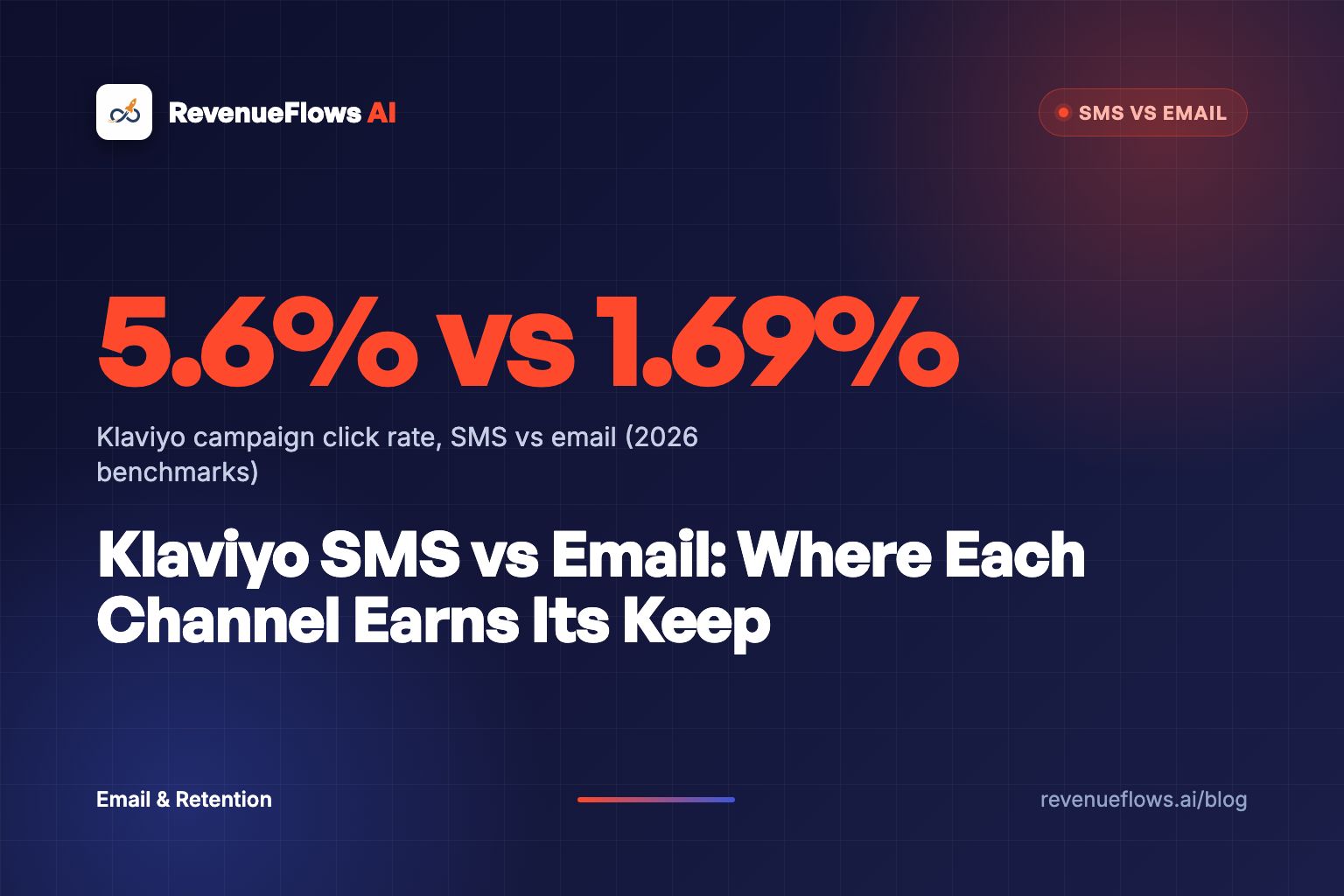
| Average campaign click rate (2026) | 5.6% | 1.69% |
| Average flow click rate (2026) | 9.65% | 5.58% |
| Cost model | Paid per message, add-on plan | Included in your platform plan |
| Consent | Separate, always explicit | Separate, can be implied in some regions |
| Default attribution window | 24 hours | 5 days |
| Best job | Urgent, intent-heavy moments | Volume, story, the whole list |
The click rates come from Klaviyo's 2026 benchmarks, built on more than 183,000 customers (SMS, email). For the full email side, my Klaviyo benchmarks breakdown goes deeper.
SMS is a tap on the shoulder. Email is a letter on the counter. You don't tap someone on the shoulder to tell them a story.
Is Klaviyo SMS worth the extra cost per send?
Here's the math. Run it on a store like this (a hypothetical).
A skincare brand selling a $52 vitamin C serum. 40,000 people on the email list. 6,000 on the SMS list. The product page converts at 2.5% with a $52 average order value. That means revenue per visitor is $1.30.
Now send one campaign on each channel, using Klaviyo's average campaign click rates.
Email: 40,000 x 1.69% is 676 clicks. At $1.30 each, that's $878.80.
SMS: 6,000 x 5.6% is 336 clicks. At $1.30 each, that's $436.80. Say each text costs 1.5 cents all-in (a hypothetical rate, check yours in Klaviyo). That's $90 for the send, so $346.80 net.
Watch what happens per subscriber. Each email subscriber earned about 2.2 cents. Each SMS subscriber earned about 7.3 cents. Per person, SMS out-earned email 3.3 to 1, even after you notice it has to pay its own way.
So yes, SMS is usually worth it. But only for one reason. The page.
Here's the break-even rule I use. Divide the cost per text by the revenue per visitor on the page the text links to. At 1.5 cents a text and $1.30 per visitor, you need a 1.15% click rate to break even. The average SMS campaign clicks at 5.6%. Plenty of room.
Where does SMS earn its keep, and where does email?
I'll be blunt about this one. I've watched founders text their whole list a newsletter. Four paragraphs. A link to a blog post. Then they wonder why the unsubscribe count spiked.
SMS earns its keep where intent is already hot:
- Abandoned cart and abandoned checkout, inside the first hour
- Flash sales and last-call deadlines
- Back-in-stock alerts for the exact item they asked about
- Order and shipping updates
- Early access for your VIPs
Email earns its keep where you need room:
- Welcome series that tells the brand story
- Product launches with photos, ingredients and proof
- Education, routines, how-to content
- Anything you want all 40,000 people to see, not just the 6,000 who gave you their number
The pattern underneath is simple. SMS is for moments with a clock on them. Email is for moments with a story in them.
The minute after checkout has a clock on it too. That one belongs to the page, so put a Shopify thank you page upsell there before you spend a text on it.
And the flows are where both channels make most of their money. Klaviyo's benchmarks show SMS flows are 7.6% of SMS sends but drive 45.2% of SMS revenue. Email flows are 5.3% of email sends and drive about 41% of email revenue. If you're still sending more campaigns than you have flows running, start with my Klaviyo flows for Shopify guide, then build the abandoned cart flow on both channels.
The text gets them back to the page. The page decides whether the text was worth sending.
How does the SMS vs email split change as your program matures?
Early on, email carries almost everything. Your SMS list is new and small, maybe a few hundred numbers. You're running one abandoned cart text. SMS is a rounding error on the revenue report.
Then three things happen. The SMS list grows from every signup form. You add texts to your welcome, browse abandonment and winback flows. And you stop sending campaign texts to people who never click.
Illustrative split for a store like the skincare example, not a benchmark. Your mix depends on list growth and flows.
Email still wins on total dollars in the mature program. It should. It's the bigger list and the cheaper send. But SMS stops being a toy and turns into the channel that closes the urgent stuff.
One warning before you read your own dashboard. Klaviyo's default attribution window is 5 days for email and 24 hours for SMS. A shopper who gets both messages can show up in both columns. Don't kill a channel off a revenue report without checking how it's counting.
What is AI changing about SMS vs email in Klaviyo?
The biggest shift: you don't have to pick one channel per message anymore. The software picks per person.
Klaviyo's channel affinity looks at each profile's past behavior and ranks their preferred channels: first, second, third. You need at least two channels active, like email and SMS. Then you use that ranking as a condition in a flow split. Send the first message on their top channel. Wait. Follow up on the second channel only if they didn't act.
That kills the double-tap problem, where the same shopper gets a text and an email about the same cart in the same minute. It also saves money, because you only pay for texts to people who actually respond to texts.
Here's the thing, though. Channel affinity routes the shopper to the right inbox. It doesn't change what they see when they tap through.
What decides how much either channel makes?
The page. Every time.
Back to the hypothetical serum. Same two campaigns, same 676 email clicks and 336 SMS clicks. But this time the product page is built for the phone, the offer from the message repeats on the first screen, and the buyer's real question (will this irritate my skin?) gets answered above the button.
Conversion rate goes to 3.5%. Average order value goes to $64, because a two-bottle bundle shows up next to the single. That means revenue per visitor is $2.24.
Email now earns 676 x $2.24, which is $1,514.24. SMS earns 336 x $2.24, which is $752.64, or $662.64 after the $90 send. Before the text bill, the two sends together earn $2,266.88 instead of $1,315.60. Same lists. Same sends. $951.28 more every time you run both.
And the SMS break-even click rate drops from 1.15% to 0.67%.
This is the part nobody in the SMS vs email marketing ecommerce debate talks about. Both channels are delivery trucks. The page is the store.
The real version of this lives on our results page. One bedding client's Adjustable Pillows page went from a 1.0% conversion rate and $125 average order value to a 4.4% conversion rate and $152 average order value. Revenue per visitor moved from $1.25 to $6.68. On 10,000 visitors, that's $66,800 instead of $12,500. See the full case study numbers. Real client numbers, not typical results, and not a promise of what your store will do.
That's why I (Ishan Soni) built RevenueFlows AI around revenue per visitor, not around whichever channel sends the click. If most of your texts land on one hero product, here's how to write a Shopify product page for SMS traffic. And if you're still picking an SMS tool at all, my Postscript vs Attentive comparison covers that.
What to do next
Open your last SMS campaign in Klaviyo. Find the product page it linked to. Multiply that page's conversion rate by its average order value.
If that number is under $2, more texts won't fix it. A better page will.
Book Your Profit Audit
Klaviyo decides which channel reaches the shopper. Your product page decides whether that tap turns into an order, so book a free profit audit and we'll show you how to rebuild a high-converting product sales page in less than 15 minutes.
Or go here to check it out → revenueflows.ai
P.S. A text that lands on a weak page is a fast way to lose a sale. Fix the page and both channels start printing.
Frequently asked questions
Is SMS or email better in Klaviyo?
Neither wins everywhere. SMS wins time-sensitive moments like abandoned carts, flash sales and shipping updates, because Klaviyo says about 98% of texts are read within minutes. Email wins volume, long-form content and anything you want every subscriber to see, because it rides on your platform plan instead of costing you per message.
Is Klaviyo SMS worth the extra cost per send?
It's worth it when each text earns more than it costs. Divide your cost per text by the revenue per visitor on the page the text links to. That's your break-even click rate. If your page earns $1.30 per visitor and a text costs 1.5 cents, you only need a 1.15% click rate, and Klaviyo's 2026 average for SMS campaigns is 5.6%.
What is a good SMS click rate in Klaviyo?
Klaviyo's 2026 benchmarks, built on more than 183,000 customers, put the average SMS campaign click rate at 5.6% and the average SMS flow click rate at 9.65%. The top 10% of SMS flows click at 16.6%.
Should I send the same message by SMS and email?
Usually not to the same person at the same time. Klaviyo's channel affinity feature ranks each profile's preferred channel, so you can send the first message where they're most likely to engage and follow up on the second channel only if they don't act.
Do I need separate consent for Klaviyo SMS?
Yes. Klaviyo's help center says consent for email does not count as consent for SMS, and SMS consent must always be explicit. Your SMS list will almost always be smaller than your email list for that reason.