Klaviyo Flows for Shopify: The Complete Retention Guide
Seven flows, built in the right order, do most of the work your email program will ever do. Here's which ones, how to write them with AI, the 2026 sender rules, and the published benchmarks to grade yourself against.

Most Klaviyo accounts I open have the flows. They're just reminders.
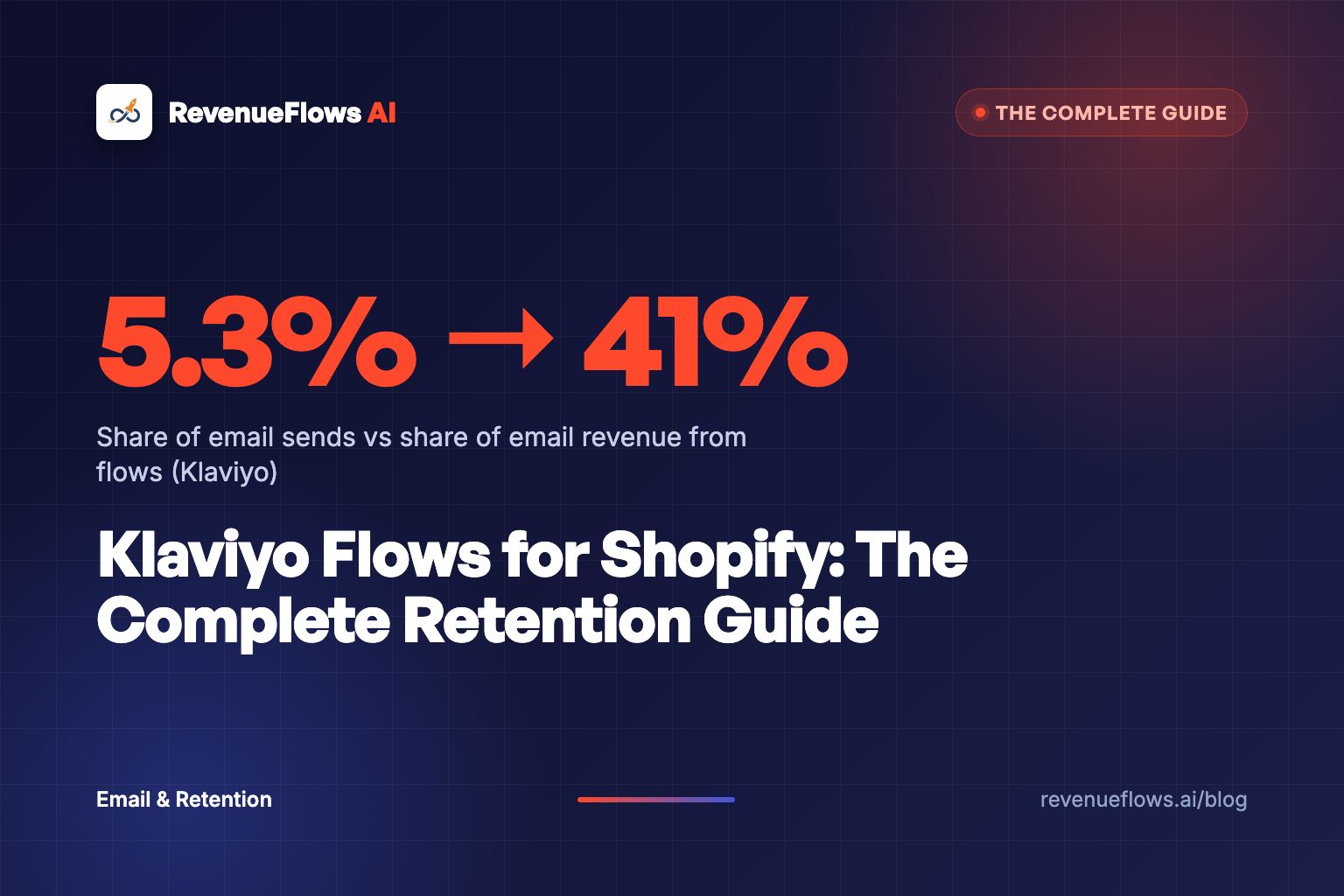
Here's the short answer. The Klaviyo flows for Shopify that earn their keep are seven automated sequences, built in this order: welcome, abandoned checkout and cart, browse abandonment, post-purchase, winback, back in stock, and replenishment. The first three catch people who are still deciding. The last four bring buyers back. Klaviyo's own 2026 email benchmarks, built on more than 183,000 of its customers, show flows making up 5.3% of email sends and nearly 41% of email revenue. That's the whole case for flows in one line: a sliver of the sending, almost half the money.
But here's the thing. A flow that only reminds people is a cleanup crew. A flow that gives people a reason to buy is a second salesperson. Same trigger, same timing, completely different revenue.
Most flows say "you forgot something." The ones that print money answer the question that made the buyer leave.
This guide is the hub for everything we write on email and retention. It covers the flows and the order to build them, what goes in each one, how to segment, where SMS belongs, how to write flows with AI (Klaviyo's Composer and beyond), the Gmail and Yahoo rules you have to follow in 2026, the published benchmarks, and a Black Friday calendar you can start this week.
The core flows and the order to build them
Order matters more than count. A store with three sharp flows beats a store with nineteen flows copied from a template library, every single time I've seen the two side by side.
Build them in this sequence, one at a time, and don't start the next until the current one is live and checked:
- Welcome flow, triggered by joining your list
- Abandoned checkout and abandoned cart, triggered by starting checkout or adding to cart
- Browse abandonment, triggered by viewing a product
- Post-purchase, triggered by placing an order
- Winback, triggered by time since the last order
- Back in stock, triggered by a restock alert signup
- Replenishment, triggered by how long the product lasts
Why this order? The top of the list talks to people with the highest intent and no purchase yet. That's where the published revenue per recipient is highest, so each hour you spend there pays back fastest. The bottom of the list compounds over months. It matters, but it can wait a week.
Here's the whole set in one table. The revenue per recipient column is Klaviyo's published average where one exists. Where Klaviyo doesn't publish a number, I've left it blank instead of guessing.
| Flow | Trigger | Messages | Timing to start with | Discount? | Avg revenue per recipient (Klaviyo) |
|---|---|---|---|---|---|
| Welcome | Joins list (popup, footer, pre-launch page) | 3 to 5 emails, 1 SMS if consented | First email within minutes, then days 1, 3, 5, 7 | Only if the popup promised one | $2.65 |
| Abandoned checkout / cart | Started checkout or added to cart | 3 emails, 1 to 2 SMS | 1 hour, 24 hours, 72 hours | Not in the first message | $3.65 |
| Browse abandonment | Viewed a product, no cart | 1 to 2 emails | 2 to 4 hours, then 24 hours | No | $1.07 |
| Post-purchase | Placed order | 4 to 6 emails over 30 to 60 days | Thank you, how to use it, review ask, cross-sell | No | $0.41 |
| Winback | No order in 60 to 120 days (set by your buying cycle) | 3 emails | 14-day spread | Last email only | Not published |
| Back in stock | Signed up for a restock alert | 1 to 2 emails or SMS | The moment inventory returns | No | Not published |
| Replenishment | Days since order, matched to product life | 1 to 3 messages | A week before they run out | No | Not published |
Averages come from Klaviyo's abandoned cart benchmark report, which draws on more than 143,000 abandoned cart flows sent in 2023 and compares them with other flow types. Timings are my starting points, not laws. Your buying cycle wins every argument.
Welcome, abandoned cart and browse abandonment
These three flows talk to people who haven't bought yet. So they carry the heaviest load in the whole program, and they're where I see the laziest writing.
The welcome flow: the most attentive reader you'll ever get
Someone just gave you their email. They're on your site, or they were thirty seconds ago. They will never be this interested again.
And most welcome flows spend that moment on a discount code and a photo of the founding team.
A welcome flow's real job is to answer the questions the product page didn't. What's it made of? Who's it for? Why does it cost $68 when the one on Amazon is $24? Does it work for my situation? Every one of those questions is a reason someone joined your list instead of buying. The popup caught them because the page didn't close them.
So write the welcome flow in this order:
- Email 1 (minutes after signup): deliver what the popup promised, then give the one reason your product exists in two sentences.
- Email 2 (day 1): the biggest objection, answered head-on. Price, fit, taste, safety, whatever your reviews say people worry about.
- Email 3 (day 3): proof. Customer photos, a before and after, one specific review that names the doubt it overcame.
- Email 4 (day 5): which product for which person. A tiny decision guide.
- Email 5 (day 7): the reminder, if the offer expires.
If your welcome popup itself is dragging on conversion rate, read what welcome popups actually do to Shopify conversion rate before you add another one. And if a discount is the only thing your welcome flow offers, the case against leaning on discounts will be uncomfortable reading.
Abandoned checkout and abandoned cart
This is the top earner in Klaviyo's published data: $3.65 average revenue per recipient, with the top 10% of accounts at $28.89. Open rates average 50.5%. Placed order rate averages 3.33%, with top performers at 7.69%. All of that is from the abandoned cart benchmark report.
Split it into two flows if you can. Checkout abandoners gave you an email and got to the payment step. Cart abandoners may have only clicked a button. They're different people with different doubts.
The standard spine is three emails at 1 hour, 24 hours and 72 hours, with an SMS as the second touch for anyone who consented to texts. I'd hold any discount for the last message, and only for carts large enough that the margin survives it. A discount in the first message teaches your list to abandon on purpose.
Now the part nobody likes hearing. A recovery flow works on carts that already exist. It can't create more of them. I went through the full math in do abandoned cart emails work, and the honest answer is yes, on a small slice of the problem. The bigger lever sits earlier, which is why reducing Shopify cart abandonment starts before the cart, and why the checkout abandonment myth matters so much: most visitors never reach checkout at all.
Check your own leak with the calculator before you rewrite a single email:
Browse abandonment
Someone looked at a product and didn't add it to cart. Klaviyo's published average here is $1.07 per recipient, with the top 10% at $7.21. Lower than cart, because intent is lower.
That lower intent changes the tone. No discount. No "you left something behind," because they didn't leave anything. Send one or two emails that answer the product's biggest question and show two alternatives in case the first product wasn't the one. Browse abandonment is a conversation starter. Treat it like a second product page with a better opening line.
A reminder assumes the buyer forgot. A reason assumes the buyer had a question. Write for the question.
Post-purchase, replenishment and winback
The first three flows win the first order. These three decide whether that order was a customer or a transaction.
Post-purchase
Klaviyo's average revenue per recipient for post-purchase is $0.41, top 10% at $5.14. Lowest of the four it publishes. That's fine. Post-purchase isn't there to sell on day one. It's there to make sure the product gets used, the review gets written and the second order feels obvious.
Build it around the moments after the box arrives:
- Order confirmation and what happens next. Plain, fast, sets expectations for shipping.
- How to get the most out of it. The single step most people get wrong. For a skincare serum it's how much to use. For a cast iron pan it's the first seasoning.
- The review ask, timed a few days after delivery, not after purchase. Nobody can review a product still in a truck.
- The cross-sell, built from what people actually buy second, which your Shopify order data already shows.
If your second purchase happens on a product page, that page should talk to someone who already owns your stuff. Here's how to write a Shopify product page for returning customers. And if the post-purchase flow offers an add-on, the same rules from Shopify upsell placement apply inside the inbox.
Replenishment
If your product runs out, this flow is free money you're leaving on the counter. Coffee, supplements, pet food, razors, skincare. A buyer who runs out and doesn't hear from you buys whatever's closest.
Time it to the product's real life. A 30-serving tub used once a day lasts about 30 days, so the first reminder goes out around day 23. The page has to say how long it lasts too, and most don't. I wrote about that missing sentence in writing product pages for consumable products.
Klaviyo can help with the timing. Its predictive analytics estimate customer lifetime value, churn risk and average time between orders, and they switch on once you have at least 500 customers who've placed an order, 180 days of order history and orders within the last 30 days. If you sell a product with a known usage cycle, use the known cycle. If you don't, the prediction is a better guess than yours.
Replenishment and subscriptions overlap. If you offer subscribe and save, read whether subscribe and save increases Shopify conversion rate and how to write a subscription product page before you decide whether the flow sells a subscription or a one-time reorder.
Winback
Winback goes to buyers who've gone quiet. The trigger is time since last order, and the right window depends on how often people normally reorder. A candle brand and a mattress brand should never share a winback window.
Three emails is enough. The first says you noticed, with something new. The second shows what changed since they last bought. The third, and only the third, carries an offer. Anyone who ignores all three goes into a sunset segment, and eventually off your list. That last part isn't generosity. It's deliverability, and we'll get there.
Back in stock
Short, fast, no fluff. The item's back, here's the link, stock is limited if it truly is. Our look at whether back in stock alerts increase Shopify conversion rate covers what the signup form itself does to the page.
Segmentation that earns more per send
Flows are triggered by behavior, so they're already segmented in a way. Campaigns aren't. And the fastest way to wreck a flow program is to blast campaigns at your whole list until Gmail starts filing everything, flows included, under spam.
Here are the segments I'd build before anything else:
- Engaged 30, 60 and 90 days. People who opened or clicked recently. Most campaigns go here.
- Buyers vs never-bought. A first-time buyer and a subscriber who's never purchased need different arguments.
- Repeat buyers (2+ orders). Your VIPs. They get early access and new products first.
- Lapsed buyers. Bought once, nothing since your normal reorder window. Winback territory.
- Unengaged 180 days. Stop mailing them campaigns. Run a sunset flow, then suppress.
Klaviyo's Composer can now build segments from a plain sentence, like "profiles who've made more than one purchase with no purchase in the last 90 days." Klaviyo's Composer announcement says every segment comes back as a draft you preview and save. Read the conditions it wrote before you trust it, the same way you'd check a spreadsheet formula a new hire wrote.
Inside flows, use conditional splits for the two differences that change the message most: bought before vs never bought, and which product they looked at. A split that changes nothing in the copy is just clutter.
Segmentation is how you earn the right to send more. Send less to people who don't care, and more to people who do.
SMS vs email: where each belongs
Klaviyo's 2026 SMS benchmarks tell the same story as email, only louder. SMS flows are 7.6% of SMS sends and drive 45.2% of SMS revenue. Flow texts average a 9.65% click rate against 5.6% for campaign texts. Placed order rates are 1.9% for flows vs 0.27% for campaigns. And 64.4% of SMS flow revenue comes from new buyers.
So the rule is simple. Texts go in flows first, campaigns second.
Here's where each channel belongs:
| Job | SMS | |
|---|---|---|
| Tell the story, handle objections, show proof | Yes | No |
| Second touch in abandoned checkout | Yes | Yes, usually the best one |
| Welcome offer delivery | Yes | Yes, if they opted in to texts |
| Shipping and delivery updates | Yes | Yes |
| Back in stock alert | Yes | Yes, time matters |
| Review request | Yes | Short link only |
| Long product education | Yes | No |
| Black Friday "last hours" | Yes | Yes, one text |
Email is the salesperson with time to talk. SMS is the tap on the shoulder. Stuff a sales letter into a text and you'll pay for it in opt-outs.
The page matters even more for text traffic, because the click lands on a phone, one-thumbed, seconds after reading. Here's how to write a Shopify product page for SMS traffic. Before you add texts to every flow, run the cost against the click rate on the SMS revenue calculator. Texts cost money per send. Emails mostly don't.
Writing flows with AI (Klaviyo's AI tools and beyond)
I'll be straight about where AI stands in September 2026, because the hype is loud and the details matter.
Klaviyo announced Composer on March 24, 2026, in its newsroom, as an agent that builds campaigns and flows from a plain-language prompt. According to Klaviyo's Composer help article, it drafts complete flows with email, push, SMS and MMS messages, creating the structure and the copy together, grounded in your account's brand settings. You describe the flow ("a welcome flow with a first email, a push two days later and an SMS offer on day five") and it returns the draft with copy for every step.
Three things from Klaviyo's own help article are worth reading twice:
- There's no send-as-is. You review, edit and approve everything before it goes live.
- It can get content wrong. Klaviyo tells you to check prices, product details and links.
- It works better on drag-and-drop layouts than on image-heavy templates, and a flow draft uses 100 or more credits depending on complexity.
The Klaviyo product updates page shows how fast it's moving. In July 2026, Composer started writing subject lines and preview text informed by what's worked for your brand before. In August it began asking follow-up questions when a prompt is too thin, and the analytics agent can now read up to 365 days of data. Also in August, Klaviyo shipped Flows 2.0, a rebuilt engine it says handles over 74,000 profiles per second.
So can AI write your flows? Yes. Should it write them alone? No.
Here's the thing. Composer is good at structure and tidy copy. What it can't know is the one sentence that closes your buyer, because that sentence usually lives in your reviews, your support inbox and your returns reasons, not in your send history. A generic AI flow is a well-dressed reminder. You still need someone to feed it the reason. We go deeper on what it gets right and wrong in our Klaviyo Composer review.
That's how we do it at RevenueFlows AI. The AI writes the email and SMS flows from the same buyer research that drives the product page (the objections, the proof, the which-one-is-for-me questions), and pushes them straight into Klaviyo as flows ready for review. Leads from a pre-launch funnel sync into Klaviyo too, so the welcome flow starts the moment someone opts in instead of the next time someone remembers to export a CSV.
Whatever tool writes your flows, check subject lines before they ship. Our free email subject line grader scores hook, clarity, length and deliverability risk, and gives you variants to test.
Deliverability rules for 2026
None of the above matters if the email lands in spam. And in 2026 the rules have teeth.
Google's sender guidelines apply to anyone sending around 5,000 or more messages a day to personal Gmail accounts. The requirements:
- SPF and DKIM authentication for your domain
- A DMARC record for your sending domain
- A From domain aligned with your SPF or DKIM domain
- One-click unsubscribe on marketing messages, plus a clearly visible unsubscribe link in the body
- Spam rate in Postmaster Tools below 0.30%, with Google recommending you stay under 0.10%
Those rules started February 1, 2024. What changed is enforcement. Google's sender guidelines FAQ says that starting November 2025, messages that fail the requirements face disruptions including temporary and permanent rejections. It also recommends processing unsubscribes within 48 hours.
Yahoo's sender best practices line up closely: SPF and DKIM, a valid DMARC policy of at least p=none that passes, honoring unsubscribes within 2 days, and a spam rate below 0.3%.
In Klaviyo, that turns into a short to-do list. Klaviyo's guide to Google, Yahoo and Microsoft sender requirements says to send from your own domain (never a Gmail or Yahoo address), set up a branded sending domain, publish DMARC on your root domain, keep your From address aligned, and keep an unsubscribe link in the body. Klaviyo adds the one-click unsubscribe header to marketing email automatically.
The rest is list discipline. The spam rate is a ratio, so the fastest way to push it past 0.30% is to keep mailing people who stopped caring six months ago. That's why the sunset flow and the unengaged segment in the section above aren't optional. A clean list of 20,000 engaged people will out-earn a dirty list of 80,000 that Gmail has stopped trusting.
Deliverability is revenue you can't see. Nobody gets an alert when their flows quietly start landing in spam.
Benchmarks: revenue per recipient by flow
Revenue per recipient is the one number to grade a flow on. It's the revenue a flow earns divided by the number of people it reached, so it captures opens, clicks, conversion and order size in one figure. Open rate alone lies, especially since privacy features inflate opens.
Here are the averages Klaviyo publishes for four flow types, from its abandoned cart benchmark report:
Source: Klaviyo abandoned cart benchmark report, averages across its customers.
| Flow | Average revenue per recipient | Top 10% |
|---|---|---|
| Abandoned cart | $3.65 | $28.89 |
| Welcome | $2.65 | $21.18 |
| Browse abandonment | $1.07 | $7.21 |
| Post-purchase | $0.41 | $5.14 |
Look at the gap between average and top 10%. For abandoned cart it's $3.65 to $28.89, roughly 7.9 times. For welcome it's $2.65 to $21.18, about 8 times. Industry and order size explain part of that. Klaviyo's report shows top-10% abandoned cart flows in hardware and home improvement at $75.66 per recipient. The rest is the flow itself.
Platform-wide averages can flatter or bury you, so compare against stores your size. Klaviyo's flow benchmarks reference breaks revenue per recipient into revenue bands and average order value ranges at the 25th and 75th percentiles. For brands doing up to $1M a year with an average order value between $44 and $83, the ranges are $0.86 to $2.91 for abandoned cart, $0.17 to $1.95 for welcome, and $0.05 to $0.44 for post-purchase. Klaviyo also shows your account's own benchmarks inside its benchmarks reports.
Now run the math on a store like this, a hypothetical. Each month, 2,000 people enter the welcome flow, 1,500 enter abandoned cart, 3,000 enter browse abandonment and 800 enter post-purchase. At the published averages:
- Welcome: 2,000 x $2.65 = $5,300
- Abandoned cart: 1,500 x $3.65 = $5,475
- Browse abandonment: 3,000 x $1.07 = $3,210
- Post-purchase: 800 x $0.41 = $328
That's $14,313 a month from four flows at average performance. Nobody sends anything by hand.
Grade your own list against the benchmark before you touch a flow:
The part the benchmarks can't show you
Every flow ends the same way: a click to a product page. Your flows can be perfect and still earn average money if the page they send people to can't close.
Here's the math, again a hypothetical. Say your flows send 10,000 clicks a month to your hero product. The page converts at 1.5% with a $68 average order value. That means revenue per visitor is $1.02. On 10,000 flow clicks, that's $10,200.
Now fix the page, not the emails. Conversion rate moves to 2.7% and average order value to $84, because the page finally answers the questions and offers a bundle. Revenue per visitor becomes $2.27. On the same 10,000 flow clicks, that's $22,680. Same list, same flows, same sends. $12,480 more a month.
Conversion rate x average order value x clicks. 1.5% x $68 vs 2.7% x $84.
And here's what that looks like with real numbers. Our bedding client started at a conversion rate of 1.0% and an average order value of $125, which is $1.25 per visitor, or $12,500 on 10,000 visitors. After the product page rebuild: 3.5% conversion rate, $231 average order value, $8.10 per visitor, or $81,000 on the same 10,000 visitors. See the full case study numbers. Real client numbers, not typical results, and not a promise of what your store will do.
Every flow in that store sends people to those pages. So every flow got better without anyone opening Klaviyo. Email traffic behaves differently from ad traffic, too. Here's how to write a Shopify product page for email traffic, and why revenue per visitor is the number to fix first.
The Black Friday / Cyber Monday email calendar
Black Friday 2026 is Friday, November 27. Cyber Monday is November 30. Today is late September, which means you're behind if you haven't started, and on time if you start now. If you want the send-by-send version, here are Black Friday email campaign ideas laid out as a 21-day calendar.
Klaviyo's BFCM checklist splits the season into five phases: diagnose in July and August, build audience from August to October, set up platform infrastructure in September and October, execute in October and November, and measure in November and December. For flows, it recommends shortening the first abandoned cart message to 1 to 2 hours and the second to 6 to 8 hours during the rush, tightening post-purchase timing, and sending a separate new-customer welcome variant to first-time Black Friday buyers.
Klaviyo's BFCM daily sending guide adds a detail most stores skip: exclude people who bought in the last day from Black Friday sends, then widen the window as the weekend goes on (last 2 days by Saturday, last 3 by Sunday, last 4 by Cyber Monday). Nothing annoys a new customer like a "50% off, last chance" email an hour after they paid full price.
Here's the calendar I'd run from today:
| Dates (2026) | What to do in Klaviyo |
|---|---|
| Sep 28 to Oct 11 | Audit every live flow against the benchmarks. Check DMARC, branded sending domain and spam rate. Build engaged 30/60/90 and unengaged segments. |
| Oct 12 to Nov 1 | Grow the list with an early-access signup. Build the BFCM welcome variant. Rewrite hero product pages before the traffic arrives. |
| Nov 2 to Nov 20 | Send to engaged segments only and build volume steadily. Tease the offer. Switch abandoned cart timing to 1 to 2 hours and 6 to 8 hours. |
| Nov 23 to Nov 26 | Early access for repeat buyers and VIPs. Thanksgiving is Thursday, November 26. |
| Nov 27 (Black Friday) | Launch to engaged segments. Exclude anyone who bought in the last day. One SMS to consented subscribers. |
| Nov 28 to Nov 29 | Proof and best-sellers. Widen purchase exclusions to 2 days, then 3. |
| Nov 30 (Cyber Monday) | Last-call email and one text. Exclude buyers from the last 4 days. |
| Dec 1 to Dec 14 | New-customer welcome variant for BFCM first-timers, shortened post-purchase, shipping cutoff reminders. |
The big risk in November isn't sending too few emails. It's sending too many to people who don't open them, pushing your spam rate over Google's line in the week it matters most. Black Friday traffic is also the coldest, most comparison-happy traffic of the year, so the page has to work harder. Here's how to write a Shopify product page for Black Friday traffic.
Start here: the full reading list
This page is the hub. These are the spokes, grouped by the job they do.
Recovery flows and cart abandonment
- Do abandoned cart emails work? The honest math
- How to reduce Shopify cart abandonment before the cart
- The checkout abandonment myth
- Do back in stock alerts increase Shopify conversion rate?
List growth and first orders
Repeat buyers, subscriptions and replenishment
- How to write a Shopify product page for returning customers
- Writing product pages for consumable products
- How to write a Shopify product page for subscription products
- Does subscribe and save increase Shopify conversion rate?
- Shopify upsell placement that adds to every order
Where flow clicks land
- How to write a Shopify product page for email traffic
- How to write a Shopify product page for SMS traffic
- How to write a Shopify product page for Black Friday traffic
- Revenue per visitor: the number to fix first
AI drafting and Black Friday sends
- Klaviyo Composer review: what the AI flow builder gets right
- Black Friday email campaign ideas: a 21-day calendar
FAQ
What Klaviyo flows should a Shopify store set up first?
Welcome, then abandoned checkout and cart, then browse abandonment. Those three talk to people who haven't bought yet, and Klaviyo's published benchmarks show the highest revenue per recipient there. Post-purchase, winback, back in stock and replenishment come next.
How much revenue should Klaviyo flows make?
Klaviyo's benchmarks put flows at 5.3% of email sends and nearly 41% of email revenue. Per flow, published averages are $3.65 per recipient for abandoned cart, $2.65 for welcome, $1.07 for browse abandonment and $0.41 for post-purchase.
Can Klaviyo write flows with AI?
Yes. Composer drafts full flows with email, SMS and push copy from a prompt, and returns them as drafts. You approve everything before it goes live, and Klaviyo says to check prices, product details and links in every draft.
Should I use SMS or email in my Klaviyo flows?
Both, for different jobs. Email does the persuading. SMS does the short, urgent nudge. SMS flows are 7.6% of SMS sends and 45.2% of SMS revenue in Klaviyo's data, so texts belong in flows first.
What are the 2026 Gmail and Yahoo rules for Klaviyo senders?
SPF, DKIM and DMARC, an aligned From domain, one-click unsubscribe plus a visible link, and a spam rate under 0.30% (Google recommends under 0.10%). Yahoo adds honoring unsubscribes within 2 days. Gmail has been rejecting non-compliant mail since November 2025.
Do Klaviyo flows fix a low conversion rate?
No. Flows send people back to the page that lost them. Fix the page first, and every flow you already run earns more from the same list.
What to do next
Open Klaviyo, go to your flows, and write down the revenue per recipient for your welcome, abandoned cart, browse abandonment and post-purchase flows. Put each one next to Klaviyo's number for your revenue band. The flow furthest below its benchmark is the one you rewrite this week. Then open the product page it links to, because that's probably where the money's really leaking.
Book Your Profit Audit
Your flows can only earn what your product page lets them earn, and that page is where every welcome, cart and winback click ends up. Get your free profit audit and we'll show you how much each flow click is worth right now, then rebuild a high-converting product sales page in less than 15 minutes.
Or go here to check it out → revenueflows.ai
P.S. A reminder brings the buyer back to the same page that lost them. A reason, on the email and on the page, is what closes the sale.
Frequently asked questions
What Klaviyo flows should a Shopify store set up first?
Build them in this order: welcome, abandoned checkout and cart, browse abandonment, post-purchase, then winback, back in stock and replenishment. The first three catch people who are still deciding, which is where Klaviyo's published benchmarks show the highest revenue per recipient, so they pay back fastest.
How much revenue should Klaviyo flows make?
Klaviyo's own benchmarks put flows at about 5.3% of email sends and nearly 41% of email revenue. Per flow, the published averages for revenue per recipient are $3.65 for abandoned cart, $2.65 for welcome, $1.07 for browse abandonment and $0.41 for post-purchase. Grade your flows against those, then against your own revenue band in Klaviyo's benchmark reports.
Can Klaviyo write flows with AI?
Yes. Klaviyo's Composer drafts whole flows from a plain-language prompt, with copy for each email, SMS and push step, and returns them as drafts. Nothing goes live until you review and approve it, and Klaviyo warns it can get prices, product details and links wrong, so check every message before you turn it on.
Should I use SMS or email in my Klaviyo flows?
Use both, for different jobs. Email carries the story, the proof and the long answer. SMS carries the short, time-sensitive nudge, like the second touch in an abandoned checkout flow or a shipping update. Klaviyo's SMS benchmarks show flows are 7.6% of SMS sends and 45.2% of SMS revenue, so put texts inside flows before you put them in campaigns.
What are the 2026 Gmail and Yahoo rules for Klaviyo senders?
If you send around 5,000 or more emails a day to Gmail, you need SPF, DKIM and DMARC, a From domain that aligns, one-click unsubscribe plus a visible unsubscribe link, and a spam rate under 0.30% in Postmaster Tools. Yahoo asks for the same authentication, honoring unsubscribes within 2 days and a spam rate under 0.3%. Since November 2025 Gmail rejects mail that fails.
Do Klaviyo flows fix a low conversion rate?
No. A flow sends a buyer back to the same product page that lost them the first time. If that page converts 1.5% at a $68 average order value, every flow click is worth $1.02. Fix the page and every flow you already run earns more on the same list.