
Shopify Product Page for SMS Traffic: 6 Rules
Text traffic arrives on a phone, on cellular, with one thumb, eleven seconds after the message landed. Most product pages treat that click like a stranger from Google.

The first time I put an SMS report next to the store's page analytics, I assumed the tracking was broken.
Click-through rate on the text: excellent. Conversion rate on the page those clicks landed on: worse than the store's cold Google traffic. Same product, same price, warmer audience, worse result.
The tracking was fine. The page was the problem, and it's the same problem in almost every store I look at. Learning how to write a Shopify product page for SMS traffic starts with one fact: that click arrives on a phone, on cellular, with one thumb, about eleven seconds after the message hit. Your page was built for a laptop.
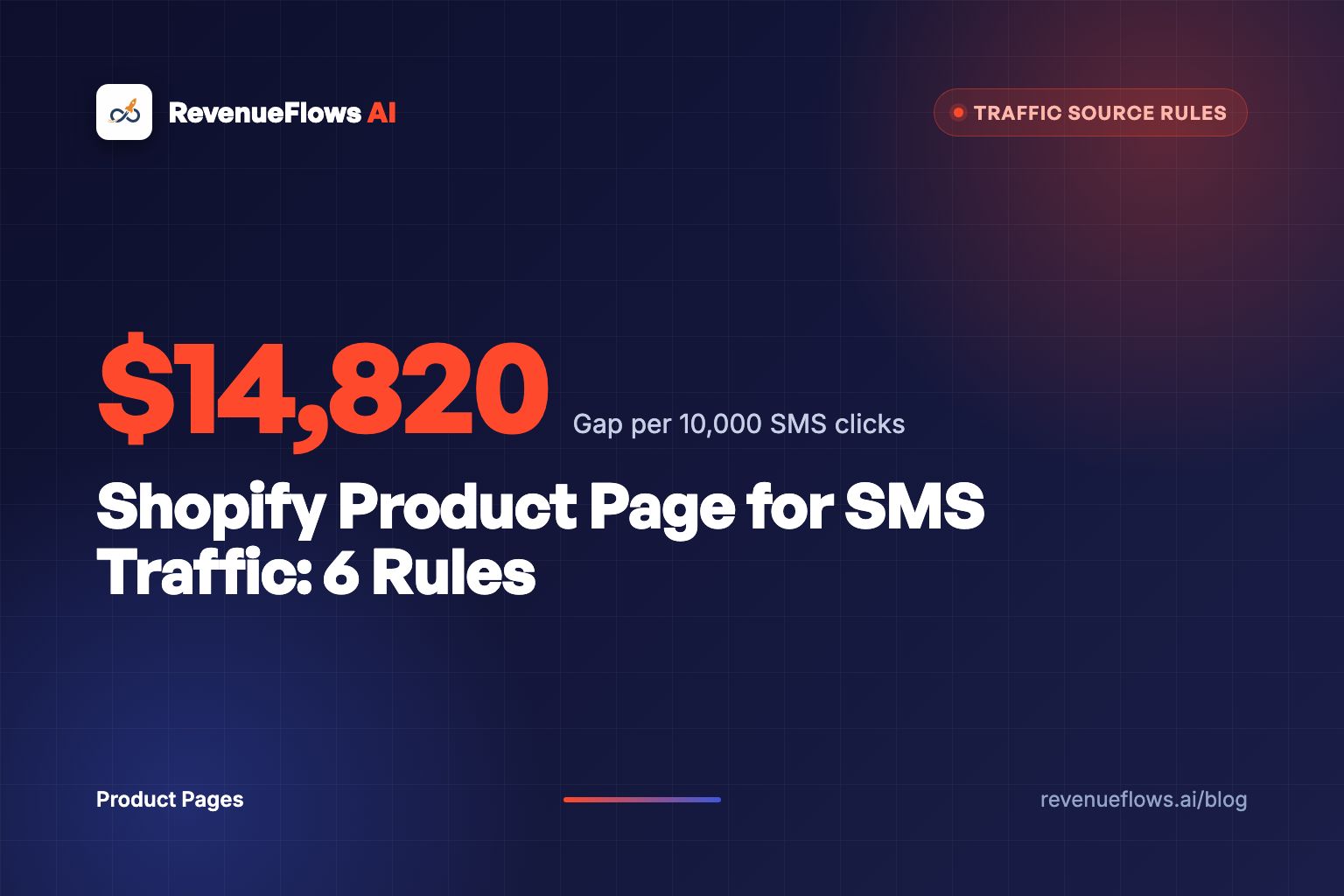
Here's the math. A store sending text campaigns to a 40,000 person list, landing them on the standard product page: conversion rate 1.4%, average order value $58. That's $0.81 per visitor. On 10,000 clicks, that's $8,120.
Rebuild that landing experience for the phone and the moment. Conversion rate 3.1%, average order value $74, because the bundle is the default instead of a scroll away. That's $2.29 per visitor. On the same 10,000 clicks: $22,940.
Same list, same sends, same product. A $14,820 difference in what those clicks were worth.
Why does SMS traffic convert worse than the click-through rate promises?
Because the text does all the selling and the page does none of the catching.
A text message is the most intimate channel you own. It sits between a message from his sister and one from his bank. He opens it in seconds and taps while walking. That intent is enormous, and it has a shelf life of about a minute.
Then the page loads. Cookie banner. Popup asking for the phone number he already gave you. A hero video that hasn't painted yet. Nine flavor variants in a grid. No sign anywhere of the 20% he was promised eight seconds ago.
The text made a promise. The page acts like it never heard about it. That gap is where your revenue per visitor goes to die.
The benchmark data makes the intent point plainly. Automated text flows convert clicks at roughly 3.8% while broadcast sends land near 1%, and Klaviyo's numbers show SMS flows are a small share of total sends while driving close to half of all SMS revenue. Intent drives the whole thing. Which means the page's only job is to not waste it.
What are the 6 rules for a product page built for text traffic?
1. Repeat the text word for word on the first screen. If the message said "20% off the variety pack today," the first line he sees should say those words back to him. Not "Shop our bestsellers." Message match is the cheapest conversion lever in existence and text traffic punishes its absence harder than any other source, because the promise is still on his screen one swipe away.
2. Auto-apply the code and show the savings. Build the discount into the link. He should land on $46.40, with $58.00 struck through and "20% off applied" underneath. Making him copy a code out of a text, switch apps, and paste it at checkout adds three ways to lose a sale you had already made. If you're planning texts for November, line them up with your Black Friday email campaign calendar so the two channels don't double up.
3. Two seconds on cellular, tested with wifi off. Not measured in your dev tools on a hardwired connection. Walk outside, turn wifi off, and open your own page. Whatever loads after the second second may as well not exist, and the autoplay hero video is usually the first thing to cut.
4. Price, promise, and buy button in the first thumb-reach. No pinching, no horizontal scroll, no navigating a variant grid to learn the price. On a phone the first screen is the whole page. Everything else is a bonus round for the 30% who scroll.
5. Kill every interruption for this traffic. He gave you his phone number. He is on your list. Showing him a "get 15% off, join our texts" popup is an insult and a bounce. Suppress popups, chat bubbles, and email gates for anyone arriving from a text link.
6. One decision, pre-made. Text traffic is impulse traffic with a deadline. Default the page to the bundle or the subscription you actually want him on, priced and stated, with the single option swap sitting underneath. Don't hand a man in a parking lot nine flavors and a comparison chart.
| What the buyer is doing | What most pages assume | What the page should do |
|---|---|---|
| Reading on a phone, one hand | Desktop layout, hover states | First screen only, thumb-reach buttons |
| On cellular in a parking lot | Office wifi speeds | Under two seconds, no autoplay video |
| Already promised a discount | Generic product page | Code applied, savings shown on the line |
| Already gave his phone number | Popup asking for it again | Popups suppressed for text traffic |
| Deciding in under 60 seconds | Nine variants and a chart | One pre-made choice, swap underneath |
| Answering "is this the deal?" | Brand story above the fold | The text's exact words, first line |
Should SMS traffic land on the product page or a dedicated landing page?
The product page, with the offer baked into the link.
I've watched brands build separate SMS landing pages, and the pattern is always the same: the landing page starts fresh, so it loses the reviews, the FAQ, the shipping answers, and the structured data the product page spent a year earning. You end up with a fast page that can't handle a single objection.
The better move is to make the product page itself capable of receiving a promise. One template, one set of proof, and a first screen that changes its headline and its price based on where the click came from.
That's the same principle behind writing a Shopify product page for email traffic, except text compresses the whole thing. Email buys you a few minutes of attention. A text buys you about forty seconds.
How do you know your page is losing text traffic?
Compare two numbers your SMS platform and Shopify both already have: the click-through rate on your last ten sends, and the conversion rate of the sessions those clicks created.
Healthy text click-through with weak on-site conversion means the page is breaking the promise. That is a page problem and you can fix it this week.
Weak click-through with decent on-site conversion means the message is the problem, and no amount of page work saves it.
If the click rate is strong and the sale isn't happening, stop rewriting the text. The text worked. It already did its job.
Run the same check by device. Text traffic is close to 100% mobile, so if your mobile conversion rate sits at half your desktop rate, every dollar you spend building the list is being taxed on arrival.
What is this worth in revenue per visitor?
The mechanism shows up cleanest in the numbers from a bedding brand that was stuck at a revenue ceiling.
Before, their conversion rate was 1.0% and their average order value was $125. That means their revenue per visitor was $1.25. On 10,000 visitors, that's $12,500. After we rebuilt their top three product pages: conversion rate 3.5%, average order value $231, revenue per visitor $8.10. On the same 10,000 visitors, that's $81,000, a 6.5x lift. See the full case study numbers. Real client numbers, not typical results, and not a promise of what your store will do.
None of that came from more traffic. It came from pages that stopped losing people who arrived ready to buy.
Text traffic just makes the leak louder, because you paid to build the list, you paid per message, and the buyer showed up warmer than any other source you have. Categories that live on text feel it first. A Shopify electrolyte drink mix product page sells on a restock text more often than on a search result, and a Shopify cosmetics product page lives or dies on a shade-drop announcement going out to 40,000 phones at 10am.
What to do next
Send yourself your next campaign. Tap the link like a customer would, on your phone, with wifi off, standing outside.
Count the seconds until you can see the price. Count the taps until you can buy. Look for the discount you were promised. Most founders find their answer in about forty seconds, which is roughly the same amount of attention their buyer gave it.
Get your free profit audit and we'll show you exactly where your text traffic is leaking, then rebuild the page into a high-converting product sales page in less than 15 minutes.
P.S. The most expensive click in your business is the one you paid twice for. Once to acquire the phone number, once to send the message. Losing that click to a popup asking for the phone number you already have is the closest thing to burning money I see in this business.
Frequently asked questions
What is a good SMS conversion rate for ecommerce?
Automated text flows convert clicks at roughly 3.8%, while broadcast campaign sends land closer to 1%, and click-through rates run about 2.2% to 6.8% on campaigns and 4% to 20% on automations. The spread between those two numbers is intent, not copy. Someone who texted BACKINSTOCK is already sold; a Friday promo blast is an interruption.
Should SMS links go to a product page or the homepage?
Send them to the exact product you named in the text, never the homepage or a collection. Every extra tap between the message and the buy button costs you buyers on a phone. If the text names a specific offer, the landing screen has to repeat that offer word for word or the click reads as a bait and switch.
Why do people click my texts and not buy?
Usually because the page breaks the promise the text made. The text said 20% off the electrolyte variety pack, the page opens on a full-price grid of nine flavors with no code applied, and the buyer now has to do work to get what he was already offered. High click rate with a low conversion rate is almost always a message-match problem, not a list problem.
How fast does a Shopify product page need to load for SMS traffic?
Under two seconds on cellular, not on your office wifi. Text traffic arrives on whatever signal the buyer has while standing in a parking lot, and the hero video that looks fine on a desktop test is the reason he backs out before the page paints. Test on a phone with wifi turned off before you blame the copy.
Should discount codes auto-apply from a text link?
Yes. Build the discount into the link so the price on the page already reflects the offer, and show the savings on the line item. Making someone copy a code from a text message, switch apps, and paste it at checkout adds three failure points to a sale you had already closed.