
Klaviyo Abandoned Cart Flow Examples: 9 Emails Dissected
Nine real abandoned cart emails from brands like SKIMS, Golde and Liquid Death, taken apart line by line, plus the flow structure that decides who gets a discount and when.

The best Klaviyo abandoned cart flow examples share one habit: they don't send everyone the same three emails. They split the flow by cart value and by first-time versus repeat buyer, they open with a plain reminder, and they hold the discount until the last email (or skip it). Below are 9 real abandoned cart emails, what each one gets right, and where each one belongs in your sequence.
Here's my bias, up front. Most of the flows I look at give the money away in email one. A 15% code lands two hours after someone leaves the cart, and half the people using it were already on their way back.
That's a leak dressed up as a strategy.
What does a winning Klaviyo abandoned cart flow look like?
Start with what Klaviyo itself says. Its help article on building an abandoned cart flow recommends 2 to 3 messages, the first 2 to 4 hours after the cart is left and the second 20 to 48 hours later. It also says the one filter you can't skip is "Placed Order zero times since starting this flow," so buyers stop getting nagged the moment they pay.
Then the structure that separates the strong flows from the average ones:
- Email 1, 2 to 4 hours: reminder only, cart contents, one button.
- Email 2, about 24 hours: answer the objection (reviews, shipping, returns).
- Email 3, about 48 hours: last call, with an offer only for the branches that earn one.
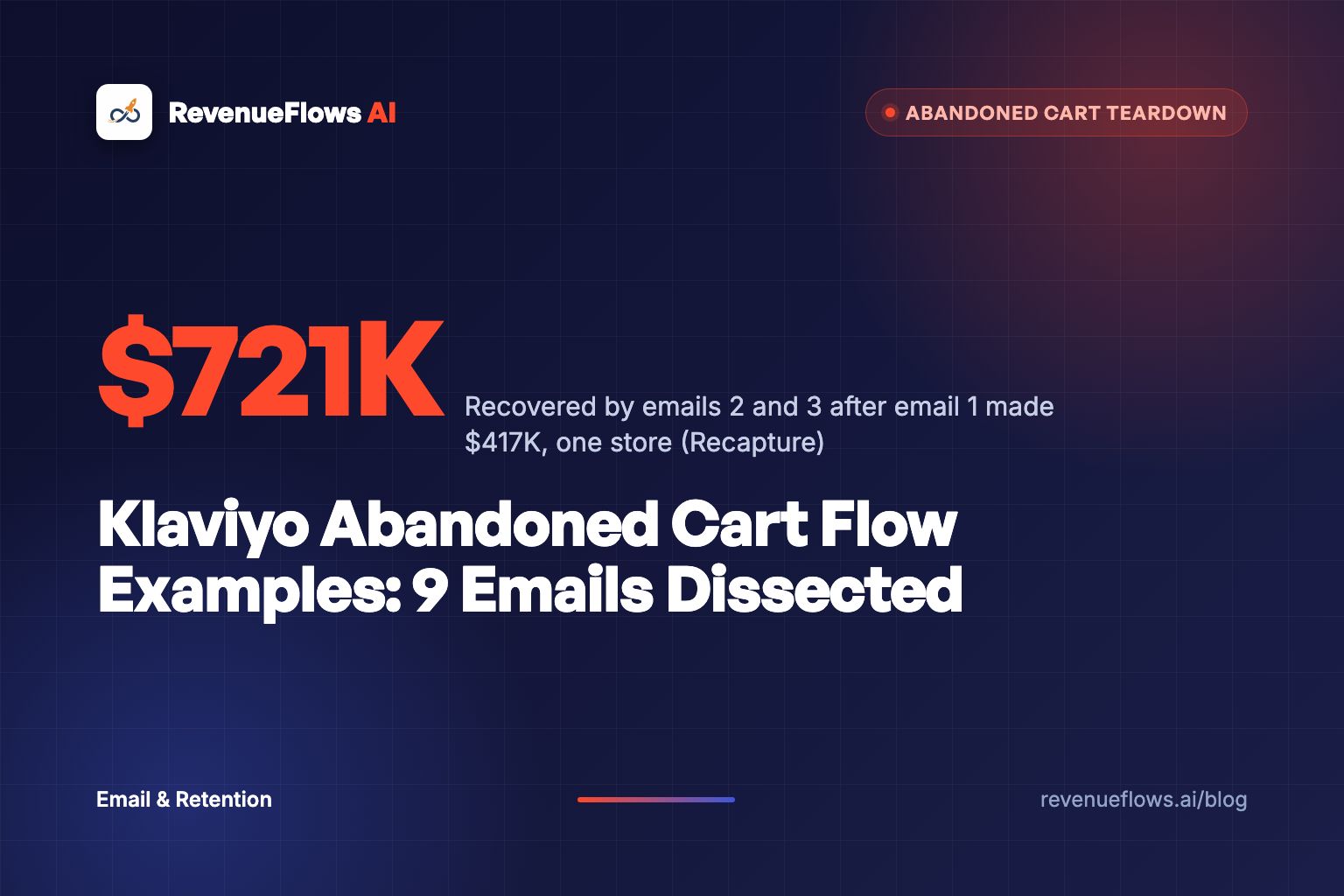
Why bother with the third email at all? Here's the math from one store. Recapture's founder published the numbers from a single store's three email flow: the first email recovered over $417,000 since 2017, and the second and third emails together recovered another $721,000. That's about 1.7 times what email one made on its own.
Source: Recapture founder Dave Rodenbaugh, 2022. One store's flow since 2017; emails 2 and 3 were reported combined.
One store is one store. But the same post gives the rule I'd tattoo on every flow: save the discount for the last email.
The follow-ups recovered more money than the first email did. Most flows still spend their best offer on the first one.
Should you trigger on Added to Cart or Started Checkout?
Both. As two separate flows.
Klaviyo's help center defines Added to Cart as firing "when someone adds an item to their cart" and Started Checkout as firing when someone enters their information at checkout and moves to the next step. Different people. Different temperature.
The checkout abandoner typed their email into your checkout. They're warm. The add to cart abandoner might have been comparing three tabs. So the abandoned checkout flow in Klaviyo gets the tighter timing and stronger last email, and the Added to Cart flow stays softer. One setup gotcha on Shopify: Added to Cart only works after you check the "Track behavioral events" setting, per the same help article.
For which flows to build first, start with our Klaviyo flows for Shopify guide.
The 9 abandoned cart emails, dissected
Sources first, because I'm not going to pretend I have their dashboards. Emails 1 to 7 come from Klaviyo's own roundup of abandoned cart emails. Emails 8 and 9 come from the Really Good Emails abandoned cart archive. None of these brands published results for these emails, so I'm grading the copy and the structure, not inventing revenue.
| # | Brand | Headline or subject | The move | Best slot |
|---|---|---|---|---|
| 1 | Beardbrand | "Reclaim my cart!" | Product front and center, friendly tone | Email 1 |
| 2 | Liquid Death | "Maybe you died?" | Dark humor that gets opened | Email 1 |
| 3 | Girlfriend Collective | "Oops" | Minimal layout, brand values in one line | Email 1 |
| 4 | SKIMS | "You've left something behind!" | Star ratings and reviews | Email 2 |
| 5 | Golde | "We saved your superfoods" | New-customer-only offer, $35 free shipping line, related products | Email 2 or 3, first-time branch |
| 6 | Rudy's | "Don't put this off like a software update" | Free shipping plus scarcity | Email 3 |
| 7 | Alex Mill | "Good news, we saved your picks ;) and you get them for 15% off" | Discount in the headline | Email 3, first-time branch only |
| 8 | Harry's | "Last call" | Urgency in two words | Email 3 subject |
| 9 | Gantri | "Your light's still here. Take another look." | Calm, product-led nudge | Email 1, high-value carts |
1. Beardbrand. "Reclaim my cart!" works because it's a button you'd actually want to press. Klaviyo notes the product sits front and center with distinct buttons. That's a perfect first email. No argument, no offer, just the thing they wanted.
2. Liquid Death. "Maybe you died?" only works for a brand that already talks like that. Copy the lesson instead: the first email's whole job is to get opened.
3. Girlfriend Collective. "Oops," then "Looks like you left something cute and sustainable in your cart." One line carries the product and the reason the buyer picked this brand in the first place. Short. Clean. On voice.
4. SKIMS. Star ratings and customer reviews under the cart. This is the email 2 move. By 24 hours, forgetting isn't the problem anymore. Doubt is. Reviews answer doubt better than a coupon does.
5. Golde. This one is the closest to how I'd build it. Klaviyo describes a one-off discount aimed at new customers, a free shipping line at $35, and related products. Translation: the offer has a target. A repeat buyer who already pays full price doesn't need it.
6. Rudy's. "Don't put this off like a software update" is a great line. Funny, true, and it names the real reason people leave (they meant to come back). Free shipping plus scarcity makes it a natural last email. And free shipping hits the biggest reason on Baymard's checkout abandonment list, where 40% of abandoners cite extra costs like shipping, tax and fees.
7. Alex Mill. 15% off right in the headline. Fine as email 3 to a first-time buyer. As email 1 to everyone, you're paying people to do what they were about to do.
8. Harry's. "Last call" plus an alarm clock emoji. I only saw the subject line on this one, and the subject line is the lesson. Your third email should say it's the third email.
9. Gantri. "Your light's still here. Take another look." No shouting. That calm tone fits a buyer still thinking about a pricey product, so it's a strong first email on the high-value branch.
A discount answers one objection: price. Most carts die of doubt, and reviews answer doubt better than a coupon does.
How do you split the flow by cart value and buyer type?
This is the part almost every list of examples skips.
Klaviyo's Flow Glossary defines two tools. A trigger split branches "based on a defining characteristic of the trigger," like the value of the abandoned cart. A conditional split branches on "defined recipient properties or activities," like how many orders someone has placed. Klaviyo's help article even suggests multi-branch splits to target first-time versus repeat buyers for selective discounts, and its examples roundup says to "offer incentives only for high-value carts."
So here's the map I'd build, as a template (illustrative, set your own threshold from your own average order value):
| Branch | Email 1 (2 to 4 hours) | Email 2 (about 24 hours) | Email 3 (about 48 hours) |
|---|---|---|---|
| High-value cart, first-time buyer | Calm reminder (Gantri style) | Reviews and guarantees (SKIMS style) | Last call with your best offer (Golde style) |
| High-value cart, repeat buyer | Reminder | Reviews or a personal note | Last call, no discount |
| Low-value cart, first-time buyer | Reminder (Beardbrand style) | Free shipping threshold | Last call, free shipping (Rudy's style) |
| Low-value cart, repeat buyer | Reminder | Last call | Skip it |
Watch what happens to the discount bill. Run the math on a store like this, a hypothetical: 20 high-value carts a month come back on the first reminder, at $240 each. Put 15% off in email one and you hand each of them $36. That's $720 a month to people who were already coming back. Move the code to email 3, on the first-time branch only, and most of that $720 stays yours.
One honest disagreement. Klaviyo's own 2026 abandoned cart benchmark report sketches a sequence with a discount in a text at 24 hours. I'd still hold it back. A text at 24 hours is a great second touch without a coupon.
What should your abandoned cart flow earn?
That same Klaviyo report, built on more than 110,000 Klaviyo customers, puts abandoned cart emails at $6.77 in revenue per recipient on average and $13.70 for the top 10%. Abandoned cart texts average $4.48. Click rate averages 6% on email, 11.3% for the top 10%.
We broke those numbers down flow by flow in our Klaviyo benchmarks post. Quick read: if you're under $6.77, look at your splits before you rewrite a single subject line.
And where does AI fit? Klaviyo's Composer, per Klaviyo's August 2026 announcement, drafts a whole flow from a prompt and returns everything as a draft you preview, edit and approve. Ask it for the four-branch map above and you'll have copy in minutes. It won't pick your threshold or your offer. That's a margin decision. (More on that in our Klaviyo Composer breakdown.)
Why do abandoned cart emails still lose the sale?
Because every click goes back to the same product page that lost the buyer the first time.
I see founders rewrite the abandoned cart email sequence four times while nobody touches the page the button points to. The email only earns a second look. The page has to close. If you want to see where that page loses people, the recordings in Microsoft Clarity on Shopify will show you for free.
Here's the math on a real one. A bedding brand we worked with had a conversion rate of 1.0% and an average order value of $125. Revenue per visitor: $1.25. After rebuilding their hero product pages, conversion rate went to 3.5% and average order value to $231, so revenue per visitor hit $8.10. On 10,000 visitors, that's $81,000 instead of $12,500. See the full case study numbers. Real client numbers, not typical results, and not a promise of what your store will do.
At RevenueFlows AI, Ishan Soni and the team chase revenue per visitor first because every flow you run (abandoned cart included) sends traffic into that number. If you want to see whether your flow or your page is the weak link, our post on whether abandoned cart emails work walks through the test, and this one covers writing a product page for email traffic. Before you add another discount, read whether discounts actually lift conversion.
What to do next
Open your abandoned cart flow in Klaviyo today and find where the discount lives. If it's in email 1, move it to email 3 and put a trigger split in front of it for cart value and a conditional split for first-time buyers. That one change takes about 20 minutes.
Book Your Profit Audit
Your abandoned cart flow can only send people back to the page that already lost them once. Book a profit audit and we'll show you where that page leaks and how to rebuild a high-converting product sales page in less than 15 minutes.
Or go here to check it out → revenueflows.ai
P.S. A coupon in email one buys back sales you already had. A page that closes earns the ones you didn't.
Frequently asked questions
How many emails should a Klaviyo abandoned cart flow have?
Two or three. Klaviyo's own help center says sending 2 to 3 abandoned cart messages leads to optimal performance, with the first one 2 to 4 hours after the cart is left and the next one 20 to 48 hours later. Past three, you're mostly annoying people who already decided no.
Should I use Added to Cart or Started Checkout to trigger an abandoned cart flow in Klaviyo?
Run both, as two flows. Started Checkout fires when someone enters their details at checkout, so those people are closer to buying and deserve the faster, tighter flow. Added to Cart catches people earlier and needs a softer flow, and on Shopify you have to turn on the Track behavioral events setting before it works.
Should my abandoned cart email include a discount?
Not in the first email. Hold the discount for the last email, and only show it to first-time buyers or high-value carts using a split. A reminder brings back the people who were coming back anyway, and a discount in email one hands them money they never needed.
How much does a good Klaviyo abandoned cart flow make?
Klaviyo's 2026 abandoned cart report, built on more than 110,000 customers, puts the average at $6.77 in email revenue per recipient, and $13.70 for the top 10% of brands. Text messages average $4.48. Compare your flow against those numbers, then against your own peer group in Klaviyo.
Can Klaviyo's AI write my abandoned cart flow?
It can draft one. Klaviyo's Composer builds a whole flow from a plain-language prompt, with copy for each email and text, and returns everything as a draft you preview, edit and approve. It still can't tell you which customers deserve a discount. That decision is yours.