
Bundle Case Study: How Order Value Went From $125 to $231
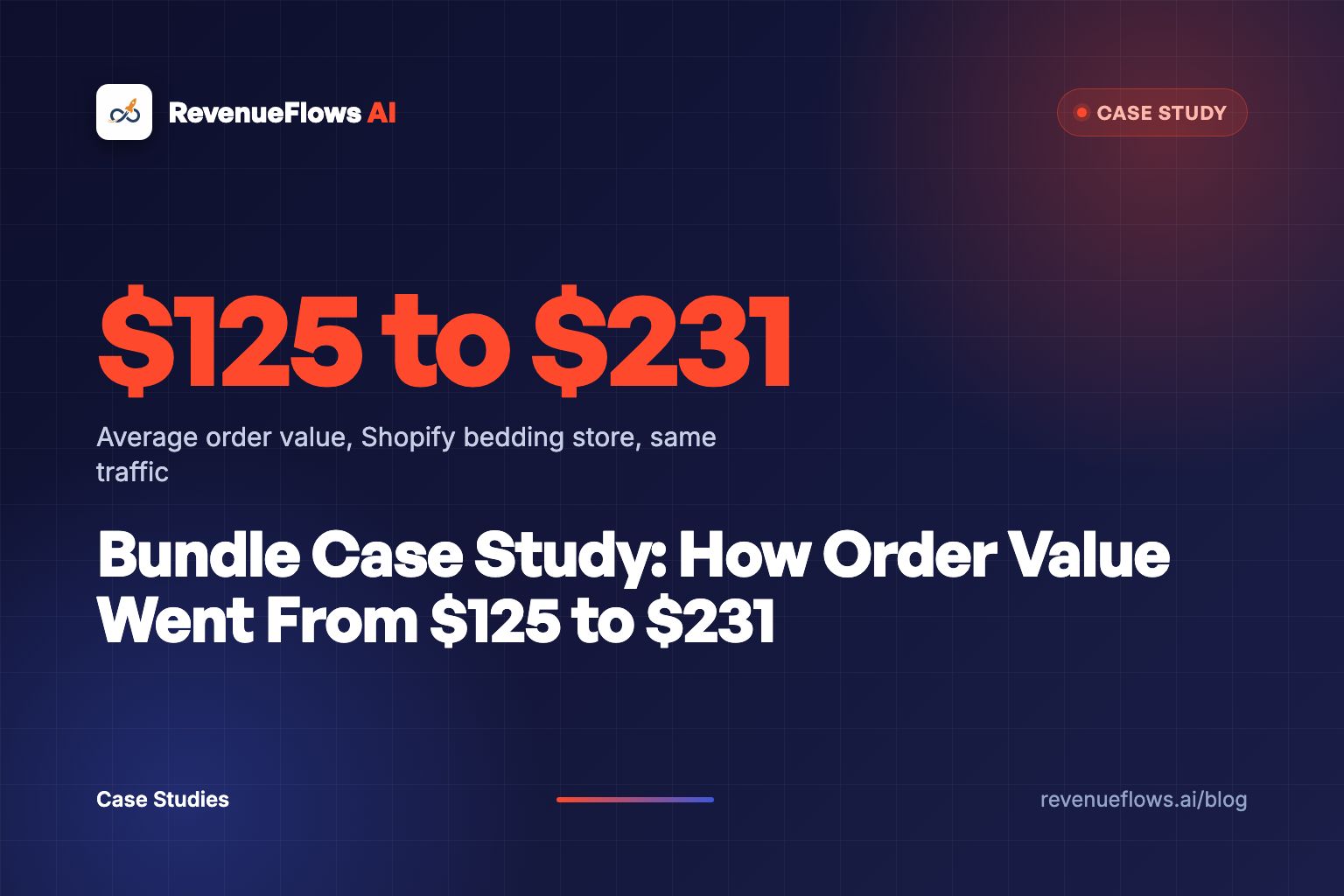
A Shopify bedding store took its average order value from $125 to $231 on the same traffic. Here's the math behind the $106 per order, what bundles had to do with it, and how to check your own bundle margins.

Every bundle case study I read this week had a percentage and no price tag.
+16%. +7%. "Bigger baskets." Fine. But plus 16% of what?
So here's the short answer, with the price tags on. This bundle case study average order value breakdown comes from a Shopify bedding store with 30+ products. We rebuilt the pages for its top 3 hero products and built bundles and offers into each one. Store-wide, average order value went from $125 to $231. Conversion rate went from 1.0% to 3.5% at the same time. See the full case study numbers on our results page. Real client numbers, not typical results, and not a promise of what your store will do.
That's $106 more on every single order. From the same traffic.
The rest of this post is where that $106 came from, page by page, and how you'd check whether bundles can do the same thing on your store without quietly eating your margin.
What does the $125 to $231 order value jump actually mean in dollars?
Start with the before. Conversion rate 1.0%, average order value $125. That means revenue per visitor was $1.25. On 10,000 visitors, that's $12,500.
Now the after. Conversion rate 3.5%, average order value $231. Revenue per visitor $8.10 (3.5% x $231 is $8.09, rounded). On the same 10,000 visitors, that's $81,000. A gap of $68,500 a month, and 6.5x the starting number.
Here's the thing. Most people read that and credit the conversion rate. It moved from 1.0% to 3.5%, so it gets the headline.
But watch what happens when you split the two levers apart.
On 10,000 visitors, a 3.5% conversion rate is 350 orders. At the old $125 order, those 350 orders bring in $43,750. At the new $231 order, the same 350 orders bring in $80,850. (The $81,000 on /results uses the rounded $8.10 per visitor. Same story, $150 of rounding.)
So the order value side alone added $37,100 on orders the store was already getting.
The conversion rate got the buyer to say yes. The order value decided how big the yes was. That second part was worth $37,100 on 10,000 visitors.
That's the part bundle case studies skip. They tell you the basket grew 16%. They don't tell you what that's worth per visitor, so you can't compare it to anything.
Which pages moved order value the most?
This is where it gets useful, because the store number hides three very different stories.
| Page | Average order value before | Average order value after | Change per order | Revenue per visitor after |
|---|---|---|---|---|
| Copper Bamboo Sheets | $125 | $221 | +$96 | $9.50 |
| Adjustable Pillows | $125 | $152 | +$27 | $6.68 |
| Cooling Bamboo Sheets | $125 | $254 | +$129 | $10.92 |
| Whole store | $125 | $231 | +$106 | $8.10 |
Real client numbers from /results. Every page started at a $125 average order value.
Look at the pillows. Same store. Same rebuild approach. The order only grew $27.
Now look at the cooling sheets. Plus $129 an order. Conversion rate 4.3%, average order value $254. Revenue per visitor $10.92. On 10,000 visitors, that's $109,200.
And the pillows, at a slightly higher conversion rate: 4.4%, average order value $152, revenue per visitor $6.68. On 10,000 visitors, $66,800.
That's a $42,400 gap between two pages on the same store, and almost all of it is order value.
I'll be straight with you about what I'm not going to do here. I'm not going to list the exact bundle contents for each page. The numbers we publish are the per-product order values, and I'd rather give you those cleanly than dress them up with details you can't check. The product-level teardowns are already written: the copper bamboo sheets case study, the cooling sheets case study and the pillow product page case study.
Why did the sheets climb so much further than the pillows?
Because a bed is a set.
Think about what a bedding buyer is quietly asking on a sheet page. "Do these come with pillowcases? Will they fit my deep mattress? Should I get two so I'm not doing laundry the same day?" Every one of those questions is an order value question wearing a disguise.
A pillow buyer is asking a narrower question. "Is this the one for my neck?" There's less around it to add.
So here's my take, and it's the polarity this whole case study rests on. Bolted-on bundles vs built-in bundles.
A bolted-on bundle is a widget under the add to cart button that says "Frequently bought together" and shows three random thumbnails. It's an afterthought. The page sells one thing, then a plugin begs for more. An offer tucked next to the pay button works the same way: a Shopify checkout upsell adds a few dollars to an order the page already sized.
A built-in bundle is part of the argument. The page answers the buyer's set question at the moment they're asking it, and the bigger order is the natural answer. Our homepage puts it in one line: "Strategic bundles and smart upsells turn every sale into a bigger order."
A bolted-on bundle asks for more money after the sale. A built-in bundle is the reason the sale got bigger.
The pillow result keeps me honest, though. Built-in bundles can't create add-on potential that the product doesn't have. They can only capture what's there.
How does this compare to other bundle case studies?
Here's the same result next to two published bundle case studies I opened while writing this.
| Case study | What changed | Order value lift | Dollar baseline given? |
|---|---|---|---|
| Cartylabs, home goods store | Bought-together bundles, in-cart upsells, shipping protection | +16% in 1 month | No |
| Spork Marketing, bundle launch | Bundles launched on the store | +7% in 6 weeks | No |
| Our bedding client | Rebuilt top 3 hero pages with bundles and offers built in | $125 to $231 (about +85%) | Yes |
The Cartylabs home goods case study reports +16% average order value, +27% units per order and 34% of carts taking a bundle. The founder quote in it is the best line on the page: their products were made to go together, but they'd never asked shoppers to buy them that way. Spork Marketing's bundling case study reports +8% conversion rate and +7% average order value in the six weeks after launch.
Both are legit results. Neither gives a starting dollar figure, so you can't work out revenue per visitor from them.
Why is ours so much bigger? I wouldn't pretend it's because our bundles were magic. The pages were rebuilt top to bottom, the conversion rate moved at the same time, and bedding is about the friendliest category for bundles you'll find. That's why I'd tell a single-SKU supplement brand to expect something closer to those +7% and +16% numbers than to +85%.
Does the same pattern show up outside bedding?
It does, and the starkest example is from Amazon sellers who moved a product to Shopify.
On Amazon, a single unit is the whole order. On Shopify, the page can build the order. Here's what happened to order value on the three Amazon-to-Shopify products on our results page:
| Product | Order value on Amazon | Order value on Shopify |
|---|---|---|
| Smart Mole | $17.95 | $101.38 |
| Smart Rodent | $29.95 | $177.75 |
| Smart Animal | $49.95 | $210.86 |
On Smart Mole, net profit per sale went from $3.83 on Amazon to $48.27 on Shopify, after paying for ads and inventory. The full fee breakdown is in the Amazon to Shopify case study.
Different category. Same lesson. The single unit was the ceiling, until the page stopped selling a single unit.
How is AI changing the way bundles get built?
The bundle itself was never the hard part. Shopify's own free Shopify Bundles app lets you create fixed bundles of up to 30 components and multipacks right from your admin.
The hard part is the thinking around it. Which products actually belong together, at what price, and does the bundle make more money per order than the single unit after the discount?
That used to be a spreadsheet afternoon. Now you can paste your catalog and margins into a tool and get a bundle plan back with the margin math done.
And the page that sells the bundle doesn't take weeks anymore either. The line on our homepage is that you drop in any product URL and the AI writes the copy, designs the images and builds the page, in less than 15 minutes. When building is fast, the founder who wins is the one who knows which numbers to watch.
Questions founders ask about this bundle case study
What did this bundle case study show about average order value? Store-wide average order value went from $125 to $231 after the top 3 hero pages were rebuilt with bundles and offers built in. Conversion rate went from 1.0% to 3.5% at the same time.
How much of the revenue lift came from order value? On 10,000 visitors at 3.5%, that's 350 orders. At $125 they bring in $43,750. At $231 they bring in $80,850. The order value side added $37,100.
Do bundles always increase average order value this much? No. Published bundle case studies report numbers like +7% and +16%. Bedding sells as a set, and the whole page was rebuilt, so expect less on a single-SKU store.
Why did the pillow page grow less than the sheets? Less to add around a pillow. It went from $125 to $152 while the cooling sheets hit $254.
How do I know if a bundle is actually profitable? Compare the bundle's contribution margin to the single unit after the discount, shipping and fees. A bigger receipt with a smaller paycheck is a loss.
If you want the full playbook beyond this one store, start with how to use product bundles on Shopify to raise average order value and the broader guide on how to increase average order value on Shopify. For conversion rate measured the same careful way, read the ecommerce case study on conversion rate, and the full case study library has every result we publish in one place.
Plug the store-level numbers in below, then swap in your own.
What to do next
Open your Shopify analytics today and find your top product page. Write down its average order value for the last 30 days, then write down the one thing a buyer most often adds to it. If that add-on isn't offered on the page itself, at the moment they're deciding, that's your first built-in bundle.
Book Your Profit Audit
On the call we'll pull your order value page by page and show you where a built-in bundle would grow the order without shrinking your margin. Then we'll show you how to rebuild a high-converting product sales page in less than 15 minutes.
Or go here to check it out → revenueflows.ai
P.S. A bolted-on bundle begs for more after the sale. A built-in bundle is why the order was $231 instead of $125.
Frequently asked questions
What did this bundle case study show about average order value?
A Shopify bedding store with 30+ products rebuilt its top 3 hero product pages, and store-wide average order value went from $125 to $231 while conversion rate went from 1.0% to 3.5%. Real client numbers, not typical results, and not a promise of what your store will do.
How much of the revenue lift came from order value?
On 10,000 visitors at a 3.5% conversion rate you get 350 orders. At $125 each that's $43,750. At $231 each it's $80,850. So the order value side added $37,100 on the same orders, on top of what the conversion rate lift added.
Do bundles always increase average order value this much?
No. Published bundle case studies usually report single-digit to mid-teens lifts, like +7% or +16%. Our bedding client's 85% climb came from bundles and offers built into rebuilt pages on a product that's naturally sold as a set. A single-SKU store should expect less.
Why did the pillow page get a smaller order value lift than the sheets?
The pillow page went from $125 to $152, while the copper bamboo sheets reached $221 and the cooling bamboo sheets reached $254. Same store, same rebuild approach, very different add-on potential per product. Judge every page on its own numbers.
How do I know if a bundle is actually profitable?
Check the contribution margin of the bundle against the single unit, after the discount, shipping and fees. A bundle that grows the order but shrinks profit per order is a bigger receipt with a smaller paycheck.