
Amazon to Shopify Case Study: $17.95 Product, $101 Orders
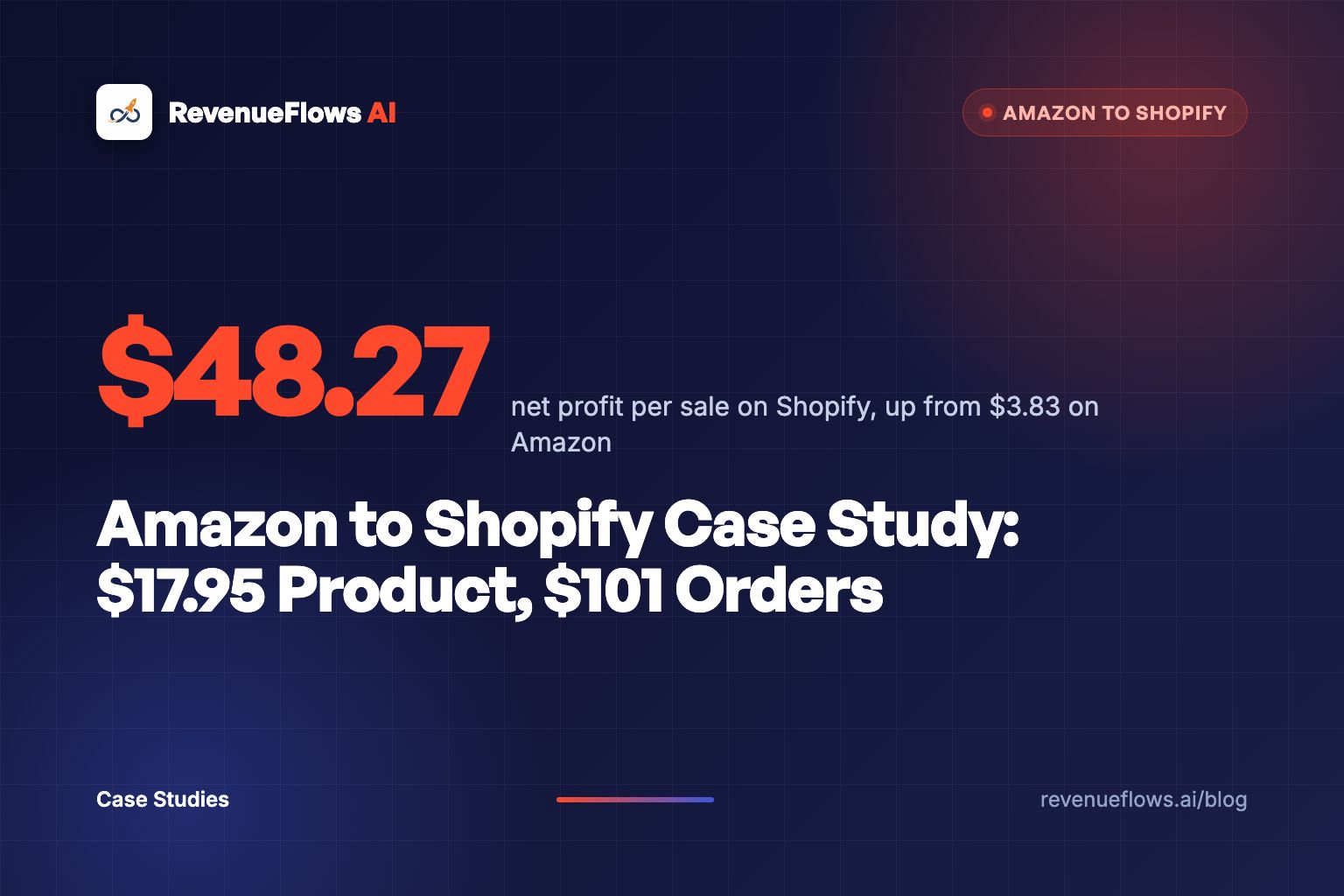
An animal repellent kept $3.83 per sale on Amazon. On Shopify it kept $48.27, after paying for ads and inventory. The order size did most of the work.

Most Amazon sellers think going direct is a fee story. Get out from under the 15%, keep the difference, done.
This Amazon to Shopify case study says otherwise. An animal repellent selling at $17.95 on Amazon kept $3.83 per sale after fees, shipping, inventory and ads. The same product on Shopify kept $48.27 per sale, after paying for ads and inventory. The fee savings helped. But the real swing came from the order itself: $17.95 per order on Amazon, $101.38 per order on Shopify.
Same product. $3.83 per sale on Amazon. $48.27 per sale on Shopify. The order got bigger, and the profit followed.
Real client numbers, not typical results, and not a promise of what your store will do.
Here's the whole teardown, line by line.
What did this product actually keep on Amazon?
The product is listed on /results as Smart Mole, an animal repellent. It was doing $8K a month on Amazon. Healthy enough on the dashboard. Thin enough in the bank.
Here's the Amazon side of one sale, straight from the breakdown on our results page:
| Smart Mole on Amazon FBA | Per sale |
|---|---|
| Product price | $17.95 |
| Landed cost | -$4.50 |
| Shipping fees | -$4.24 |
| Platform fees (15%) | -$2.69 |
| Gross profit per sale | $6.52 |
| Advertising | -$2.69 |
| Net profit per sale | $3.83 |
Run it yourself. $17.95 minus $4.50, minus $4.24, minus $2.69 is $6.52. Take out $2.69 in ads and you're left with $3.83.
That 15% isn't a quirk of this product. Amazon's own seller pricing page lists a 15% referral fee for most of its common categories, including Home and Kitchen, Sports and Outdoors, and Tools and Home Improvement. And it's charged on every single sale, forever.
I sold on Amazon for years before I built anything on Shopify, so I'll say the quiet part. $3.83 is a job. You're doing all the work of a brand, the inventory risk, the reviews, the stockouts, and Amazon is setting the price of your paycheck.
What changed when the product moved to Shopify?
Three things changed. Only one of them was big.
| Amazon FBA | Shopify | |
|---|---|---|
| Product price | $17.95 | $24.95 |
| Platform fees | -$2.69 (15%) | -$0.75 (3%) |
| Advertising per sale | -$2.69 | -$26.36 |
| Average order value | $17.95 | $101.38 |
| Net profit per sale | $3.83 | $48.27 |
First, the price went up $7, from $17.95 to $24.95. Off the marketplace, a product doesn't sit in a search result next to a row of cheaper lookalikes.
Second, the platform cut dropped from 15% to 3%. Shopify's pricing page shows card processing in the low single digits per order, a long way from a 15% referral fee.
Third, and this is the one that matters: the average order went from $17.95 to $101.38. That's about 5.6x more money per checkout. On a $24.95 product, a $101.38 average order is a little over four times the sticker price in every cart.
After paying for ads and inventory. Real client numbers from /results, not typical results.
$48.27 divided by $3.83 is about 12.6x more profit per sale.
Why didn't higher ad costs kill the Shopify math?
Here's the line most Amazon to Shopify stories leave out.
Advertising went from $2.69 per sale on Amazon to $26.36 per sale on Shopify. Nearly 10x. Shopify traffic isn't free, and anybody who tells you "own your customers and the margin takes care of itself" hasn't paid a Meta bill.
On Amazon, the buyer is already in the store with a wallet out. On Shopify, you rent every visitor yourself. If your Shopify order looks like your Amazon order, $17.95 and one unit, that ad cost eats you alive. You'd be paying more to get the same skinny sale.
A small order on Shopify is an Amazon sale with a bigger ad bill. A big order is a business.
So the case only works because the order got big enough to carry the ads. $101.38 in the cart can absorb $26.36 in ad cost and still leave $48.27. A $17.95 cart can't.
That's the polarity. Amazon sellers who move a product over and copy the listing are amplifying a leak: same small order, higher ad cost. The ones who rebuild the page to sell a bigger order are amplifying a machine.
What does a 12.6x profit gap mean in sales per day?
Here's the math, and it's the same logic as the calculator under each case study on /results.
Say you want $1,000 a day in profit from this product.
- On Amazon at $3.83 per sale, that's 262 sales a day.
- On Shopify at $48.27 per sale, that's 21 sales a day.
Read that again. 262 packages versus 21. Same $1,000.
Flip it to revenue and the gap is still there. $1,000 a day in revenue takes 56 orders at $17.95, or 10 orders at $101.38. That's the "5.6x fewer sales for the same money" line on the results page.
Watch what happens to everything downstream. Fewer orders means fewer packages to ship, fewer customer service tickets, fewer units of inventory sitting in a warehouse waiting for a sale. You do less, and you keep more.
The proof screenshots on /results show monthly sales between $15K and $30K, a $101 average order value, and $529K in total sales generated. It went from $8K a month on Amazon to $30K a month on Shopify.
What does this Amazon to Shopify case study not prove?
I want to be straight with you here, because a case study that only shows the good parts is an ad.
It doesn't prove fees are the answer. The fee savings on this product were $1.94 per sale ($2.69 down to $0.75). Ad cost went up $23.67 per sale. If fees were the whole story, this move would have lost money.
It doesn't prove you should leave Amazon. The Amazon numbers are the baseline this whole comparison is built on. Keep the reach. Build the profit somewhere else. If your stock already sits in FBA, Amazon Multi-Channel Fulfillment for Shopify can ship those Shopify orders from the same shelf.
And it doesn't prove every product can do this. A $17.95 item turning into a $101.38 order needs a product people buy more than one of, and a page built to sell that bigger order instead of a single unit. If you're curious how the other two Amazon products did, the full set of three, including a $29.95 product and a $49.95 one, is in our ecommerce case studies breakdown.
How is AI changing the move from Amazon to Shopify?
The old reason Amazon sellers stayed put was the page. An Amazon listing is a template. A Shopify product page is a blank screen, and a blank screen that has to sell a $101 order is weeks of copywriter, designer and developer time.
That's the part AI has changed. The way we build pages now, per our homepage: "Drop in any product URL, the AI writes the copy, designs the images, and builds the page, in less than 15 minutes." You start from the Amazon listing you already have, the reviews, the objections, the photos, and the AI builds a page whose job is a bigger order.
The page still has to be built for a Shopify buyer, though. Your visitor will have an Amazon tab open to compare. Our guide on writing a Shopify product page for Amazon shoppers covers what that buyer needs to see, and how to increase average order value on Shopify covers the order side. If you're still deciding what stays on the marketplace, start with the Amazon selling guide for 2026 and the Amazon FBA fee changes for 2026. And for the full fee story, read why Amazon sellers are moving their winners to Shopify.
What to do next
Take your best Amazon product. Write down one number: net profit per sale after ads and inventory. Then work out how big a Shopify order would need to be to carry 10x your Amazon ad cost and still beat it. If that order looks impossible on your current page, the page is the problem, not the channel.
Book Your Profit Audit
We'll take your Amazon numbers, find what each sale is really keeping, and show you how big your Shopify order needs to be to make the move pay. Then we'll show you how to rebuild a high-converting product sales page in less than 15 minutes.
Or go here to check it out → revenueflows.ai
P.S. On Amazon you're paid per package. On Shopify you're paid per order. Make the order bigger and the whole business gets lighter.
Frequently asked questions
Is moving from Amazon to Shopify worth it?
It's worth it when your Shopify page can sell a bigger order than Amazon does. In our animal repellent case, net profit per sale went from $3.83 on Amazon to $48.27 on Shopify, after paying for ads and inventory, because the average order grew from $17.95 to $101.38.
Do Amazon sellers make more profit on Shopify?
They can, but not from fee savings alone. Fees on our case dropped from 15% to 3%, yet ad cost per sale rose from $2.69 to $26.36. The profit came from the order getting bigger, not from the traffic getting cheaper.
Why is advertising more expensive on Shopify than on Amazon?
On Amazon, buyers are already shopping inside the marketplace. On Shopify you pay to bring every visitor in yourself. In our case that meant $26.36 in ads per Shopify sale against $2.69 on Amazon, which only works if each order is big enough to carry it.
Should I stop selling on Amazon if I move to Shopify?
Not necessarily. The Amazon numbers in this case study are the baseline the whole comparison is built on. Keep Amazon for reach and build Shopify as the place where a buyer spends $101 instead of $17.95.
How many sales do I need on Shopify versus Amazon for the same profit?
In our case, $1,000 a day in profit took 262 sales on Amazon at $3.83 each, and 21 sales on Shopify at $48.27 each. That's the gap order value creates.