
Amazon FBA Fee Changes 2026: Fuel Surcharge and Peak Fees
Amazon raised fulfillment costs three times in 2026: $0.08 in January, a 3.5% surcharge in April, and $0.32 peak fees from October 15 with the surcharge on top. Here's what the stack does to one unit, and the repricing math.

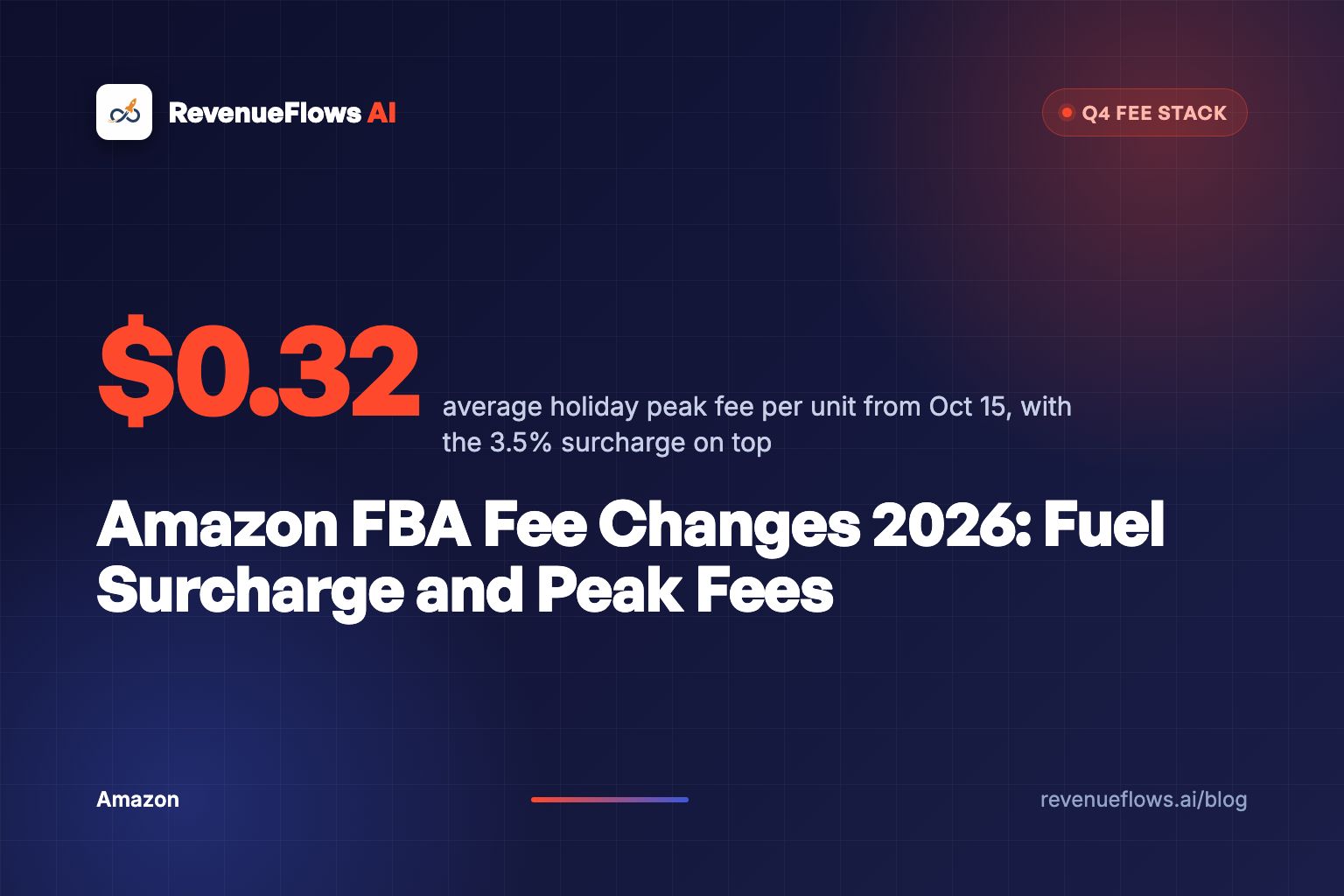
Amazon raised your rent three times this year. Most sellers only noticed once.
Here's the short version of the Amazon FBA fee changes 2026, straight from Amazon's own announcements. On January 15, FBA fulfillment fees went up by an average of $0.08 per unit. On April 17, Amazon added a 3.5% fuel and logistics surcharge on top of every fulfillment fee, about $0.17 per unit on average. And from October 15, 2026 to January 14, 2027, holiday peak fulfillment fees add an average of $0.32 per unit, with the 3.5% surcharge applied on top of the peak fee too.
Three small numbers. Stacked on a 15% referral fee, on a product that keeps $10 a sale, they're the difference between a Q4 that prints and a Q4 that bleeds.
So let me walk you through what changed, what it does to one unit, and the one decision you have to make before October 15.
What actually changed in the Amazon FBA fee changes 2026?
Amazon split this year's changes across three announcements, so most sellers caught one and missed two. Here they are in one table, every line from Amazon's own pages.
| Date | What changed | Amazon's stated size | Source |
|---|---|---|---|
| January 15, 2026 | Annual FBA fulfillment fee update | Average increase of $0.08 per unit sold | Amazon's 2026 fee update |
| April 17, 2026 | 3.5% fuel and logistics surcharge on FBA fulfillment fees (US and Canada) | About $0.17 per unit on average for US FBA | Surcharge announcement |
| May 2, 2026 | Surcharge extends to Buy with Prime and Multi-Channel Fulfillment | Same 3.5% | Surcharge announcement |
| October 15, 2026 to January 14, 2027 | Holiday peak fulfillment fees on FBA, Remote Fulfillment, Multi-Channel Fulfillment and Buy with Prime | Average increase of $0.32 per unit, surcharge applied on top | Holiday 2026 announcement |
A few things Amazon said that matter more than the headline numbers.
The January update came with the line that there would be no new FBA fee types in 2026. True on paper. The surcharge that arrived three months later rides on an old fee instead of creating a new one.
The surcharge is calculated on your fulfillment fees, not on your sale price. Amazon called it temporary and said it will keep evaluating it as conditions evolve. No end date. I've watched "temporary" on Amazon before. The 5% fuel and inflation surcharge from April 2022 was temporary too.
And the referral fee didn't move, which sellers read as good news. It sits at 15% across the big categories (Home and Kitchen, Sports and Outdoors, Toys and Games, Pet Supplies, Lawn and Garden, with a $0.30 per-item minimum) on Amazon's referral fee table. It didn't need to move. It's a percentage of the price you're about to raise to cover the other three.
The referral fee didn't go up in 2026. It didn't have to. Every price increase you make to cover the surcharge hands Amazon 15% of the increase.
How much does the 3.5% fuel surcharge cost on one unit?
Amazon's average is $0.17 per unit. The average hides the shape.
Run the math on a product like this, a hypothetical: a large standard-size item that sells for $24.95 and carried a $5.00 fulfillment fee in 2025.
January 15 adds the average $0.08. The fee is now $5.08.
April 17 adds 3.5% of $5.08, which is $0.18. The fee is now $5.26.
Between January and April, that unit's fulfillment cost rose $0.26 with no change to the product, the box, or the price.
Here's the thing. $0.26 is nothing on one unit. On 2,000 units a month it's $520, every month.
On that hypothetical $24.95 unit, with a 15% referral fee of $3.74 and a landed cost of $6.00, the 2025 margin before ads was $24.95 minus $3.74 minus $5.00 minus $6.00, which is $10.21. After April 17, it's $9.95. You lost 2.5% of your margin to a 3.5% surcharge on a fee that's a fifth of your price.
A surcharge on fulfillment fees looks small because the base is small. Measure it against your profit per unit, never against your price.
What do the holiday peak fees do to a thin-margin product?
Now watch what happens on October 15.
Amazon's holiday 2026 announcement puts the peak increase at an average of $0.32 per unit, the same as last year, and says the 3.5% surcharge applies on top. So the stack on the hypothetical item is $5.08 base, plus $0.32 peak, equals $5.40, times 1.035 for the surcharge, equals $5.59 per unit.
The 2025 baseline is hypothetical. The $0.08 January increase, the 3.5% surcharge and the $0.32 peak fee are Amazon's stated averages; your item varies by size and weight.
From $5.00 to $5.59. That's $0.59 more per unit than the same item's off-peak 2025 fee, and $0.27 more than last Q4's peak rate.
Margin before ads drops to $24.95 minus $3.74 minus $5.59 minus $6.00, which is $9.62. Sell 3,000 units in the peak window and the fulfillment line alone takes $16,770 instead of $15,000. A $1,770 gap on one ASIN.
Then Q4 adds the costs that aren't called fees. Amazon's holiday page lists Best Deals, Lightning Deals and Prime Exclusive Price Discounts at $100 upfront per promotion plus 1.5% of promotional sales, capped at $5,000. A deal that moves $20,000 costs $400 in deal fees before the discount itself.
Peak fees don't hit your revenue. They hit the slice of revenue you were going to keep.
Why do these fees stack worse than they look?
Because they're all rent, and rent on Amazon is charged on three different bases.
The referral fee is a percentage of price. The fulfillment fee is a flat rate by size and weight. The surcharge is a percentage of the fulfillment fee. The peak fee is a flat add-on, and the surcharge then applies to that too. Raise your price to cover the flat fees and the percentage fee grows. Cut your price to hold the Buy Box and the flat fees don't shrink.
I ran a page-one Amazon product for years and set my fee assumptions once, in January. That habit worked right up until the year the fees changed in January, April and October. And fees aren't the only line that moved in 2026. If any of your stock crosses a border as a parcel, the de minimis rule change put duty on it before Amazon's fees even start.
Sellers on Amazon's own forum are saying the quiet part. In one thread about the surcharge, a seller describes being pushed toward a $4.99 price while Amazon is "taking $7.47 in FBA fees." Another called the pricing checks "price manipulation by Amazon." The complaint underneath is that Amazon's competitive price checks compare your all-in price to an outside price that carries none of these fees.
That's the tenant's position. The landlord sets the rent, the rent goes up mid-lease, and you're told to stay competitive with the store across the street that pays no rent at all.
Should you raise your price before October 15?
Yes, on your winners, and here's the math.
To keep the hypothetical item's $10.21 margin through the peak window, you need to recover $0.59 per unit. But a price increase pays 15% referral on itself, so you raise the price by $0.59 divided by 0.85, which is $0.70. The price moves from $24.95 to $25.65. Check it: 15% of $25.65 is $3.85, and $25.65 minus $3.85 minus $5.59 minus $6.00 is $10.21.
Seventy cents. Most buyers won't notice. Amazon's pricing checks might, which is exactly what those forum threads are about.
Three rules I'd follow:
- Reprice the top 20% of ASINs by profit first. Those are the ones where $0.70 moves money.
- Recalculate break-even ACoS with the peak fee included. Our Amazon selling guide for 2026 walks through that math, and the peak fee lowers the ceiling.
- Skip deals on any ASIN keeping under $5 a unit at peak rates. The $100 deal fee plus 1.5% of sales eats what's left.
And then there's the fourth rule, the one most Amazon sellers never get to.
What does the same product earn on a page you own?
Here's the shift. Three client products on our results page ran on Amazon first and then on their own Shopify store with a rebuilt product page. Real client numbers, not typical results, and not a promise of what your store will do.
Smart Mole, an animal repellent: $17.95 on Amazon, a 15% platform fee, $3.83 net profit per sale. On Shopify at $24.95, with a 3% platform fee and a $101.38 average order value, $48.27 net profit per sale, after paying for ads and inventory.
Smart Rodent: $7.73 net profit per sale on Amazon. $78.87 on Shopify, after ads and inventory, with the average order climbing from $29.95 to $177.75.
Smart Animal: $17.58 on Amazon. $134.28 on Shopify, after ads and inventory, at a $210.86 average order.
The fee line on those tables reads 15% on Amazon and 3% on Shopify. But the fee gap is the small part. The big part is what a page you control does to the order itself. On Amazon the listing sells one unit at the Buy Box price. On your own page, the page sells the bundle, the size up, the refill, and the order goes from $17.95 to $101.38.
Revenue per visitor is conversion rate times average order value, and it's the number that decides whether a store can afford traffic at all. Run the math on a store like this, a hypothetical: 10,000 visitors a month, a 1.2% conversion rate and a $50 average order value. That's $0.60 per visitor, or $6,000 a month. Rebuild the page so it converts at 2.4% with an $80 average order value and the same 10,000 visitors are worth $1.92 each, or $19,200 a month. Same traffic. No new ads. No landlord.
Amazon's fees are a percentage of a price you don't fully control. Your own page is a multiplier on a visitor you already paid for.
If the listing itself is the weak link, start with the fatal flaw we keep finding in Amazon listing audits. If you're already moving a winner off the marketplace, how to write a Shopify product page for Amazon shoppers covers what those buyers expect to see when they land. And for the platform-by-platform math, Shopify vs Amazon revenue per visitor in 2026 lays it out.
What to do next
One move this week. Open the Fee Preview report in Seller Central (Reports, then Fulfillment, then Fee Preview), pull your top 5 ASINs by profit, and for each one write down the October 15 fulfillment fee with the surcharge on it. Then reprice those five by the fee gap divided by 0.85. That's the whole job, and it takes an hour.
Then take the best of the five and ask what it would earn on a page you own. Our Amazon seller page puts the fee math and the three case studies side by side.
Book Your Profit Audit
Amazon changed the rent three times this year and will do it again. The profit audit shows you what your best Amazon product would earn on a page you control, and then we rebuild a high-converting product sales page in less than 15 minutes.
Or go here to check it out → revenueflows.ai
P.S. The surcharge is "temporary." The 2022 one was too. Tenants wait for the rent to drop. Owners build the page.
Frequently asked questions
What are the Amazon FBA fee changes for 2026?
Three changes, all from Amazon's own announcements: FBA fulfillment fees rose an average of $0.08 per unit on January 15, 2026; a 3.5% fuel and logistics surcharge was added to fulfillment fees on April 17 (about $0.17 per unit on average); and holiday peak fulfillment fees averaging $0.32 per unit run from October 15, 2026 to January 14, 2027, with the surcharge applied on top. Referral fees did not change.
How is the Amazon FBA fuel surcharge calculated?
The 3.5% surcharge is calculated on your fulfillment fee, not on your sale price. On a $5.08 fulfillment fee it adds about $0.18. Amazon's stated average is $0.17 per unit for US FBA, and it varies with your item's size and weight.
When do Amazon's 2026 holiday peak fulfillment fees start and end?
October 15, 2026 through January 14, 2027. They apply to FBA, Remote Fulfillment with FBA, Multi-Channel Fulfillment and Buy with Prime, and Amazon says the per-unit increase averages $0.32, the same as last year.
Does the 3.5% surcharge apply on top of holiday peak fees?
Yes. Amazon's holiday 2026 announcement states the 3.5% fuel and logistics surcharge applies on top of holiday peak fulfillment fees. So a $5.08 base fee plus $0.32 peak becomes $5.40, and the surcharge takes it to $5.59.
Is the Amazon fuel surcharge permanent?
Amazon calls it temporary and says it will keep evaluating it as conditions evolve, but it gave no end date. The 5% fuel and inflation surcharge Amazon added in April 2022 was also announced as temporary. Plan as if it stays.
Should I raise my Amazon prices before October 15?
On your best-selling ASINs, yes. To recover a fee increase you need to raise the price by the fee gap divided by 0.85, because a 15% referral fee takes its cut of the increase. A $0.59 fee gap needs a $0.70 price increase to keep the same margin.