
Product Bundle Case Study Roundup: 8 Brands, Published Numbers
I read the published bundle case studies from eight brands, from a Malaysian mattress store to a teeth whitening giant. The winners all did one thing: the bundle finished a job the buyer already had.

I used to think bundles were a pricing trick.
Stack three products, knock 15% off, watch the order value climb. That's how most founders build them, and it's how I built my first ones. Some worked. Most just sat there.
So this week I went looking for every product bundle case study I could actually verify: the brand's own story, published by the app or agency behind it, with numbers. I found eight brands worth your time, plus one that walked away from bundles. Here's the short answer before the details.
Across these case studies, the bundles that won didn't stack random products at a discount. Each one finished a job the buyer already had: a full bed, a daily routine, a gift, a taste of every flavor.
That's the whole pattern. The rest of this post is the proof, the fine print, and how to copy it.
What do product bundle case studies actually report?
Every row below links to the case study I opened. These are vendor success stories, so read them as the best cases, not the average.
| Brand | What they report | The job the bundle finished |
|---|---|---|
| Sonno (sleep retail, Malaysia) | Order value up 166%, conversion rate up 2.5% | A complete bed: mattress with linen, pillow with bolster |
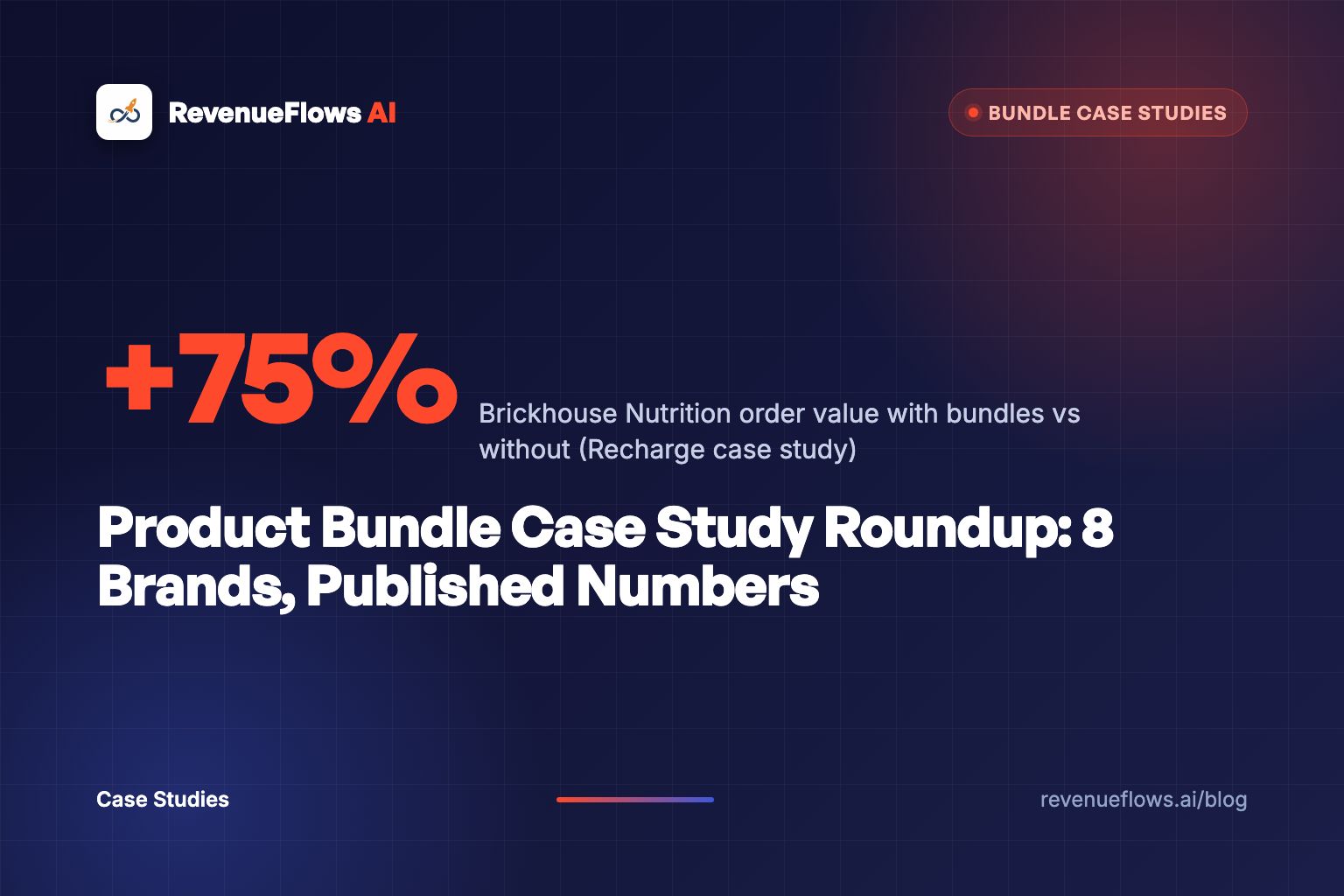
| Brickhouse Nutrition | Bundle orders $135 vs $77 without (+75%), $134K+ in bundle sales | Choose your own flavor mix |
| Cabau Lifestyle (supplements) | Order value up 27.12%; bundles grew from about 5% to 10-12% of sales | "Which supplements go together?" answered as a routine |
| Bouf (York St Brands) | Order value up 23.59% in the last 30 days reported | "Complete your Routine" on the product page |
| The Breakout Hack (York St Brands) | 16% of all store visitors placed a bundle order in January | Build your own skincare set with tiered savings |
| Oat Haus (granola butter) | 60%+ more subscriptions; build-a-box subscribers 50% less likely to cancel | Mix flavors in a box you can edit |
| Lvly (flower delivery) | 150+ bundled products, order value up 6% year over year | The whole gift: flowers, chocolate, prosecco |
| HiSmile (teeth whitening) | 80%+ of orders are bundles, average cart size grew fourfold | Try 10+ toothpaste flavors without guessing |
One more from that last source. Shopify's blog, citing Particl data, says rhode skin's kit-driven upsell revenue went from $948,000 to $2.53 million a month between January and July 2025. That's third-party estimated data, not the brand's own report, so it gets a footnote instead of a row.
Source: each brand's published case study. Brickhouse compares bundle orders with non-bundle orders; Lvly is year over year; the others are before vs after. Different methods, so compare the direction, not the decimals.
Why did Sonno's bundle beat everyone else's?
Look at what Sonno sold together. A mattress with bed linen. A pillow with a bolster.
Nobody buys a mattress and sleeps on the bare foam. The linen isn't an add-on. It's the second half of the purchase, the part the buyer was going to go find somewhere else anyway. Sonno just put it on the same page, priced together.
That's why the number is so big. Sonno had grown to 100 SKUs, and customers were calling in to ask about deals because the store had no clean way to show them. MakeBeCool built bundles from products people already bought together and tuned the configurations and bundle pricing to lift spend per order. It even pushed slow-moving stock into the less popular bundles, which is a smart inventory move most founders never think about.
Here's the thing. A 166% lift doesn't come from a discount. It comes from selling the finished bed instead of one piece of it.
A bundle that finishes the job gets bought. A bundle that just bundles gets ignored.
What do the supplement and food brands teach about bundles?
Three of the eight sell things you eat or drink, and they all hit the same nerve: choice.
Brickhouse Nutrition wanted to let customers pick the exact flavor combinations they wanted, and its old setup couldn't do it. Its COO says the brand was looking for "a bundling solution that allowed for full customization." After moving to Recharge Bundles, orders with a bundle averaged $135 against $77 without. Bundles also became its launch pad for new flavors, and daily sales of new flavors doubled.
Cabau Lifestyle had the opposite problem. Too many questions. After the founder appeared on Netflix, demand spiked, and buyers didn't know which supplements they could take together. The commercial chief put it plainly: "Our products raise a lot of good questions." So the bundle became the answer. Rebuy's Bundle Builder packaged supplements into a daily routine, and bundles went from about 5% of sales to 10-12%. With an order value around €40 and fixed fulfillment costs on every box, that 27% lift mattered more than it looks.
Oat Haus fought a clunky dropdown. Its old setup made customers pick from a long list of preset jar combinations. After moving to Awtomic's build-a-box, it sold 60%+ more subscriptions, and build-a-box subscribers were 50% less likely to cancel.
Watch what happens across all three. The bundle wasn't a deal. It was the menu.
When do bundles fail, and what did Magic Spoon do instead?
This is the case study founders skip, and it's the one I'd read twice.
Magic Spoon's Rebuy case study says its pre-packaged bundles sold out every time. Great, right? But the team also noticed bundles pushed up the total price shoppers paid in ways that didn't always serve them. So they switched to a gift with purchase: hit a cart amount, get a free product.
That's an honest admission from a brand that was winning with bundles. A bundle can raise the receipt and still feel like a squeeze.
I've seen the same thing in audits (and I'll admit I've built a few of these myself). A skincare store bundles a cleanser with a candle because both have margin. Order value ticks up for a week. Then it flattens, because nobody was trying to buy a candle with their cleanser. The bundle solved the founder's inventory problem, not the buyer's.
What does AI change about building bundles?
Two honest things, both verified on vendor pages this week.
First, AI can find the pairs for you. Rebuy's bundle best practices guide shows a store using Rebuy's AI endpoint to recommend products frequently bought together, while another store hand-picks the components with a rule. Same widget, two ways to fill it. Sonno's bundles came from the same idea, items people already bought together.
Second, AI is good at the part that sinks most bundles: the page copy. A bundle box with three thumbnails and a strikethrough price doesn't explain why these three things belong together. That sentence is what sells it. If you want the build steps, our guide on how to use product bundles on Shopify to raise average order value walks through it, and mix and match bundles on Shopify covers the build-your-own format Oat Haus and The Breakout Hack used.
How does a bundle show up in our own numbers?
So if you were wondering whether this holds outside vendor case studies, here's ours.
A Shopify bedding store with 30+ products rebuilt its top 3 hero product pages. Before: conversion rate 1.0%, average order value $125. That means revenue per visitor was $1.25. On 10,000 visitors, that's $12,500. After: conversion rate 3.5%, average order value $231. Revenue per visitor $8.10. On the same 10,000 visitors, that's $81,000. See the full case study numbers. Real client numbers, not typical results, and not a promise of what your store will do.
Now look at the per-product split. The copper bamboo sheets reached a $221 average order value and the cooling bamboo sheets reached $254. The adjustable pillows reached $152. Same store, same rebuild. The sheets are the bed. The pillow is one piece of it. The products that complete a job carried the bigger orders, which is the exact pattern from Sonno. The full breakdown is in our bundle case study on average order value.
Run the math on a store like this (a hypothetical). 10,000 visitors a month, conversion rate 2.0%, average order value $60. Revenue per visitor is $1.20, so that's $12,000. A bundle built around the complete job lifts average order value to $78 while conversion rate holds at 2.0%. Revenue per visitor becomes $1.56. On the same 10,000 visitors, that's $15,600.
Conversion rate x average order value x visitors. Before: 2.0% x $60. After: 2.0% x $78.
But a bigger order with a fatter discount can shrink your profit. Check the margin before you launch.
How do you copy these bundle strategy examples on your store?
Start with one product, not ten. Ask what the buyer needs next to get the full result from it. Then build one bundle around that answer and say why on the page. More ideas by category are in Shopify bundle ideas, and more brand stories live in our ecommerce case studies and Shopify case studies roundups.
What to do next
Open your best seller's product page today. Ask one question: what does someone buying this need next to get the result they paid for? If the answer isn't on that page, that's your first bundle.
Book Your Profit Audit
Every winning bundle in these case studies finished a job on the product page, and most stores bury the offer or skip the sentence that sells it. Book a profit audit and we'll show you where your page is leaking order value, then show you how to rebuild a high-converting product sales page in less than 15 minutes.
Or go here to check it out → revenueflows.ai
P.S. A discount pack bundles products. A winning bundle finishes the job. Your buyer can feel the difference.
Frequently asked questions
What results do product bundle case studies report?
Published bundle case studies report order value lifts from about 6% to 166%. Sonno reported a 166% lift with frequently bought together bundles, Brickhouse Nutrition reported bundle orders of $135 vs $77 without, and Cabau Lifestyle reported a 27% lift. Each number comes from the brand's vendor case study, so read them as best cases.
Do product bundles work for every category?
No. Bundles work when the products finish one job together, like a mattress with bed linen or supplements built into a daily routine. Magic Spoon's Rebuy case study says its pre-packed bundles raised the total price in ways that didn't always serve shoppers, so it moved to a gift with purchase instead.
What kind of bundle gets the biggest order value lift?
In these case studies, the biggest lifts came from bundles that complete a setup (Sonno's mattress plus linen) or let buyers mix variety (Brickhouse's flavor combinations). Generic discount packs of unrelated products don't show up among the winners.
Are vendor bundle case studies trustworthy?
Treat them as directional. They're published by the app or agency that sold the bundle tool, they rarely show a control group, and some measure bundle orders against non-bundle orders instead of before vs after. Copy the move, then measure against your own baseline.
How do I test a bundle on my own store?
Pick your best seller, ask what the buyer needs next to get the full result, and build one bundle around that answer. Run it for 30 days and track order value, conversion rate and profit per order against the 30 days before.