
Post-Purchase Upsell on Shopify: 11 One-Click Offers That Work
The post-purchase page is the only spot in your store where a no costs nothing. Here are the 11 one-click offers buyers actually accept, Shopify's current rules on who sees them, and the honest math.

Let me say the thing the upsell apps won't.
The best post-purchase upsell Shopify stores run is boring. A consumable, an accessory, or a second unit of what the buyer just bought. Priced below the order they just placed. Shown once. One click. That's the whole playbook, and it works because the buyer has already said yes to you with their card. The post-purchase page is the only spot in your store where a no costs you nothing.
Here's what the apps sell instead: funnels, timers, downsells, three screens deep, a 10% discount on something the buyer never looked at. That's a tip jar with a sales pitch taped to it. And even done right, the tip jar is a bonus, not a multiplier. The multiplier is still the product page.
What makes a post-purchase offer take?
Three things, and the product is two of them.
It belongs with what they just bought. Shopify's own design guidance says to "present relevant products by tailoring upsell offers to the shopping behaviors and preferences of customers." In plain words: if the buyer has to think about why this product is here, they're gone.
It costs less than the order they just placed. The card is still warm. A $19 add-on to an $89 order is a reflex. A $140 add-on to an $89 order is a second decision, and second decisions get the decline button.
It's shown once, with one button. The buyer is between paying and seeing their confirmation. Shopify's guidance warns against language that "introduces doubt about the status of the order." Every extra screen there is doubt.
The post-purchase page is a tip jar, not the register. Put the right thing in front of a happy customer and it fills up. Put a sales funnel there and they walk.
What are Shopify's rules for post-purchase offers right now?
I re-read the docs for this post because the rules decide who sees your offer at all. October 2026 state, from Shopify's pages:
| Rule | Current state (October 2026) |
|---|---|
| Where it shows | "after the payment step, but before the Order status page" (Shopify dev docs) |
| Plans | Apps built with post-purchase extensions: "Basic Shopify plan or higher" and Shopify Plus (Shopify Help Center) |
| Apps and offers | One app on the page at a time; "a maximum of three post-purchase offers for each checkout" (post-purchase rules) |
| Payments that skip the page | Wallets (Apple Pay, Google Pay, Amazon Pay), installments (Klarna, Affirm, Afterpay), gift cards, any non-card payment, gateways that keep the CVV (Braintree, Payflow Pro, PayPal Payments Pro, Eway) |
| Orders that skip the page | Under $0.50, local delivery, duties or multiple currencies, any channel other than the online store |
| Status | Still labeled beta; app developers request access for live stores. Offers inside the checkout itself stay Plus only (product offers overview) |
Two things founders get wrong here. The post-purchase page is not a checkout step. It sits after payment, so your one-page checkout stays as short as it is and the cart upsell debate doesn't apply. And the payment gap is real: if 40% of your orders pay with Apple Pay or installments, 40% of buyers never see the offer. Shop Pay works, minus installments, per Zipify's processor page; PayPal Express needs "Automatic payments" approval. Check your payment mix first.
Which 11 post-purchase offers actually get accepted?
Every example below is a hypothetical. Run the math on your own catalog.
1. The refill. They bought the thing that runs out. A coffee brand sells a $24 bag of beans and the post-purchase page says "Add a second bag for $20, ships in the same box." The buyer already knows they'll need it.
2. The accessory that completes the product. A cast iron skillet brand sells the $89 skillet and offers the $19 chainmail scrubber. Nobody searched for a scrubber. Everybody who owns a skillet needs one. $19 against $89 is a reflex, not a decision.
3. The second unit, clearly labeled. "Add another at 20% off." One warning. An AfterSell review complained customers were "charged twice," and the developer's reply named the cause: the same product offered again without making it obvious it's an extra one (the review and reply). The button says "Add a second skillet," never "Buy now."
4. The travel or mini size. Shopify's own guide lists Native offering a travel-sized toothpaste alongside the full-size purchase (Shopify's post-purchase upsell guide). A skincare brand sells a $42 cleanser and offers the $9 travel size. Cheap, on brand, rides in the box they already paid shipping on.
5. The companion from the same line. Cleanser bought, toner offered. The buyer trusts the line because they just chose it. Keep it below the original price or the reflex breaks.
6. The stock-up pack. A supplement brand sells one $38 tub and offers two more at $30 each. A quantity break shown after the first yes instead of before it.
7. The set-completer. They bought two of a three-piece set. A bedding brand sells the sheet set and offers the matching pillowcase pair at 25% off. The discount reads as a reward for closing the set, not a markdown.
8. The subscription switch. "Make this a monthly delivery and save 15%." Shopify's post-purchase extension can add subscriptions, with one documented catch: not on orders without a shipping address. Best for consumables with a known reorder date.
9. The gift for someone else. Same product, gift-wrapped, second address. A candle brand sells a $34 candle and offers "Send one to a friend, $30, gift note included." Spikes in November and pairs well with a Q4 gift card offer on the thank you page.
10. The protection plan. A $249 pair of headphones with a $29 two-year protection add-on. Better here than in the cart, where protection and shipping insurance can drag on conversion rate. After payment, it's a pure add.
11. The trial of your next product. A tea brand sells the $28 oolong and offers a $7 sampler of the jasmine. The profit on the sample is nothing. The point is the second order 30 days later, from a customer who already tried it.
Ten of these eleven cost less than the order they follow. That's the pattern. The post-purchase page rewards the reflex yes, and reflexes have a price ceiling.
Which post-purchase upsell app should you use?
Four names come up every time. Numbers are from each app's own page, opened this week.
| App | What it does after payment | Pricing (as listed) | App Store rating |
|---|---|---|---|
| AfterSell by Rokt | One-click offers, downsell funnels, checkout and thank you page upsells | Post-Purchase plan $34.99/month, Complete $79.99/month, 30-day trial | 4.9 from 1,083 reviews |
| ReConvert (Upsell.com) | One-click funnels, thank you page builder, A/B testing on every plan, checkout upsell on Plus | Free up to 50 orders or $50 upsell revenue, Growth $9.99/month, Scale $199/month | 4.8 from 3,094 reviews |
| Zipify OneClickUpsell | One-click upsells and downsells, thank you page offers, pre-purchase popups, in-checkout on Plus, split testing | From $9.95/month, billed on the upsell revenue it generates | Not on the page I opened |
| Checkout Blocks (Shopify) | Content blocks on the thank you and order status pages on any plan; full checkout customization on Plus | Free | 4.1 from 214 reviews |
The honest read: Checkout Blocks is free and Shopify's own, but it's a page editor, not a one-click offer engine. Use it on the thank you page. For the offer itself you need one of the other three, and only one, since Shopify lets one app own that page.
The vendor claims are loud. AfterSell's homepage claims a 35% average lift in order value and a 12% acceptance rate for its top brands (aftersell.com). Zipify publishes 8% to 25% as its typical take rate (zipify.com). Those are the brands that made the case study. Which brings me to the math.
What does a post-purchase offer actually add?
Run the math on a store like this, a hypothetical. The cast iron skillet brand from offer number two. 10,000 visitors a month. Conversion rate 2.0%, so 200 orders. Average order value $89. That means revenue per visitor is 2.0% x $89, which is $1.78. On 10,000 visitors, that's $17,800.
Now switch on offer two, the $19 scrubber, at a 14% take rate. 28 of 200 buyers add it. $532 a month, or $2.66 spread across every order. Average order value becomes $91.66.
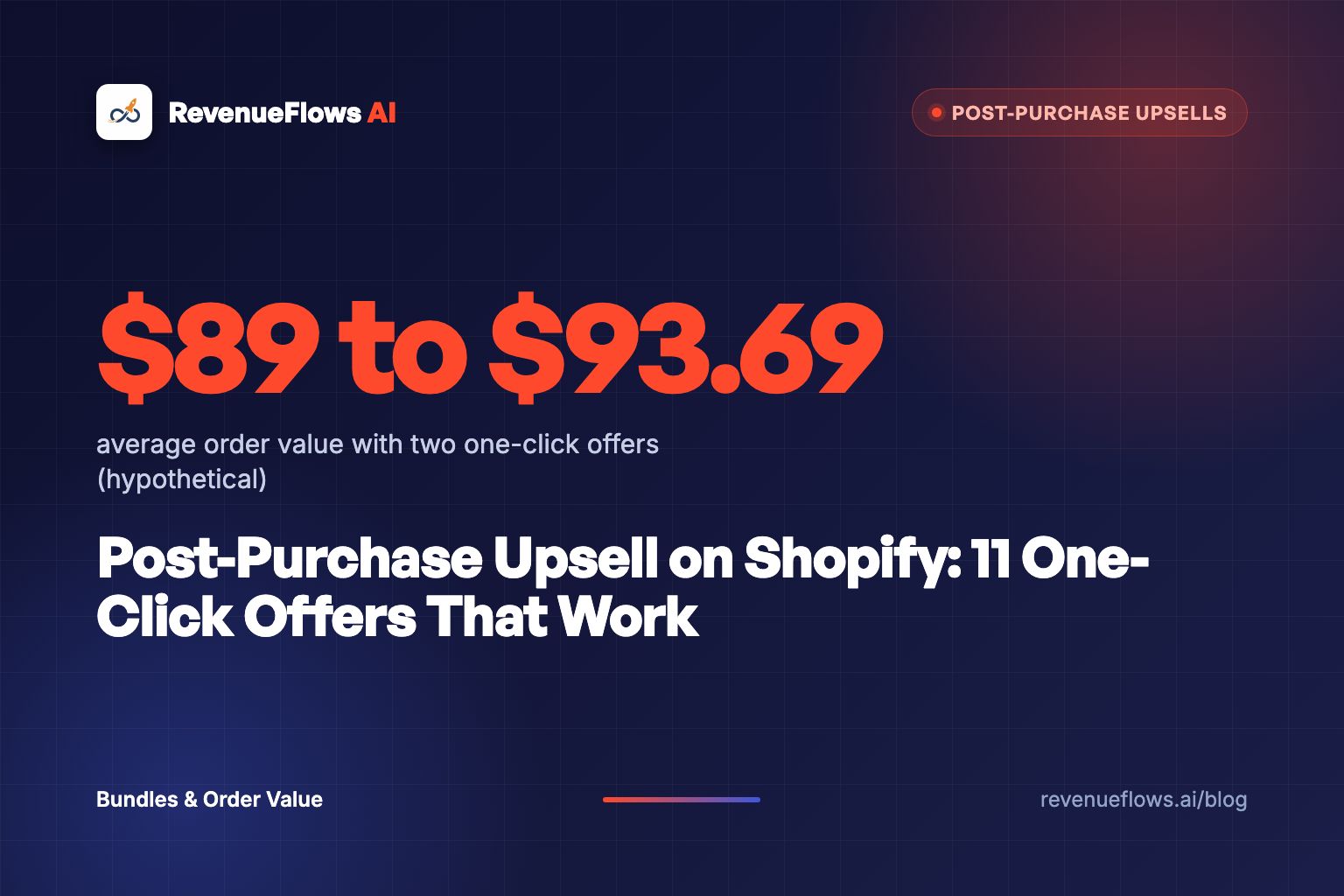
Add offer five behind it, a $29 seasoning set, at 7%. 14 buyers, $406, another $2.03 per order. Average order value lands at $93.69. Revenue per visitor is now 2.0% x $93.69, which is $1.87. On the same 10,000 visitors, that's $18,738.
200 orders a month. Offer one: $19 accessory at a 14% take rate. Offer two: $29 companion at 7%.
That's $938 more a month, for an hour of setup, with zero risk to the first sale. But look at the order: up $4.69. Five percent.
Now look at what the page does. A bedding brand we rebuilt went from conversion rate 1.0% and average order value $125 (revenue per visitor $1.25) to conversion rate 3.5% and average order value $231 (revenue per visitor $8.10). On 10,000 visitors that's $12,500 before and $81,000 after. See the full case study numbers. Real client numbers, not typical results, and not a promise of what your store will do.
The order moved $106 there before any upsell existed, because the page sold a bigger first purchase. The post-purchase offer stacks on top of that. I've switched off more post-purchase offers than I've switched on, and every time it was a founder treating the tip jar like the register. The per-product version of that $106 move is the copper bamboo sheets case study.
A post-purchase offer adds a few dollars to the order the page already closed. Fix the page and the same offer adds a few dollars to a bigger order.
Why do post-purchase offers fail?
Four ways. I've seen all of them this year.
Wrong product. The offer is whatever had the best margin, not whatever belongs with the purchase. Skillet bought, $60 knife set offered. Take rate 2%. Founder concludes "post-purchase doesn't work for us."
Priced above the order. A $45 order followed by a $79 offer. A new purchase decision at the worst possible moment.
Three screens. Offer, downsell, second downsell. Shopify's UX guidance says the decline button "should still be easy to see" and warns against making the offer "feel compulsory." A funnel there is a maze.
The same product, unlabeled. The double-charge complaint above. Buyer sees their product again with a "Buy now" button, assumes it's a confirmation, taps it, owns two, calls their bank.
The fix for all four is the sentence from the top. Consumable, accessory, or second unit. Below the order value. Once. One click.
What to do next
Export last month's orders with line items. Find the product that most often shows up in a customer's second order. That's your post-purchase offer, and it's probably a refill or an accessory. Price it below your average order, write the button as "Add," switch it on in one app, and leave it alone for 30 days.
Then do the thing that moves the order by $100 instead of $5. The average order value playbook ranks the levers, the upsell stack shows where post-purchase fits against cart offers, and the upsell copy post covers the words on the offer.
Book Your Profit Audit
A post-purchase offer adds a few dollars to the order your page already closed. We'll show you what the page is leaving on the table before the upsell ever fires, then rebuild a high-converting product sales page in less than 15 minutes.
Or go here to check it out → revenueflows.ai
P.S. The tip jar only fills when the register is ringing. Fix the page, then add the offer.
Frequently asked questions
Does a post-purchase upsell hurt conversion rate on Shopify?
No. Shopify shows the post-purchase page after the payment step and before the order status page, so the first sale is already captured when the offer appears. A decline costs you nothing. The only thing a bad offer can hurt is trust, which is why the product you offer matters more than the discount.
Why isn't my post-purchase upsell showing?
Usually the payment method. Shopify won't show post-purchase offers on orders paid with a wallet like Apple Pay, Google Pay or Amazon Pay, an installment service like Klarna, Affirm or Afterpay, a gift card, cash on delivery, or a third-party gateway that keeps the card's security code. Orders under $0.50, local delivery orders, multi-currency orders and orders from channels other than the online store are also skipped.
What is a good acceptance rate for a post-purchase offer?
Vendors publish wide ranges: Zipify lists 8% to 25% as its typical take rate, AfterSell claims 12% for its top brands, and a CartHook case study on Shopify's blog reports 30% for one supplement brand. My rule is simpler. Under 5% means the product is wrong, and no amount of copy or discount fixes a wrong product.
Do post-purchase upsells work on the Basic Shopify plan?
Yes. Shopify's help center lists apps built with post-purchase extensions as available on Basic Shopify or higher as well as Shopify Plus. Offers inside the checkout itself are still a Plus feature, but the post-purchase page is open to every plan through App Store apps.
How many post-purchase offers should I show?
One. Shopify caps it at three accepted offers per checkout and its own design guidance says a maximum of three consecutive offers, but every extra screen between payment and the order confirmation adds doubt. One relevant product, one price, one button, then the thank you page.