Best Post-Purchase Upsell Apps for Shopify Compared (2026)
Every upsell app grades its own homework. Here are 7 post-purchase upsell apps checked on the Shopify App Store today, compared on offer logic, AI picks, A/B testing and how honestly they report the revenue they add.

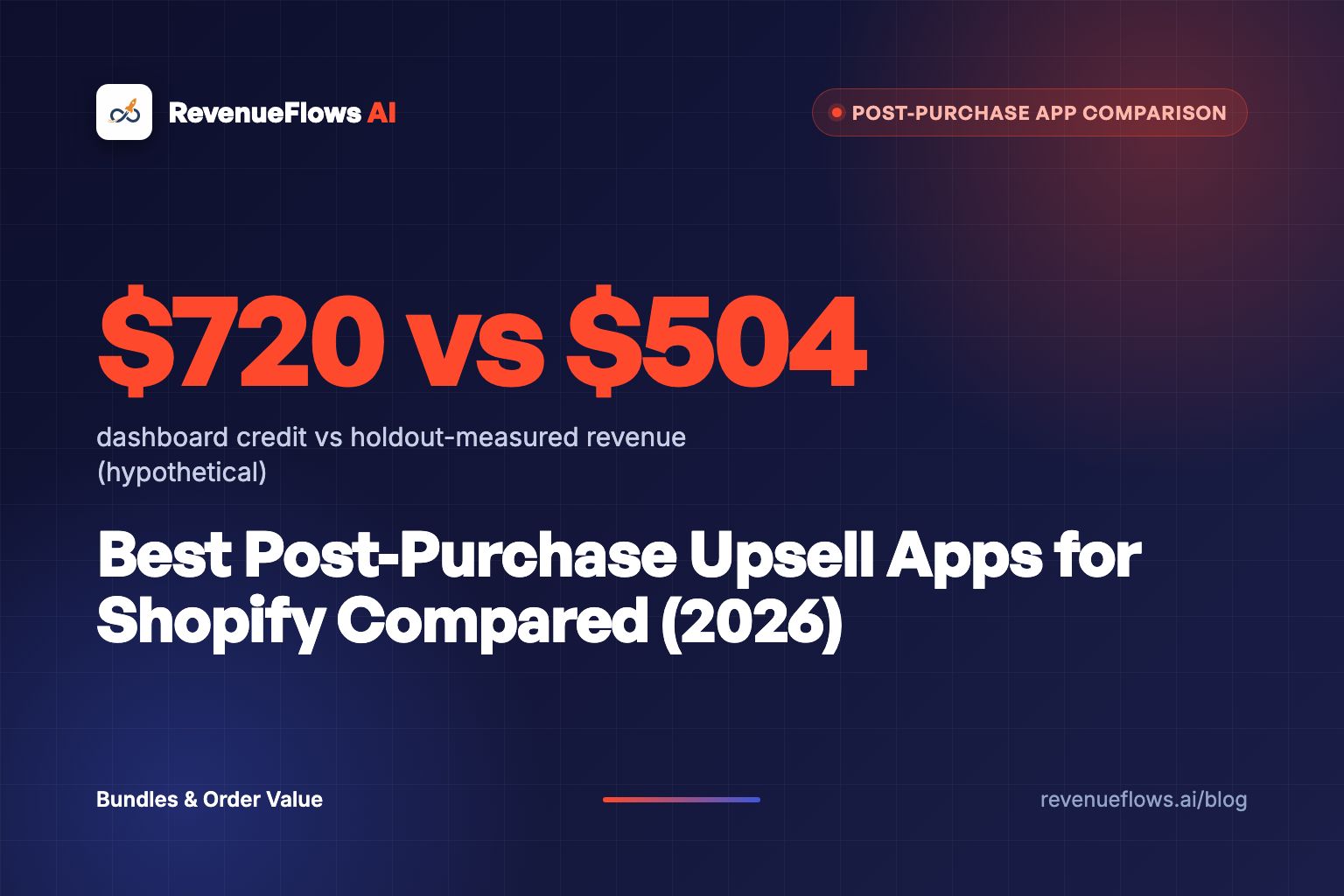
Every upsell app grades its own homework.
That's the thing nobody says in the "top 10" lists. The app picks the offer, shows the offer, counts the yes, and then reports the money to you on its own dashboard. Of course the number looks good. It wrote the test.
So here's the short answer. The best post purchase upsell app Shopify stores can install today is ReConvert if you want the most proven option at the lowest price, AfterSell if you want the deepest testing on a flat fee, and Zipify OCU if you want AI choosing offers and a bill tied to upsell revenue. Rebuy, Candy Rack, Selleasy and Wiser fit when post-purchase is one job inside a bigger cart setup. Every price below comes from each app's own listing, opened today, October 3, 2026.
If you still need to decide what to offer on that page, start with our breakdown of post-purchase upsells on Shopify and the 11 offers buyers accept. This post is about the tool. And about the one number none of these tools show you by default.
Which post-purchase upsell apps are worth comparing?
Seven. I opened every listing, plus Rebuy's and Zipify's own pricing pages. One rule from Shopify shapes the whole choice: its help center says you can use "only one checkout app to add post-purchase features at a time," and those apps work on the Basic Shopify plan or higher. So you're picking one app, and you don't need Plus to run it.
| App | Price on the listing | Rating (reviews) | Offer logic | AI recommendations | A/B testing | What the reporting shows |
|---|---|---|---|---|---|---|
| AfterSell | Post-Purchase $34.99/mo, Complete $79.99/mo, 30-day trial | 4.9 (1,084) | One-click upsells, downsell funnels, subscription upgrades | Smart Funnel AI, recommendation engine | A/B and multivariate | Conversion and click-through per offer |
| ReConvert | Free to 50 orders, Growth $9.99/mo to 2,000 orders, Scale $199/mo | 4.8 (3,096) | Funnels plus custom rules and segments | AI product suggestions | A/B testing on the funnel | Funnel performance, segment analytics |
| Zipify OCU | $9.95/mo up to $200 upsell revenue, scales with upsell revenue, 30-day trial | 4.6 (566) | Targeting by product, cart value and customer tags | Dynamic AI Upsells | Built-in, A/B/C/D split tests | Upsell revenue and conversion |
| Rebuy | From $25/mo per package, scales with orders, 14-day trial | 4.7 (853) | Post-purchase offers in the Checkout & Post-Purchase package | AI recommendations and search | In the Flows & A/B Testing package | "Rebuy Generated Revenue" |
| Candy Rack | Lite $29.99/mo (0 to 50 orders) to Growth $59.99/mo (201 to 500) | 4.9 (262) | Custom rules across page, cart, checkout, post-purchase | Candy Rack AI or Google Gemini picks | Via Intelligems | Funnel and recommendation performance |
| Selleasy | Free to 50 orders, $9 to $29/mo, 30-day trial | 4.9 (2,736) | 18 upsell strategies, one-click post-purchase | 50 free AI recommendations (ChatGPT) | Not listed | Click-through and conversion |
| Wiser | Free to 50 orders, $9 to $49/mo up to 500 orders | 4.9 (560) | Post-purchase and checkout offers, bundle rules | AI recommendations and bundles | A/B testing | Funnel and recommendation performance |
Prices move, so recheck the listing the day you install.
You can only run one post-purchase app at a time. That makes this a hiring decision, not a shopping trip. Hire the one whose numbers you can check.
How do these apps decide which offer to show?
Two ways. Rules you write, or a model that picks for you.
Rules look like this: if the order contains the skillet, offer the scrubber. If the cart is over $100, offer the protection plan. ReConvert, Zipify OCU, Candy Rack and Wiser all advertise rules on their listings, and Zipify's is the most specific: targeting "by product, cart value & customer tags."
The model approach is the newer pitch. AfterSell calls it Smart Funnel AI. Zipify says OCU is "powered by Zipify AI" and runs split tests for you. Candy Rack lets you hand the pick to its own AI or to Google Gemini. Selleasy gives every plan 50 AI recommendations powered by ChatGPT.
My take. AI offer picking is real today, and useful on a big catalog with lots of orders, because the model has data to learn from. On a store doing 250 orders a month with 14 products, I'd write the rule by hand. You already know the refill follows the starter kit. A rule you wrote is a rule you can read when the test comes back.
What does A/B testing look like inside an upsell app?
Most of these apps test offer A against offer B. Scrubber versus seasoning set. 15% off versus 20% off. That's useful. AfterSell goes further with multivariate tests, and Zipify runs up to four variants at once.
But notice what's missing from both arms of that test. A group that saw no offer at all.
A test between two offers tells you which offer wins. It can't tell you whether either one added money you wouldn't have made anyway. That takes a holdout. For proper experiments on the page itself, see our comparison of Shopify A/B testing apps.
Why does the app's revenue number run high?
Read how Rebuy defines its own metric on its pricing page: Rebuy Generated Revenue is "all revenue driven by Rebuy within a given period." That's honest. It's also the whole problem. If a buyer accepted the offer, the app counts the sale. Even if that buyer was going to reorder the same refill in three weeks.
Wiser, which sells one of the apps on this list, says it plainly in its upsell playbook: "Hold out 10 to 20 percent of traffic. Same period, no offers. Every other method estimates. This one measures." A vendor telling you not to trust vendor dashboards. I'll take it.
Here's the math. Run it on a store like this, a hypothetical coffee brand. 10,000 visitors a month. Conversion rate 2.5%, so 250 orders. Average order value $72. That means revenue per visitor is 2.5% x $72, which is $1.80. On 10,000 visitors, that's $18,000.
Switch on a post-purchase offer: a second $24 bag, one click. 12% of buyers take it. That's 30 bags, and the dashboard says $720 a month.
Now run a holdout for 30 days. The buyers who never saw the offer reorder at a rate that says 9 of those 30 would have bought the second bag anyway, on their next order. So the offer really added 21 bags. $504.
250 orders a month, $24 offer, 12% take rate. Holdout figure assumes 9 of 30 takers would have reordered anyway.
Still worth it. $504 a month against a $9.99 or $34.99 fee is a great trade. But the dashboard overstated it by 43%. Stack a cart upsell, a checkout block and a post-purchase offer, and each app claims its own slice of the same buyer. Add up three dashboards and you're rich on paper.
With the offer, average order value goes from $72 to $74.88 on the dashboard's math. Revenue per visitor is 2.5% x $74.88, which is $1.87. On the same 10,000 visitors, that's $18,720. On the holdout's math it's $18,504, or $1.85 per visitor.
The app's dashboard is the scoreboard it keeps for itself. The holdout is your bank statement. Pay the app on the second one.
So which one should you install?
It depends on the job, and on the size of your store.
Under 500 orders a month, post-purchase only. ReConvert. Free to start, $9.99 up to 2,000 orders, 3,096 reviews. Selleasy and Wiser are both free to 50 orders if you also want product page bundles in the same app.
Want the deepest testing on a flat fee. AfterSell at $34.99 for post-purchase. Multivariate testing, a 4.9 rating, and it notes that checkout upsells need Plus while post-purchase works on every plan.
Want AI choosing offers and a bill tied to what upsells earn. Zipify OCU. It's billed on "the upsell revenue OCU generates," which means your bill grows with that same dashboard number, so run the holdout before you scale it.
Already run Rebuy for the cart. Use its Checkout & Post-Purchase package rather than adding a second vendor, then compare it against a specialist with the swap plan in our Rebuy alternatives post.
Want one app across page, cart and post-purchase with an AI pick. Candy Rack, with the trade-off that A/B testing runs through Intelligems.
One more thing. AfterSell and Rebuy both now sell ad space on your thank you page (Rokt Thanks and Rebuy Monetize). Cents per order, and someone else's offer in front of your happiest customer.
Where does a post-purchase app sit next to the page?
Honest moment. I've watched founders spend a week choosing between two upsell apps whose real difference was $3 an order, while the product page above them closed 2.5 of every 100 visitors, like the coffee brand above.
A post-purchase offer works on buyers you already won. It can't touch the ones who left. Here's what moving the page did on one product. A bedding brand's copper bamboo sheets went from conversion rate 1.0% and average order value $125 (revenue per visitor $1.25) to conversion rate 4.3% and average order value $221 (revenue per visitor $9.50). On 10,000 visitors, that's $12,500 before and $95,000 after. See the full case study numbers. Real client numbers, not typical results, and not a promise of what your store will do.
The order grew $96 there, and no upsell app did it. The page sold a bigger first order. That's where we point AI at RevenueFlows AI: the headline, the objection answers, the offer and the order of the argument on the product page itself. The post-purchase app stacks a few dollars on top. Our order value stacking formula shows where each layer fits, and the full ranked playbook is in how to increase average order value on Shopify. If cart offers are also in the mix, read whether cart upsells hurt conversion rate first.
FAQ
What is the best post-purchase upsell app for Shopify? For most stores, ReConvert (price and reviews) or AfterSell (testing).
Can I run two post-purchase upsell apps at the same time? No. Shopify allows one checkout app to add post-purchase features at a time.
Do post-purchase upsell apps need Shopify Plus? No. They work on Basic Shopify or higher. Offers inside the checkout itself need Plus.
How do I know if my upsell app is actually making money? Hold out 10% to 20% of buyers from seeing any offer and compare revenue per order against the group that did.
Are AI upsell recommendations better than manual rules? On a big catalog with lots of orders, often yes. On a small store, a rule you wrote is easier to trust and easier to test.
What to do next
Open your upsell app today and find the revenue it claims for the last 30 days. Then set up a 10% holdout for the next 30. When the month ends, you'll know two numbers: what the app says it made, and what it actually made. Keep the app on the second one.
Book Your Profit Audit
A post-purchase app adds a few dollars to orders your page already closed, and its dashboard counts some of them twice. On a free profit audit we'll show you what the page itself is losing before any upsell fires, then show you how to rebuild a high-converting product sales page in less than 15 minutes.
Or go here to check it out → revenueflows.ai
P.S. The app keeps its own scoreboard. You keep the bank statement. Grade the app on yours.
Frequently asked questions
What is the best post-purchase upsell app for Shopify?
For most stores it's ReConvert or AfterSell. ReConvert has the most reviews and a $9.99 Growth plan up to 2,000 orders. AfterSell has a 4.9 rating, A/B and multivariate testing, and a $34.99 post-purchase plan. If you want AI to pick offers and price tied to upsell revenue, look at Zipify OCU.
Can I run two post-purchase upsell apps at the same time?
No. Shopify's help center says you can use only one checkout app to add post-purchase features at a time. Pick one app for that page and test offers inside it, rather than stacking apps.
Do post-purchase upsell apps need Shopify Plus?
No. Shopify lists apps built with post-purchase extensions as available on the Basic Shopify plan or higher. Upsells inside the checkout itself still need Shopify Plus, which AfterSell, Zipify OCU and Rebuy all note on their pages.
How do I know if my upsell app is actually making money?
Hold out 10% to 20% of buyers who never see the offer, over the same window, and compare revenue per order between the two groups. The app's dashboard counts every accepted offer, including buyers who would have bought that product later anyway. The holdout tells you what the app really added.
Are AI upsell recommendations better than manual rules?
Only once you have order volume. AI picks need purchase data to learn from. Under a few hundred orders a month, a hand-picked rule (refill after the starter kit, scrubber after the skillet) usually beats the algorithm, and it's easier to read in a test.