Subscription vs One-Time Purchase: Which Earns More Profit
A subscriber can earn more than twice the profit of a one-time buyer, or less. On a $48 product the whole answer sits in the first two renewals.

Everybody quotes the same number. 217%.
Salesforce says subscribers are an average of 217% more profitable than one-time customers. No study link. No method. No product, no margin, no churn rate. And it gets repeated like a law of physics by people selling subscription apps.
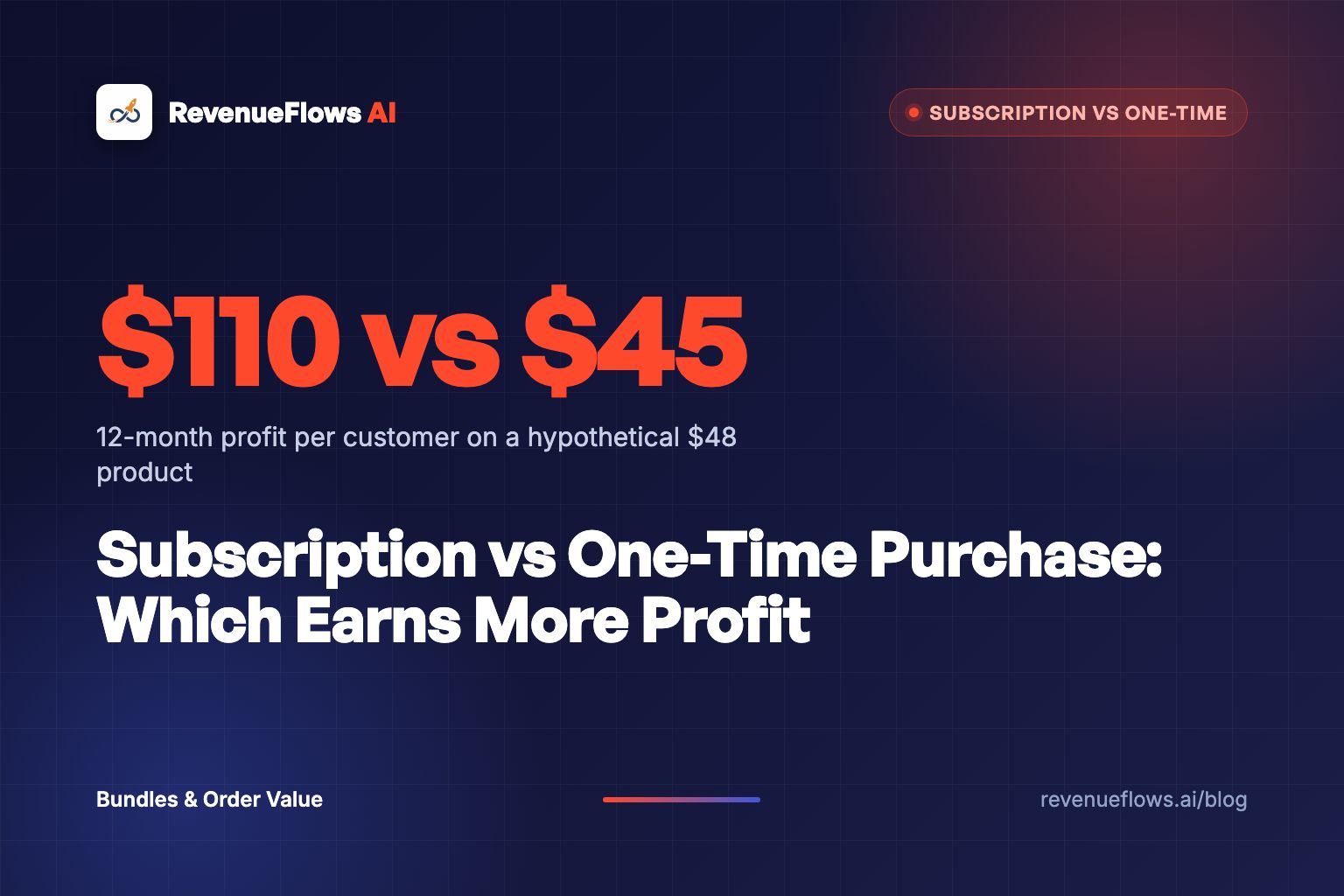
Here's the actual answer to subscription vs one time purchase. A subscription earns more profit over 12 months when the product runs out on a schedule and most subscribers survive their first two renewals. It earns less when the discount attracts people who cancel after one box. On the $48 product below, a subscriber makes about $110 in profit and a one-time buyer makes about $45.
Same product. And that gap is all churn.
What does a subscription model vs one time actually earn per customer?
Run the math on a store like this (a hypothetical): a $48 tub of collagen powder, a 30-day supply.
Product cost is $11. Shipping and packing is $7.50. Payment fees are about 3%, or $1.44. So a full-price order leaves $28.06.
Now knock 15% off for subscribers. They pay $40.80. Fees drop to $1.22, so that order leaves $21.08.
Here's the thing. You gave up 15% of the price and lost 25% of the profit ($6.98 out of $28.06). The discount is calculated on price, but it comes straight out of margin. If you haven't worked out your own number per order, contribution margin is where to start.
A 15% discount never costs 15%. Check your margin and you'll find it costs a lot more.
Now the 12 months. Say 100 one-time buyers place 160 orders in a year, so 1.6 orders each (made up, pull yours from Shopify). That's 1.6 x $28.06 = $44.90 per customer.
For subscribers I used Recharge's renewal data: 24.1% gone at the first renewal, 27.1% at the second, then 16.6%, 12.4% and 10.1%, easing to 5.4% by cycle 12. Recharge doesn't publish cycles 7 through 11, so I eased those from 9% down to 6%. That curve gives you 5.21 orders per subscriber. At $21.08 each, that's $109.78.
$28.06 profit per one-time order at 1.6 orders a year. $21.08 profit per subscriber order, 12 monthly deliveries. Flat churn lines are illustrations. The renewal curve uses Recharge's published cycle rates with cycles 7 to 11 estimated.
Look at the top and bottom of that chart. Same subscriber. Same discount. $42 or $175.
Why does the churn benchmark flatter your subscription?
Because the monthly average hides the people who just walked in.
Recharge's consumer panel shows 7.1% monthly churn, 4.1% voluntary and 3% from failed payments, as summarized by Eightx. That number includes the loyal crowd in year three, who almost never leave. Your new customers aren't that crowd yet.
Plug 7.1% into a spreadsheet and you'll forecast about $174 a subscriber. The renewal curve says $110. That's a $64 hole in your plan, per subscriber, before you've spent a dollar on ads.
And the $110 is generous. Those Recharge rates are voluntary cancels only. Failed cards take their own cut on top.
Do the math on the first two renewals. 75.9% survive the first and 72.9% of those survive the second, so 55.3% are still active. 44.7% are gone by the third order.
The 7% is an average of everybody. The 44.7% is what your new subscribers do.
Flat churn gives you a clean break-even, though. With these inputs a subscriber needs 2.13 orders to match the one-time buyer's $44.90. That happens at about 47% monthly churn. Above that, you paid a discount to earn less.
Do subscriptions convert worse up front?
Yes, when subscription is the only option. It's a bigger commitment, and buyers treat it that way.
ReferralCandy puts one-time conversion at 2% to 5% and cold-traffic subscription conversion at 0.5% to 2%. They don't give a source, so treat that as a rough shape. But the shape matches what you'd expect, and the subscribe and save conversion rate breakdown goes deeper on it.
So let's price it. Same collagen store, 10,000 visitors at $0.75 a click, $7,500 in ads, and a 2.5% conversion rate.
One-time only: 2.5% x $48 = $1.20 revenue per visitor. On 10,000 visitors that's $12,000.
Offer both, with 30% of buyers choosing the subscription: average order value falls to $45.84. Revenue per visitor is 2.5% x $45.84 = $1.146. On 10,000 visitors that's $11,460. You're down $540 on day one and it looks like a mistake.
Subscription only, assuming conversion halves to 1.25% (my assumption): 125 customers paying $40.80.
Now watch what happens over a year.
| Page offer | Customers | Month-one cash after ads | 12-month profit after ads |
|---|---|---|---|
| One-time only | 250 | -$485 | $3,725 |
| Both, 30% subscribe | 250 | -$1,009 | $8,591 |
| Subscription only | 125 | -$4,865 | $6,222 |
Offering both wins by $4,866 over one-time only, as long as conversion holds at 2.5%. Test that on your store.
Subscription only is the trap. It beats one-time on the 12-month line, but your customer cost doubled to $60 and each order earns $21.08. You don't get that $60 back until the fifth delivery. If you're funding inventory from this month's sales, a profitable spreadsheet can still put you in a cash hole. And if churn runs above about 22% a month on that page, the 12-month win is gone too.
Recurring revenue pays you later. Your ad bill and your supplier want paying now.
That's why Shopify's own 2025 merchant survey bothers me. Fewer than half of the 500 owners it asked track profit margin. You can't make this call from a revenue dashboard. Recurring revenue ecommerce looks gorgeous on a revenue chart and the margin gets hidden in the bars.
When should you skip the subscription entirely?
When nobody's going to run out. I'm blunt about this one because it's where the toggle does the most damage.
| Question | Subscription fits | One-time fits |
|---|---|---|
| Does it run out on its own? | Collagen, coffee, dog food | A weighted blanket, a copper sheet set |
| Who already buys it again? | Plenty at full price, on a rhythm | Almost nobody within 12 months |
| Where's the profit? | Orders 3 through 12 | The first order |
| What's the biggest lever? | Survival past renewal 2 | A bigger first order |
| What hurts your cash flow? | Waiting months for payback | Paying for every new buyer from scratch |
Watch for the buyer who was going to rebuy anyway, too. Someone who'd order 5 times a year at full price earns you $140.30. Put them on subscribe and save and those same 5 orders earn $105.40. You just paid $34.90 for a recurring label on a customer you already had. A Klaviyo due for reorder segment can remind that buyer at full price instead.
And one-time doesn't mean small. One of our Amazon-to-Shopify products went from a $29.95 Amazon listing to a $49.95 Shopify price and a $177.75 average order value. Net profit per sale went from $7.73 to $78.87, after paying for ads and inventory. Real client numbers, not typical results, and not a promise of what your store will do.
That breakdown doesn't lean on a single renewal. One order, $78.87. If your product has no refill cycle, the average order value playbook is your subscription.
What moves subscription profit the most?
I'd want this ranked before anyone touches a discount, so I ran three levers on the same hypothetical.
Cut the discount from 15% to 10%. Subscriber price becomes $43.20 and profit per order becomes $23.40. If the same people stay, that's $121.86 a subscriber, about $12 more. Test it, since a smaller discount may also lower your subscribe rate.
Hold more people through the first two renewals. Take 24.1% and 27.1% down to 18% and 20%, and you get 5.91 orders instead of 5.21. That's $124.56 a subscriber, about $15 more, and no margin given away. The subscribe and save lifetime value post walks through the month-two fixes. Recurly's 2026 report adds two useful numbers across all subscription types: 52% of consumers canceled something over lack of use, and about 3 in 4 who pause eventually return. On a consumable, I read lack of use as a pile of unopened tubs. So make pause the easy button.
Lift the page. Take conversion from 2.5% to 3% on the offer-both store. That's 300 customers on the same $7,500 instead of 250, so your customer acquisition cost falls from $30 to $25, and 12-month profit after ads goes from $8,591 to $11,809. That's $3,218 more, and it helps the one-time buyers and the subscribers at once. Every renewal starts from an order the page had to win first.
Churn decides what a subscriber is worth. The page decides how many you get.
How is AI changing the subscription vs one time decision?
It's made the data pull fast and the rescue work automatic. It hasn't made the decision for you.
The boring win is the best one. Export your orders, paste them into any AI assistant, and ask for three things per product: orders per customer in the first 12 months, the median days between first and second order, and how many customers are still active at each renewal by start month. That used to be an afternoon in a spreadsheet. Now it's a few minutes, and you can check the work with the cohort method here.
Then there's the app layer. Stay AI lists AI-optimized cancel flows, gifts for predicted churn risk customers and proactive smart dunning for failed payments. Recharge lists predictive analytics and churn prevention tools. I didn't find independent testing of how accurate any of this is. Those are vendor claims. So run them as a test on one cohort before you credit them with anything.
Failed payments are the easiest place to start, because nobody on that list decided to leave. Eightx cites Recurly's recovery rate at 49% as a baseline and 71% for merchants who tune it.
What to do next
Pull one number this week: orders per customer over 12 months, for buyers who started a year ago.
Multiply it by your full-price profit per order. That's the number a subscriber has to beat after the discount. Then divide it by your subscriber profit per order and you'll know how many renewals you need. On the collagen store, that's 2.13 orders. If most of your subscribers aren't reaching that, fix retention before you promote the subscription any harder.
Book Your Profit Audit
Whether you pick subscription, one-time or both, every one of those numbers starts with the first order your product page wins. Book a free profit audit and we'll show you where your page is leaking and how to rebuild a high-converting product sales page in less than 15 minutes.
Or go here to check it out → revenueflows.ai
P.S. Recurring revenue feels safe and one-time feels like starting over every month. Neither one pays you until the math says so, and on most stores the math gets settled by the second renewal.
Frequently asked questions
Is a subscription more profitable than a one-time purchase?
Usually, if the product runs out on a schedule and subscribers survive the first two renewals. On a hypothetical $48 product, a subscriber earned about $110 in profit over 12 months against $45 for a one-time buyer. Past about 47% monthly churn, the one-time buyer wins.
Do subscriptions convert worse than one-time purchases?
A subscription-only offer usually converts worse, because the buyer is committing to more than one order. Offering both on the same page protects most of your conversion rate, but it lowers your average order value by whatever share of buyers takes the discount.
How much does a subscription discount cost in profit?
More than the sticker suggests. On a $48 product with $28.06 in profit per order, a 15% discount takes $6.98 of that profit, which is about 25%. The discount is calculated on price, but it comes out of margin.
What is a good churn rate for ecommerce subscriptions?
Published monthly benchmarks mostly sit between 4% and 7% for replenishment products, but those blend old and new subscribers. New cohorts lose far more early. Recharge's renewal data shows 24.1% at the first renewal and 27.1% at the second, so measure your own cohorts.
Should I offer both subscription and one-time purchase on Shopify?
For a consumable product, yes. In the math below, offering both beat one-time only and subscription only on 12-month profit, and it hurt month-one cash far less than going subscription only. For a product that doesn't run out, skip the subscription and raise the order value instead.