AfterSell Alternatives: 6 Upsell Apps Compared on Testing
Template count stops mattering the day your first offer goes live. Here are 6 AfterSell alternatives checked on the Shopify App Store today, compared on how they test offers, what they report and how they bill you.

I'll admit something. The first time I saw a post-purchase dashboard, I believed every dollar on it.
Most founders do. So when you start shopping for AfterSell alternatives, you compare templates, layouts and drag-and-drop blocks, because that's what the listings sell. Wrong filter. Once your offers are live, the apps differ most on two things: how they test an offer and how honestly they report what it made.
Here's the short answer. ReConvert is the closest swap for most stores (A/B testing on every plan, $9.99 a month up to 2,000 orders). Zipify OCU fits if you want AI choosing offers and four-way split tests, billed on upsell revenue. CartHook is a lean post-purchase specialist with A/B tests on every tier. Rebuy, Candy Rack and Selleasy make sense when post-purchase is one slot in a wider upsell setup. I opened every listing below today, October 4, 2026.
If you want the full category ranked, AfterSell included, read our comparison of the best post-purchase upsell apps for Shopify. This post is for the founder already running AfterSell and wondering what else is out there.
What does AfterSell actually do well?
Start with an honest AfterSell review, because it's a strong app. The listing shows a 4.9 rating from 1,086 reviews. Plans run Post-Purchase $34.99, Pre-Purchase $59.99 and Complete $79.99 a month, each with a 30-day trial. It lists A/B testing and multivariate testing, plus Smart Funnels for AI-picked offers. On its own comparison page, AfterSell claims "up to 6,000+ offer variations" without dev work.
Two things changed underneath it. Rokt announced it was buying AfterSell on January 10, 2024. And the listing now pitches Rokt Thanks: "Earn up to $0.80 per order" by showing offers from other brands on your thank you page. Some founders love the extra cents. Others don't want a stranger's ad in front of their happiest customer.
The low-star reviews on that same listing cluster around billing surprises and funnels that sometimes don't fire. That's the "why are you here" for most readers of this post.
Which AfterSell alternatives are worth a look?
Six. One rule frames the whole choice. Shopify's help center says "You can use only one checkout app to add post-purchase features at a time," and those apps run on Basic Shopify or higher. So this is a swap, never a stack.
| App | Rating (reviews) | Price on the listing | How it tests offers | What the reporting shows | Bill grows with |
|---|---|---|---|---|---|
| AfterSell (baseline) | 4.9 (1,086) | $34.99 to $79.99/mo, 30-day trial | A/B and multivariate, Smart Funnels AI | Conversion, click-through, funnel performance | Plan tier |
| ReConvert | 4.8 (3,095) | Free to 50 orders, Growth $9.99/mo to 2,000 orders, Scale $199/mo | A/B testing on all plans | Analytics and segmentation | Monthly orders |
| Zipify OCU | 4.6 (567) | $9.95/mo to $200 upsell revenue, $25 to $2,500, $149 above | A/B/C/D split tests, Dynamic AI Upsells | Conversion, click-through, funnel performance | Upsell revenue |
| CartHook | 4.1 (94) | Free install ($0.12/order over 20 plus 1% of upsells), Growth $49/mo, Scale $149/mo | A/B tests on every tier | Analytics, export on Scale only | Orders and upsells |
| Rebuy | 4.7 (854) | From $25/mo, scales with orders, 14-day trial | A/B in the Flows & A/B Testing package | Conversion, click-through, recommendation performance | Monthly orders |
| Candy Rack | 4.9 (263) | Lite $29.99 to Growth $59.99/mo by orders | A/B testing, with Intelligems | Conversion, click-through, funnel performance | Monthly orders |
| Selleasy | 4.9 (2,738) | Free to 50 orders, $9 to $29/mo | Not listed | Conversion, click-through, recommendation performance | Monthly orders |
Look at the last two columns. That's where these apps really split.
Templates are what you compare before the offer goes live. Testing and reporting are what you live with every month after.
Why do testing and reporting matter more than templates?
Because the template decides what the offer looks like once. The test and the report decide every offer you keep, kill or scale for the next year.
Every app above counts a sale when a buyer clicks yes. None of them lists a holdout group on its listing, meaning a slice of buyers who see no offer at all. Without that slice, the dashboard can't separate the bag of coffee you sold from the bag that buyer was going to reorder next month anyway.
Wiser, which sells an upsell app itself, says it flat out in its upsell playbook: "Hold out 10 to 20 percent of traffic. Same period, no offers. Every other method estimates. This one measures."
Here's the math. Run it on a store like this, a hypothetical skincare brand. 20,000 visitors a month, conversion rate 2%, so 400 orders. Average order value $58. Revenue per visitor is 2% x $58, which is $1.16. On 20,000 visitors, that's $23,200.
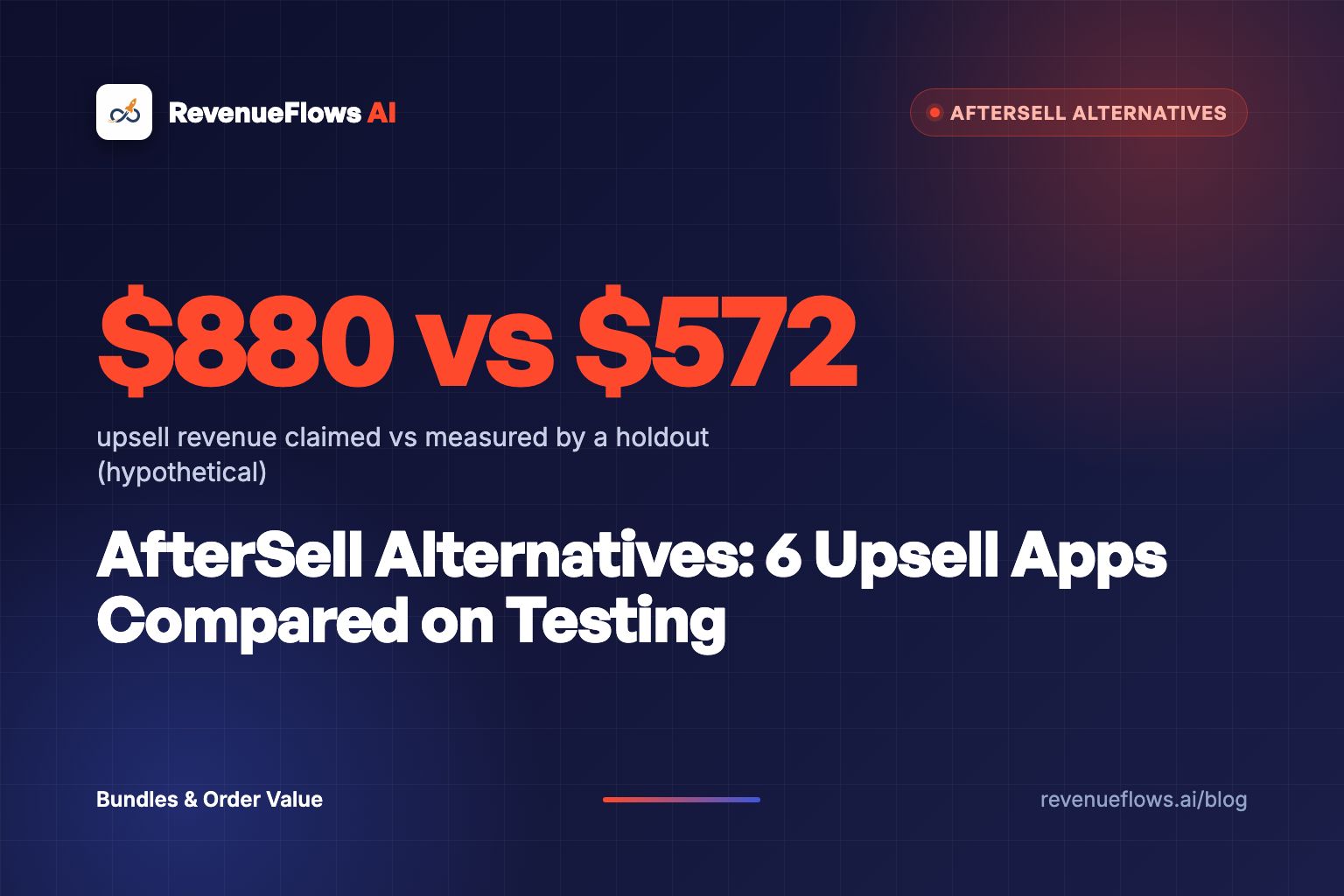
The post-purchase offer is a $22 serum. 10% of buyers say yes. That's 40 serums, and the dashboard reports $880.
Now the holdout. The buyers who never saw the offer show that 14 of those 40 would have bought the serum on their next order anyway. So the offer really added 26 serums. $572.
400 orders, $22 offer, 10% take rate. Holdout assumes 14 of 40 takers would have bought anyway.
Still a good trade. But the dashboard claims $308 more than the offer earned. And here's where billing joins the story. Zipify OCU says plainly on its own page: "You're billed on the upsell revenue OCU generates for your store." Honest pricing. It also means your bill tracks the dashboard number, never the holdout number.
On the holdout's math, average order value moves from $58 to $59.43, and revenue per visitor goes to 2% x $59.43, which is $1.19. On the same 20,000 visitors, that's $23,772.
What would each app cost this store?
Same hypothetical store, 400 orders a month, $880 of dashboard upsell revenue. Each price below is the plan that fits on the listing today.
Prices from each app's Shopify App Store listing, opened October 4, 2026. AfterSell shown at its Post-Purchase plan, Zipify at its $200 to $2,500 upsell revenue tier.
Notice CartHook. Its free plan charges $0.12 per order over 20 plus 1% of upsells. At 400 orders that's 380 x $0.12, or $45.60, plus $8.80, so $54.40. Growth at $49 is cheaper here. Run that check on your own order count before you pick a tier.
Is the cheapest app the right one, then? Not by itself. Selleasy is $9, but its listing doesn't mention A/B testing at all. For a store that wants to know which offer works, that's a big gap to accept for a smaller bill.
So which AfterSell alternative fits your store?
You want the closest swap for less money. ReConvert. A/B testing on every plan, segmentation, 3,095 reviews and $9.99 up to 2,000 orders. Anyone searching ReConvert alternatives will usually land back on AfterSell, which tells you how close these two are.
You want AI choosing offers and more variants per test. Zipify OCU. A/B/C/D split tests and Dynamic AI Upsells. Run the holdout before you scale it, because the bill rides on its own revenue number.
You only care about the post-purchase page. CartHook. A/B tests on every tier and an analytics export on Scale. Its 4.1 rating from 94 reviews is the thinnest record here, so test it on a slice of traffic first.
You already run Rebuy in the cart. Use its post-purchase features before adding a vendor. Our Rebuy alternatives breakdown covers the swap the other way.
You want product page and post-purchase offers in one app. Candy Rack, with A/B testing through Intelligems. For proper page-level experiments, see our Shopify A/B testing apps comparison.
Any of these post purchase app alternatives will run a one-click offer fine. The question is which one lets you prove it.
Where should the next dollar of order value come from?
Here's my contrarian take. Swapping AfterSell for ReConvert saves you $25 a month. Fine. But the post-purchase page only works on buyers the product page already won.
Look at what one product page did once it was rebuilt. A bedding brand's cooling bamboo sheets went from conversion rate 1.0% and average order value $125 (revenue per visitor $1.25) to conversion rate 4.3% and average order value $254 (revenue per visitor $10.92). On 10,000 visitors, that's $12,500 before and $109,200 after. See the full case study numbers. Real client numbers, not typical results, and not a promise of what your store will do.
That order grew $129, and no upsell app did it. The page sold a bigger first order. That's where RevenueFlows AI points the AI: headline, objection answers, offer and the order of the argument on the product page. The post-purchase app adds a few dollars on top. Our order value stacking formula shows where each layer fits, and the full playbook lives in how to increase average order value on Shopify. Still deciding what to offer after checkout? Start with the post-purchase offers buyers accept.
An upsell app counts yeses. Your bank account counts dollars you wouldn't have had. Judge the app on the second number.
FAQ
What is the best alternative to AfterSell? ReConvert for most stores. Zipify OCU if you want AI picks and four-way split tests.
Is AfterSell worth $34.99 a month? Yes, if a holdout shows the offers add at least three times the fee in revenue you wouldn't have made anyway.
Can I run AfterSell and ReConvert at the same time? Not on the post-purchase page. Shopify allows one checkout app to add post-purchase features at a time.
Which AfterSell alternative has the best A/B testing? Zipify OCU runs A/B/C/D tests. ReConvert and CartHook list A/B testing on every plan. None lists a holdout, so build your own.
Who owns AfterSell? Rokt, which announced the deal on January 10, 2024.
What to do next
Before you cancel anything, pull AfterSell's claimed upsell revenue for the last 30 days. Then turn on a 10% holdout for the next 30. If the measured lift clears three times your $34.99 fee, keep AfterSell and spend the switching time on your product page. If it doesn't, move to ReConvert or Zipify OCU and run the same holdout there.
Book Your Profit Audit
Switching upsell apps moves a few dollars per order on buyers you already won, and the dashboard still overstates it. On a free profit audit we'll show you what the product page is losing before any offer fires, then show you how to rebuild a high-converting product sales page in less than 15 minutes.
Or go here to check it out → revenueflows.ai
P.S. The best upsell app is the one whose numbers you can check. The best upsell is a product page that sells the bigger order the first time.
Frequently asked questions
What is the best alternative to AfterSell?
ReConvert is the closest swap for most stores: post-purchase funnels, A/B testing and a $9.99 Growth plan up to 2,000 monthly orders. If you want AI picking offers and a bill tied to upsell revenue, Zipify OCU is the other strong option.
Is AfterSell worth $34.99 a month?
It's worth it if a holdout test shows the offers add at least three times the fee in revenue you wouldn't have made anyway. AfterSell's own dashboard can't tell you that, because it counts every accepted offer, including buyers who would have reordered later.
Can I run AfterSell and ReConvert at the same time?
Not on the post-purchase page. Shopify's help center says you can use only one checkout app to add post-purchase features at a time, so a switch means turning one off before the other goes live.
Which AfterSell alternative has the best A/B testing?
Zipify OCU runs A/B/C/D split tests, and ReConvert and CartHook both list A/B testing on every plan. AfterSell still has the deepest testing on paper with multivariate tests, but none of these apps lists a no-offer holdout group, so you set that up yourself.
Who owns AfterSell?
Rokt. It announced the deal on January 10, 2024, and AfterSell now runs Rokt Thanks, which shows other brands' offers on your thank you page for up to $0.80 per order.