
Klaviyo Flows vs Campaigns: How to Split Your Revenue Goal
Flows earn nearly 18 times more per recipient. Campaigns still carry most of the money. Here's how to set one monthly email target and split it between the night shift and the megaphone.

Where should your email hours go this week? Into flows or into campaigns?
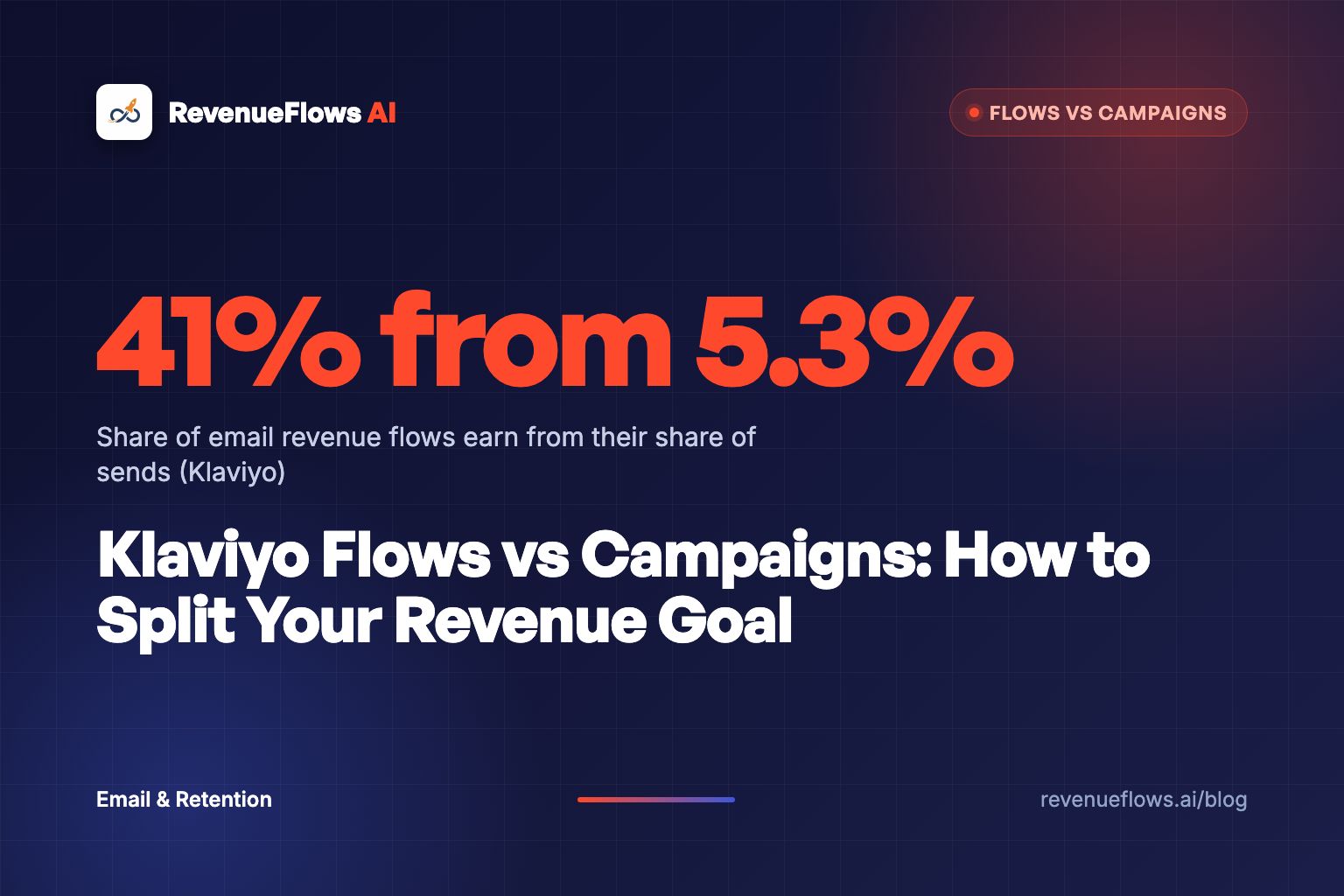
Here's the short answer on Klaviyo flows vs campaigns. Flows earn far more per send. Campaigns earn more in total. Klaviyo's own 2026 email benchmarks, built on more than 183,000 customers, say flows drive nearly 41% of email revenue from just 5.3% of sends, with revenue per recipient nearly 18 times higher than campaigns. Campaigns carry the other 94.7% of sends and the other 59% of the money.
So you don't pick one. You set one monthly email revenue target, hand roughly 40% of it to flows, hand the rest to campaigns, and work backward to how many campaigns you actually need to send.
That's the whole method. The rest of this post is the math and the traps.
What's the difference between a Klaviyo flow and a campaign?
Klaviyo's help center keeps it plain. A campaign is "a one-time send to a pre-established target group of contacts." A flow is triggered "when a profile meets the flow's trigger, filters, and re-entry criteria" (Klaviyo help center).
I think of them as two different employees.
Flows are the night shift. They never sleep, they only talk to people who just did something (signed up, left a checkout, bought), and they say the same right thing every time. Campaigns are the megaphone. You pick the moment, you pick the message, and you shout it at the whole list at once.
The night shift earns more per conversation. The megaphone reaches more people. Here's how the two compare on Klaviyo's published numbers:
| Flows | Campaigns | |
|---|---|---|
| What starts it | A buyer's action (signup, cart, order) | Your calendar |
| Share of email sends | 5.3% | 94.7% |
| Share of email revenue | Nearly 41% | About 59% |
| Revenue per recipient | Nearly 18x campaigns | Baseline |
| Average click rate | 5.58% | 1.69% |
| Revenue from new buyers | Nearly 48% | 16% |
| Work after launch | Check it monthly | Write and schedule every send |
All figures from Klaviyo's 2026 benchmarks page. The campaign revenue share is the remainder of the 41%.
Flows earn more per send. Campaigns earn more in total. A healthy Klaviyo account plans both from one number.
Flows vs campaigns: why not just build more flows?
Because flows have a ceiling you don't control.
A flow only fires when somebody does something. Your abandoned checkout flow can only email the people who abandoned a checkout this month. Your welcome flow can only greet the people who signed up this month. Double your flow count and you don't double those events. The traffic and the signups set the ceiling.
Campaigns have no such ceiling. They reach the whole list, including everyone who signed up last year and haven't bought since. That's why campaigns carry most of the volume and still earn most of the money, even at a fraction of the per-send return.
But here's the thing. Most founders I talk to get this backward in one of two ways.
The first group lives in campaigns. Three sends a week, a sale every other Friday, and a welcome flow they built in 2022 and never opened again. They're shouting at a list while the highest-earning conversations in the account sit broken.
The second group read one blog post about automation, built 14 flows, and stopped sending campaigns because "flows do the work." Their flow revenue looks great as a percentage. Their total email revenue quietly shrinks.
Both are guessing. Neither started from a number.
How do you split one revenue goal between flows and campaigns?
Start with a monthly email revenue target. Then split it, then work backward to sends.
Run the math on a store like this (a hypothetical): a Shopify skincare brand wants $20,000 a month from email.
Step 1, split the target. Use Klaviyo's 41% as the starting line. Flows own $8,200. Campaigns own $11,800.
Step 2, price one campaign send. The brand has 25,000 engaged subscribers. Its own campaign revenue per recipient (Klaviyo shows this in each campaign report) is $0.059. One send to the full list earns 25,000 x $0.059 = $1,475.
Step 3, count the sends. $11,800 divided by $1,475 is 8. That's two campaigns a week. Not five. Not one.
Step 4, price the flows. Say the store's flows deliver 8,000 messages a month at $1.025 each. That's $8,200, right on target. And $1.025 against $0.059 is about 17 times the campaign number, close to the 18x Klaviyo reports.
Here's the math as a split:
Source: Klaviyo 2026 email marketing benchmarks. Flows earn nearly 41% of email revenue from 5.3% of sends; campaigns earn the remainder from 94.7% of sends.
Now watch what this does to your week. If the brand misses its $20,000, the split tells you which employee to talk to. Campaigns short? Check the send count before you rewrite a single subject line. Flows short? Check the triggers and the abandoned cart flow first, because that's where Klaviyo's flow benchmarks show the highest revenue per recipient.
A target turns "where should my email time go" into a subtraction problem. You stop guessing and start checking one number.
What split should you expect as the account grows?
It moves. That's normal.
In the early months, the welcome flow tends to swallow most of the flow revenue, because new signups are the hottest people you'll ever email. In one Klaviyo community thread, a founder reported a welcome series doing $12,000 in 30 days while campaigns did $1,200. The Klaviyo partner who answered called a dominant welcome series "a healthy dynamic to have" and said a mature account might land around 60% flows and 40% campaigns, with roughly 50/50 also normal (Klaviyo community).
So treat the bands like this:
- Flows under about 30%: something's missing or broken. Build the core set from the Klaviyo flows guide before you add another campaign.
- Flows between 40% and 60%: healthy. Keep both engines running and grow the list.
- Flows above about 75%: your megaphone is quiet. You're probably under-sending to a list you already paid to build.
I'll be honest. I care less about the exact percentage than about whether it was chosen on purpose. A 50/50 account that set its split is in better shape than a 60/40 account that drifted there.
Where does AI fit into flows and campaigns now?
This part changed fast. Klaviyo's Composer now drafts campaigns, flows, messages and segments inside Klaviyo, and Klaviyo says it gives you a chance to review customer-facing work before it goes live. I broke down what it does well and where it slips in the Klaviyo Composer review.
So the build time for both engines is shrinking. A welcome flow draft that took an afternoon now takes a prompt and a review pass. Eight campaign drafts a month is no longer a full-time job.
Which means the hours you save have to go somewhere. And here's where most founders spend them wrong.
What do flows and campaigns have in common that nobody checks?
They both end on the same page.
Every flow click and every campaign click lands on a product page. The email's job is to get the click. The page's job is to close it. Klaviyo measures the email. Nobody measures the page the email points at.
And here's the math. Run it on a store like this (a hypothetical): flows and campaigns together send 4,000 clicks a month to one hero product page. That page converts at 1.0% with a $125 average order value, so revenue per visitor is $1.25. Those 4,000 clicks are worth $5,000.
Now put the same 4,000 clicks on a page converting at 3.5% with a $231 average order value. Revenue per visitor is $8.10 (3.5% x $231 = $8.09, rounded). The same clicks are worth $32,400.
Those 3.5% and $231 numbers come from a bedding brand we rebuilt. Real client numbers, not typical results, and not a promise of what your store will do.
Same list. Same flows. Same campaign count. The page was the multiplier.
You can tune flows and campaigns for a year and still be sending your best buyers to a page that leaks. Fix the page and both engines earn more on the same list.
If your email traffic is landing on a page written for cold ad traffic, start with how to write a product page for email traffic. Email buyers already trust you. The page should talk to them like it.
Frequently asked questions about Klaviyo flows vs campaigns
What is the difference between Klaviyo flows and campaigns? A campaign is a one-time send you schedule for a list you pick. A flow is an automated series that fires when a person does something, like signing up or abandoning a checkout. Campaigns run on your calendar. Flows run on the buyer's.
Do Klaviyo flows make more money than campaigns? Per send, yes. Klaviyo's 2026 benchmarks show flows earning nearly 18 times more revenue per recipient and nearly 41% of email revenue from 5.3% of sends. Campaigns still earn the other 59%.
What percentage of email revenue should come from flows? Start from Klaviyo's 41%. Mature accounts often land between 50% and 60%. Under about 30% usually means flows are missing or broken.
How many campaigns should I send per month? Divide the campaign share of your target by what one send earns. $11,800 divided by $1,475 per send is 8 sends a month.
Can Klaviyo AI build flows and campaigns for me? Composer drafts campaigns, flows, messages and segments, and you review before anything goes live. It won't fix the page those emails send people to.
What to do next
Open Klaviyo, pull last month's total email revenue, and write down two numbers: flow revenue and campaign revenue. Divide flows by the total. Then set next month's target, split it on purpose, and divide the campaign half by your revenue per send.
That's one number turned into a calendar. Fifteen minutes, tops.
Book Your Profit Audit
Your flows and campaigns can only send buyers to a product page that still has to close them. Book a profit audit and we'll show you where that page leaks and how to rebuild a high-converting product sales page in less than 15 minutes.
Or go here to check it out → revenueflows.ai
P.S. The night shift and the megaphone both deliver buyers to the same door. If the door doesn't open, it doesn't matter who knocked.
Frequently asked questions
What is the difference between Klaviyo flows and campaigns?
A campaign is a one-time send you build and schedule for a list you pick in advance, like a weekly newsletter or a flash sale. A flow is an automated series that fires when a person does something, like signing up, abandoning a checkout or placing an order. Campaigns run on your calendar. Flows run on the buyer's.
Do Klaviyo flows make more money than campaigns?
Per send, by a mile. Klaviyo's 2026 benchmarks say flows earn nearly 18 times more revenue per recipient than campaigns and drive nearly 41% of email revenue from only 5.3% of sends. Campaigns still carry most of the volume and the other 59% of the money, so a healthy account needs both.
What percentage of email revenue should come from flows?
Use Klaviyo's benchmark of about 41% as your starting line. In Klaviyo's own community, one partner described about 60% flows and 40% campaigns as a typical mature account and said roughly 50/50 is also normal. There's no single right number. Below about 30% usually means flows are missing or broken.
How many campaigns should I send per month?
Work it backward from your target. Take the campaign share of your monthly email goal and divide it by what one send earns (list size times your campaign revenue per recipient). If one send earns $1,475 and campaigns need to bring in $11,800, you need 8 sends a month.
Can Klaviyo AI build flows and campaigns for me?
Klaviyo's Composer can draft campaigns, flows, messages and segments inside Klaviyo, and it gives you a chance to review customer-facing work before it goes live. It drafts fast. It doesn't know which objection kills your sales or whether your product page can close the click, so you still decide both.