
Black Friday Discount Percentage: 15 vs 25 vs 40 Percent
Deeper Black Friday discounts lift conversion rate and quietly shrink profit per visitor. Here's how to model 15%, 25% and 40% off on your own store and find where the lines cross.

The deepest discount usually wins the revenue chart and loses the profit chart.
That's the whole problem in one line. And it's why picking a black friday discount percentage by copying the big retailers is the most expensive guess you'll make this November.
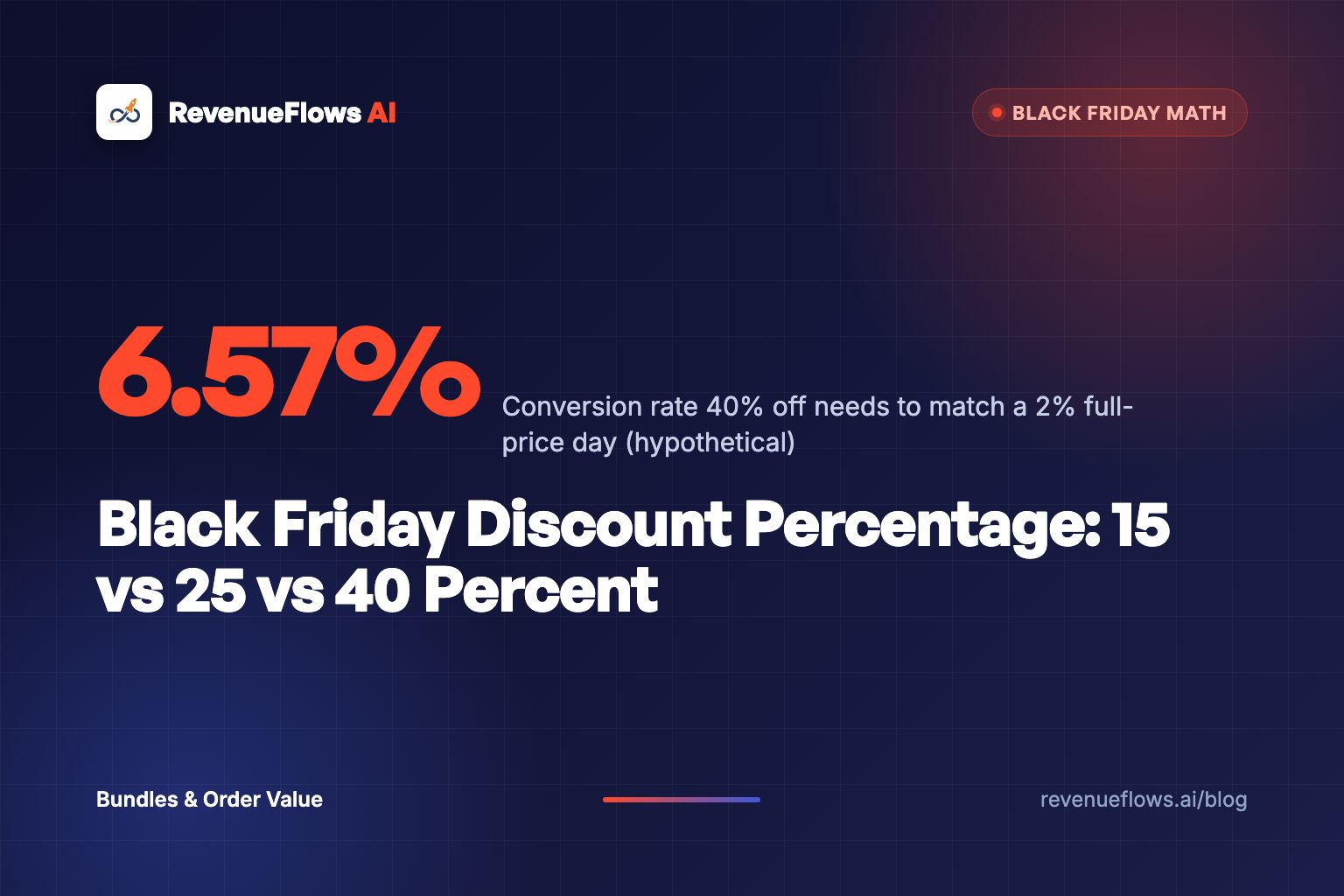
Here's the short answer. For most Shopify brands with healthy margins, the best Black Friday discount sits between 15% and 25%. Deeper than that, conversion rate has to climb so far just to break even on profit that it rarely gets there. In the hypothetical store modeled below, 15% off needs conversion rate to rise from 2.0% to 2.71% to match full-price profit. 25% off needs 3.54%. 40% off needs 6.57%. Revenue goes up at every depth. Profit per visitor goes down at every depth unless your buyers respond harder than those thresholds.
So the question isn't "how much discount on Black Friday?" It's "how much does my conversion rate have to move to pay for it?"
This post is the method, so you can run the same model on your own store tonight. No invented benchmarks. One hypothetical store, clearly labeled, plus the published research I could actually open and read.
A discount doesn't cost you the percent on the banner. It costs you that percent out of your margin, and your margin is a much smaller number.
What discount percentage do stores actually run on Black Friday?
Start with what happened last year, because it's the number everyone anchors on.
Salesforce tracked online shopping on Black Friday 2025 and found average discount rates peaked at 28% in the U.S. and 27% globally, flat versus 2024. By category, electronics peaked at 29% off, toys at 30%, televisions at 24.3% and furniture at 19%.
Here's the part almost nobody quotes. In the same Salesforce data, U.S. online order volume on Black Friday dropped 1% year over year, while average selling prices rose 7% and units per transaction fell 2%.
Read that again. Same discount depth as the year before. Fewer orders. Fewer items in each one.
Meanwhile, Shopify merchants did a record $14.6 billion over Black Friday-Cyber Monday 2025, up 27% from 2024, with an average cart of $114.70. Buyers showed up. They were going to show up anyway.
That 28% figure belongs to retailers selling televisions and toys, many of them with vendor funding behind the markdown. It tells you what the market is used to seeing. It tells you nothing about what your margin can carry.
| What the data says (Black Friday 2025) | Number | Source |
|---|---|---|
| Peak average online discount, U.S. | 28% | Salesforce |
| Peak average online discount, global | 27% | Salesforce |
| Change in U.S. online order volume | -1% | Salesforce |
| Change in average selling price | +7% | Salesforce |
| Shopify merchant BFCM sales | $14.6 billion | Shopify |
| Shopify average cart price | $114.70 | Shopify |
The industry average discount is a fact about Best Buy's margin. It isn't a fact about yours.
How do you model discount depth on your own store?
You need four numbers. That's it. Most founders already have all four in their Shopify admin and have never put them in the same row.
- Full price of your hero product (or your average order value at full price).
- Product cost per order, landed. If tariffs moved your costs this year, redo your landed cost calculation first.
- Fulfillment cost per order: pick, pack, box, shipping you pay for.
- Normal conversion rate on that product page during a promo period.
From those, you get margin per order at full price and at each discount. Then one formula does the heavy lifting:
Break-even order multiple = full-price margin per order ÷ discounted margin per order. Break-even conversion rate = your normal conversion rate × that multiple.
That's the line your discount has to cross. Below it, you sold more and kept less.
Now watch what happens when we run it.
What does 15 vs 25 vs 40 percent off do to one store?
Run the math on a store like this, a hypothetical cast iron cookware brand. The hero is a 12-inch pre-seasoned skillet at $80. It costs $24 landed. Fulfillment and shipping cost $10 an order. To keep it clean, every order is one skillet, so average order value equals the price.
At full price you keep $46 an order. That's $80 minus $24 minus $10.
Now cut the price.
- 15% off: the skillet sells for $68. You keep $34.
- 25% off: it sells for $60. You keep $26.
- 40% off: it sells for $48. You keep $14.
Notice what just happened. A 40% discount on the price became a 70% cut to the margin (69.6%, to be exact). $46 down to $14. The banner says 40. Your bank account feels 70.
Here's the math that decides it. Say this store converts at 2.0% during a full-price promo week. On 1,000 visitors that's 20 orders, and 20 orders at $46 is $920 of profit. Every discount has to beat $920.
- 15% off needs $920 ÷ $34 = 27.06 orders. That's a 2.71% conversion rate.
- 25% off needs $920 ÷ $26 = 35.38 orders. That's a 3.54% conversion rate.
- 40% off needs $920 ÷ $14 = 65.71 orders. That's a 6.57% conversion rate.
Hypothetical. $80 skillet, $24 product cost, $10 fulfillment, 2.0% full-price conversion rate. Break-even = 2.0% x (full margin / discounted margin).
That last bar is the one to stare at. 40% off has to more than triple your conversion rate before you earn a single extra dollar of profit. I've audited a lot of product pages. I can't remember one that tripled its conversion rate because of a price tag.
Where do the revenue and profit lines cross?
Here's where it gets uncomfortable, because revenue keeps saying yes.
Give the hypothetical store a reasonable response to each discount. Assume conversion rate goes from 2.0% at full price to 2.6% at 15% off, 3.2% at 25% off, and 4.0% at 40% off. These are assumptions for the model, not benchmarks. Plug in your own.
Now revenue per visitor, shown the long way:
- Full price: conversion rate 2.0%, average order value $80. Revenue per visitor $1.60. On 10,000 visitors, that's $16,000.
- 15% off: conversion rate 2.6%, average order value $68. Revenue per visitor $1.77. On 10,000 visitors, that's $17,680.
- 25% off: conversion rate 3.2%, average order value $60. Revenue per visitor $1.92. On 10,000 visitors, that's $19,200.
- 40% off: conversion rate 4.0%, average order value $48. Revenue per visitor $1.92. On 10,000 visitors, that's $19,200.
Every discount beats full price on revenue. Your Shopify dashboard would light up green on all three.
Now profit per 1,000 visitors:
- Full price: 20 orders × $46 = $920
- 15% off: 26 orders × $34 = $884
- 25% off: 32 orders × $26 = $832
- 40% off: 40 orders × $14 = $560
Hypothetical skillet store. Assumed conversion rates: 2.0%, 2.6%, 3.2%, 4.0%. Profit = orders x margin per order after product cost and $10 fulfillment.
There's the crossing. Revenue climbs as the discount deepens. Profit falls. At 40% off, this store doubles its orders, posts its best revenue day of the year, and keeps $360 less per 1,000 visitors than it would have at full price.
Twice the boxes. Twice the support tickets. 39% less profit.
Revenue is the scoreboard your discount is designed to win. Profit is the one it's designed to hide.
And if you're paying for the traffic, it gets worse, not better. Ad cost per visitor is the same at every depth, so it doesn't change which option wins. It changes whether any of them make money. At $0.90 a click, those 1,000 visitors cost $900. Full price clears $20. 40% off loses $340.
| Discount depth | Price | Margin per order | Break-even conversion rate | Assumed conversion rate | Revenue per visitor | Profit per 1,000 visitors |
|---|---|---|---|---|---|---|
| Full price | $80 | $46 | 2.00% | 2.0% | $1.60 | $920 |
| 15% off | $68 | $34 | 2.71% | 2.6% | $1.77 | $884 |
| 25% off | $60 | $26 | 3.54% | 3.2% | $1.92 | $832 |
| 40% off | $48 | $14 | 6.57% | 4.0% | $1.92 | $560 |
All hypothetical. The method is the asset here, not the numbers.
When does a deeper discount actually win?
I'm not going to pretend discounts never work. They do, under conditions you can check.
When the buyer response is steeper than the break-even line. In the model, if 15% off had lifted conversion rate to 2.8% instead of 2.6%, that's 28 orders × $34 = $952, which beats $920. A shallow discount on a product with a fat margin can win. The steeper your margin, the more room a discount has.
When your margin is thin, almost nothing wins. Same skillet, but say it costs you $40 landed instead of $24. Full price keeps $30 an order. 15% off keeps $18. 25% off keeps $10. 40% off sells a $48 skillet that costs you $50 to make and ship. You pay $2 for every order you take. No conversion rate fixes a negative number.
When the buyer is new and comes back. This is the part of the research that surprised me. Eric Anderson and Duncan Simester ran three large field experiments with a catalog company selling durable goods, published in Marketing Science in 2004. They found deeper price discounts increased future purchases by first-time customers but reduced future purchases by established customers. The established customers forward bought and got more deal sensitive. The authors' warning: if you set prices from short-run response alone, prices for established customers end up too low.
That's one study, from one catalog business, two decades ago. Don't treat it as a law. But it points at a split most stores never make.
Your email list already knows you. Hit them with 40% off and a chunk of them are buying the skillet they were going to buy in January, at a fraction of the margin. Cold traffic doesn't know you yet. A deeper first-order offer to them can earn back through repeat orders, if your product gets reordered at all.
Run the math on that, still hypothetical. Say 1 in 5 of those new 40%-off buyers comes back later for a full-price order worth $46 of margin. Each new buyer carries $9.20 of future margin on average. Add it to the $14 and that 40%-off customer is worth $23.20, which still trails the $46 full-price buyer by a wide gap. The repeat order helps. It rarely closes the hole on its own.
Your list doesn't need a reason to buy. It needs a reason to buy now. Those are very different price tags.
How is AI changing the way you pick a discount?
The math above takes ten minutes on a napkin for one product. The problem is that you don't have one product. You have 40 SKUs with 40 different costs, and nobody builds that spreadsheet in November.
That's the job AI has quietly taken over.
Export your products with cost per item, plus last year's orders. Hand both to an AI assistant and ask one question: for each product, what's margin per order at full price, 15%, 25% and 40% off, after $10 fulfillment, and what conversion rate does each discount need to break even? You get the whole catalog sorted by how much discount it can afford, in minutes.
What you'll usually see: two or three products can carry 25% off. Most can carry 15%. A few with thin margins can't carry any discount at all and belong in a bundle or a gift with purchase instead.
Inside Shopify, Sidekick can create and edit reports from a plain-language prompt, display the key metrics in the chat panel, and create amount-off product and order discounts. So you can check last November's sales by product and build the discount that matches the math without hunting through menus.
Here's the honest limit. AI is fast at the arithmetic. It doesn't know how your buyers respond to 15% versus 25%. That number only comes from your own data, which is why the next section matters more than this one.
How do you test discount depth before Black Friday?
You can't learn your buyers' response to a discount on Black Friday itself. By then the decision is made. So you learn it in October, on a smaller stage.
Here's the study design I'd run on your own store, starting this week.
- Pull last year's promo numbers. Conversion rate, average order value and units per order for the hero product during last year's sale, next to a normal week. That's your real response to whatever depth you ran.
- Split your email list into random groups. Send the same email on the same day to each group, with different codes: 15% off to one, 25% to another. Same subject line, same product, same send time. Only the depth changes. (Need a subject line that names the offer and the deadline? Pull one from these holiday email subject line patterns.)
- Measure profit per recipient, not orders. For each group, take orders × margin per order, divided by the number of people who got the email. Orders will favor the deeper code almost every time. Profit per recipient is the tiebreaker.
- Check new versus returning buyers. Split the results by first-time and repeat customers. If the deeper code mostly pulled in people who already buy from you, that's the Anderson and Simester warning showing up in your own data.
- Set the Black Friday depth from the result, not the calendar. If 15% wins on profit per recipient, that's your number, whatever 28% the retailers run.
Email groups beat a live page split for this test because the price on the page stays the same for everyone, and nobody sees a different price than their friend. We cover the traps of testing on the busiest weekend in A/B testing during Black Friday. If you'd rather split discount depth on the page itself, that's a pricing-app job, and I compare the two main options in Shoplift vs Intelligems.
Your October test is cheap. A November guess at 40% off is the most expensive experiment you'll ever run.
What beats a deeper discount?
A bigger order at the same discount. Or no discount at all and a page that answers the question killing the sale.
Raise the order, not the markdown. Instead of 40% off one skillet, put the skillet, a $14 chainmail scrubber and a $12 bottle of seasoning oil together at $96 instead of $106. The buyer saves $10, and the order is twice the size of a $48 skillet at 40% off. We run the full margin math on this in Black Friday bundle ideas that protect your margin, and you can stress-test your own pairs below.
Spend the effort on the page. The other way to cross the break-even line is to lift conversion rate without paying for it in margin. If your skillet page converts at 2.0% because it never answers "why $80 when the big-box one is $25?", that's a page problem, and a discount is a bribe to look past it. The do discounts increase Shopify conversion rate breakdown and our guide to the product page for Black Friday traffic cover what that page needs.
For numbers that aren't hypothetical: on one Amazon product we moved to Shopify, the Amazon price was $29.95 with $7.73 of net profit per sale. On Shopify, with a page built to sell a bigger order, average order value reached $177.75 and net profit was $78.87 per sale, after paying for ads and inventory. See the full case study numbers. Real client numbers, not typical results, and not a promise of what your store will do.
That's the lever. More margin per order, from the order, not from the price cut. There are more plays like that in our guide on how to increase average order value on Shopify and in boosting average order value without discounts.
Here's the calculator set to the hypothetical skillet at full price versus 15% off. Remember it shows revenue, not profit. Subtract your costs before you celebrate.
A note on method
Every number in the skillet model is hypothetical, built to show the method: an $80 product, $24 product cost, $10 fulfillment, a 2.0% full-price conversion rate, and assumed conversion rates of 2.6%, 3.2% and 4.0% at each depth. The market figures come from Salesforce's Black Friday data (linked above) and from Shopify's own BFCM release. The repeat-purchase finding comes from Anderson and Simester's 2004 field experiments in Marketing Science. Swap in your own four numbers and the model holds. The conclusions only hold if your numbers say so.
FAQ
What is a good Black Friday discount percentage? For most brands with healthy margins, 15% to 25%. Salesforce saw U.S. online discounts peak at 28% on Black Friday 2025, but your margin per order sets your number.
How much discount should I give on Black Friday? Divide full-price margin per order by discounted margin per order. If your conversion rate can't climb by that multiple, the discount is too deep.
Is 40% off too much for Black Friday? Usually. In the hypothetical skillet store, 40% off needs conversion rate to go from 2.0% to 6.57% just to match full-price profit.
Does a deeper discount bring in better customers? Mixed. Field experiments found deeper discounts lifted future purchases from first-time customers but cut them from established ones.
How do I calculate break-even on a Black Friday discount? Break-even conversion rate = normal conversion rate × (full-price margin per order ÷ discounted margin per order).
What to do next
Open your product export tonight and fill in four numbers for your hero product: full price, landed cost, fulfillment cost, and normal conversion rate. Work out the break-even conversion rate at 15%, 25% and 40% off. Whichever depth needs a conversion rate you've never seen on that page is off the table.
Book Your Profit Audit
Bring your four numbers to a free profit audit and we'll show you how much revenue per visitor your hero page is leaving behind before Black Friday traffic lands, so you don't need a 40% bribe to close the sale. Then we'll show you how to rebuild a high-converting product sales page in less than 15 minutes.
Or go here to check it out → revenueflows.ai
P.S. The deepest discount always wins the revenue chart. Run the profit line before you let it win your November.
Frequently asked questions
What is a good Black Friday discount percentage?
The best Black Friday discount is the shallowest one that still moves your buyers, usually 15% to 25% for a brand with healthy margins. Salesforce found average online discounts peaked at 28% in the U.S. on Black Friday 2025, but the right number for your store comes from your margin per order, not from what big retailers run.
How much discount should I give on Black Friday?
Work backward from margin. Divide your full-price margin per order by your discounted margin per order. That's how many more orders you need. If your conversion rate can't realistically climb that far, the discount is too deep.
Is 40% off too much for Black Friday?
For most Shopify brands, yes. In our hypothetical skillet store, 40% off needs conversion rate to jump from 2.0% to 6.57% just to earn the same profit as full price. On a product with a 50% gross margin, 40% off loses money on every order once shipping is counted.
Does a deeper discount bring in better customers?
Research points both ways. Field experiments published in Marketing Science found deeper discounts increased future purchases by first-time customers but reduced future purchases by established customers, through forward buying and higher deal sensitivity. That's a case for a shallower discount to your email list.
How do I calculate break-even on a Black Friday discount?
Required order multiple equals full-price margin per order divided by discounted margin per order. Multiply your normal conversion rate by that multiple and you get the conversion rate the discount must hit to break even on profit.