Black Friday Customer Retention: Keep Discount Buyers
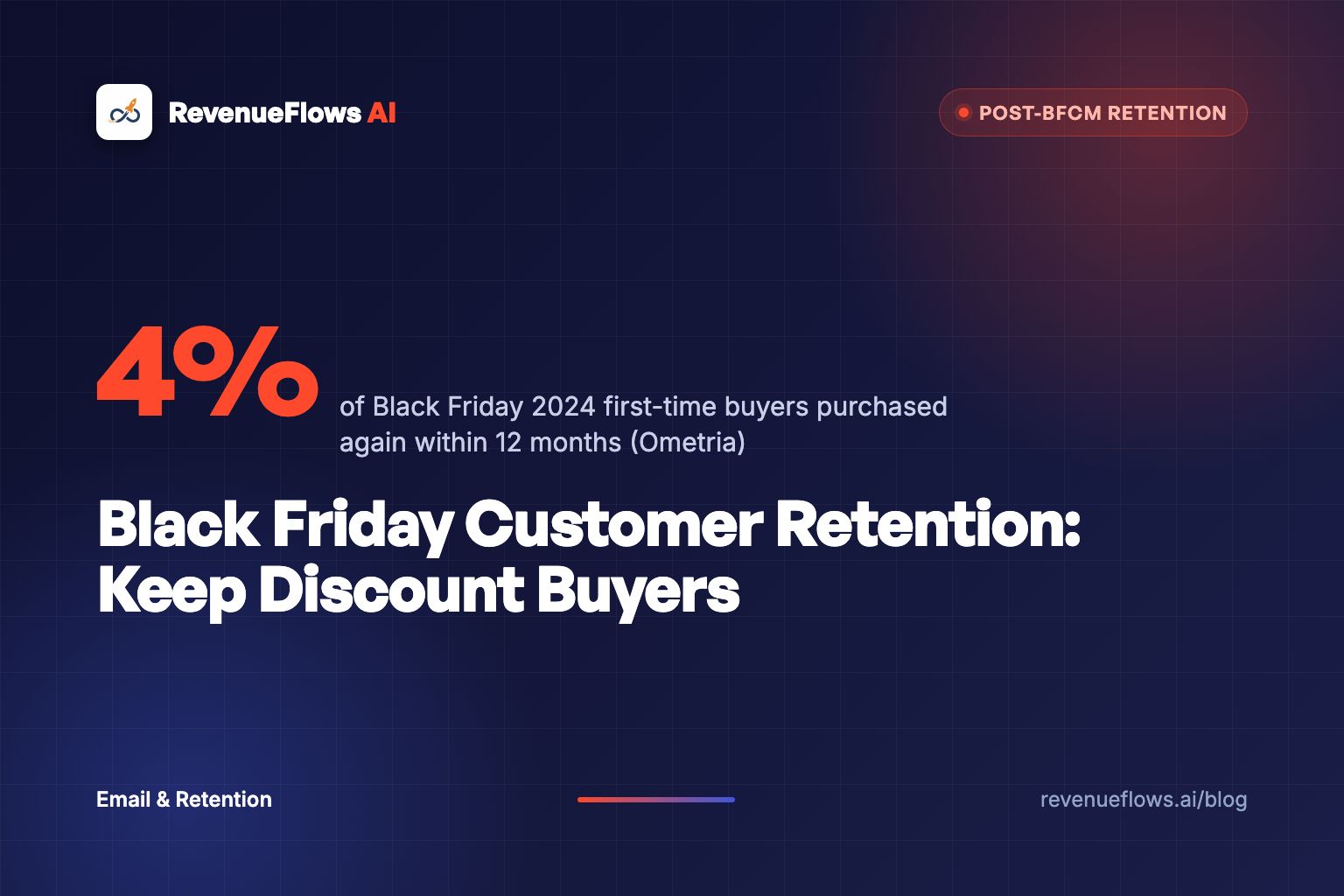
Only 4% of Black Friday first-timers buy again within a year. Another sale in January won't fix that, because they never bought your product in the first place. Here's the flow that sells it to them.

A greens powder founder messaged me the second week of January.
He'd run 35% off site-wide over Black Friday weekend, picked up more first-time customers in four days than in the three months before, and now his list was dead quiet. His plan was a "New Year, New You" sale. 25% off.
I told him to stop. Here's why.
Black Friday customer retention is a different job from normal retention, because the buyer you acquired in November didn't buy your product. They bought your discount. Ometria's Black Friday 2025 data, drawn from its retail customer base across fashion, beauty, lifestyle and specialty brands, found that only 4% of Black Friday 2024 new customers made a repeat purchase within 12 months, and 75% of those repeats happened during Black Friday 2025. Black Friday-acquired customers were 6x less likely to return than typical new customers.
So another sale in January teaches them to wait for sales. The flow that keeps them has to sell the thing they haven't bought yet: the product experience. What it does, how to use it, who it's for, and why it was worth full price all along.
A Black Friday buyer bought your price. Your January flow has to sell them your product.
Why don't Black Friday customers come back?
Because most of them were never shopping for you.
Shopify merchants did $14.6 billion over Black Friday Cyber Monday 2025, up 27% on 2024, with 81 million consumers buying and an average cart of $114.70. A big slice of that crowd arrived from a deal roundup, a gift guide, or a friend's text. They compared you on one axis. Price.
Ometria's data says 45% of Black Friday revenue came from new customers. Then 11% of the previous year's Black Friday shoppers came back for the next one. The rest didn't return at all.
Compare that to a normal month. Shopify's retention benchmarks, citing Bluecore's 2025 Customer Growth Benchmarks Report, put overall retail retention at 27.4%, with health and beauty at 41.2% and apparel at 31.7%. Same report: once someone buys twice, they're 95% more likely to buy again.
A Black Friday first-timer repeats at 4%. A regular customer repeats at 27%. The second order is the whole fight, and the discount buyer is the hardest person on your list to get there.
What did they actually buy from you?
Here's the thing. There are two buyers in your November cohort, and your Klaviyo account treats them as one.
The product buyer wanted your cold brew maker, or your merino base layer, and the sale was the nudge. The discount buyer wanted a deal, and your product happened to be 35% off at 11pm on Friday. Same order. Same tag. Opposite reasons.
The cage founders live in: treat the whole cohort as price-driven and feed it more price. January sale. Valentine's sale. Spring sale. Each one works a little, and each one teaches the list that full price is for people who didn't wait. I've written about what discounts do to conversion rate and how deep a Black Friday discount should go. The same thing shows up both times. The discount hides a page, and an email program, that can't close at full price.
The product buyer doesn't need another coupon. They need to open the box, use the thing right, get the result they were promised, and hear from you before they forget why they bought.
The discount buyer needs the exact same emails, because the product is the one thing you never showed them.
Price got them in the door once. Only the product gets them back.
What should the January flow say instead?
Klaviyo's own BFCM checklist says to send a new-customer welcome flow variant built for BFCM first-time buyers, ask for reviews 7 to 10 days after delivery, and move fast, because the buyer just saw your brand at its most generous and the window to turn that into a long-term relationship is 2 to 3 weeks.
So the flow starts in December, when the box lands, and it sells the experience in this order:
- Day 1 after delivery: the one thing to do first. For the greens powder, that's one scoop, cold water, before breakfast, for 14 days before you judge it. Specific instructions beat a thank-you.
- Day 4: the result they should notice first, and when. Name it. If they don't feel it by day 10, tell them what to change.
- Day 8: the review ask, inside Klaviyo's 7 to 10 day window, with one question: what did you notice?
- Day 14: the "which one is next" email. Buyers who bought the trial size get the full tub. Buyers who bought the tub get the second flavor. No coupon.
- Day 30: the reorder reminder, timed to when the product runs out, with a subscribe option at the price they already paid.
Not one of those emails mentions a sale. Every one of them answers a question the Black Friday page skipped, because that page was built to say "35% off" in the biggest font it could. The send-by-send calendar for the sale itself is in Black Friday email campaign ideas. This post is what happens after.
The whole thing sits inside the retention system from our Klaviyo flows for Shopify guide. The post-purchase flow there is the base. The Black Friday variant swaps the tone from "thanks for joining us" to "here's what you got for your money, and how to get all of it."
One number to keep you honest. Klaviyo's abandoned cart benchmark report puts the average post-purchase flow at $0.41 revenue per recipient, against $2.65 for welcome. That's the average for a flow that says "thanks, here's 10% off." A flow that teaches the product shows its payoff in the second-order rate, not the flow report.
How do you run the math on a Black Friday cohort?
Run the math on a store like this, a hypothetical. 3,000 first-time customers over Black Friday weekend. Average repeat order $90.
At Ometria's 4%, 120 of them buy again within 12 months. 120 x $90 = $10,800 of repeat revenue from the whole cohort.
Now the December flow does its job and the repeat rate reaches 12%. Still less than half the retail average. 360 x $90 = $32,400. Same cohort, same November ad spend, $21,600 more over the year, no coupon anywhere in it. That November spend is the costly part, which is why the Black Friday Facebook ads strategy sets a profit floor per order first.
Repeat rate x cohort size x $90 average repeat order. 4% vs 12%.
But here's the thing. Every email in that flow ends in a click to a product page. And in most stores, that's the same page that needed 35% off to close in November.
Say the flow sends 10,000 clicks to the hero page over the quarter, still hypothetical. The page converts at 1.5% with an $80 average order value. That means revenue per visitor is $1.20. On 10,000 clicks, that's $12,000.
Fix the page so it answers "why is this $80 instead of $30" and offers the two-tub bundle. Conversion rate 2.5%, average order value $96. Revenue per visitor $2.40. Same 10,000 clicks, $24,000. The flow didn't change. The page doubled what every click was worth.
And here's what that looks like with real numbers. Our bedding client started at a conversion rate of 1.0% and an average order value of $125, which is $1.25 per visitor, or $12,500 on 10,000 visitors. After the product page rebuild: 3.5% conversion rate, $231 average order value, $8.10 per visitor, or $81,000 on the same 10,000 visitors. See the full case study numbers. Real client numbers, not typical results, and not a promise of what your store will do. Every retention email that store sends lands on those pages.
A returning buyer reads a page differently from a stranger. Here's how to write a Shopify product page for returning customers, and the version for email traffic, where the visitor already knows your name.
The flow brings them back. The page decides whether the trip was worth it.
Can AI write the post-Black Friday flow?
Yes, with a catch.
Klaviyo's Composer, according to Klaviyo's own help article, can draft a whole flow and the email, push, SMS and MMS messages inside it from a prompt. Nothing sends as-is. You review and approve every message. Klaviyo says it can produce inaccurate content, that you're responsible for checking prices, product names and links, and that a flow draft costs upwards of 100 credits.
So you can type "a 5-email post-purchase flow for first-time Black Friday buyers of our greens powder, no discounts, focused on how to use it and what to expect" and get a draft in minutes.
What the AI can't know is the sentence that turns a discount buyer into a product buyer. That sentence lives in your reviews ("I didn't expect the taste to be fine"), your support inbox ("how many scoops is a serving"), and your return reasons ("didn't notice anything after a week"). Feed those in and the flow gets sharp. Skip them and you get a reminder with nicer formatting.
The greens powder founder got there faster than I expected. He pulled his one-star reviews, pasted them into the prompt, and the draft's day 4 email opened with the exact complaint his five-star customers had already answered. That's the move. The AI writes. The reviews decide what it writes about.
At RevenueFlows AI we write the flows from the same buyer research that builds the product page, so a December email and a December product page tell one story instead of two.
FAQ
Why don't Black Friday customers buy again?
Because most of them bought the discount, not the product. Ometria measured a 4% repeat rate within 12 months for Black Friday 2024 first-timers, 6x less likely to return than other new customers.
Should I run a January sale to bring back Black Friday customers?
No. A January sale confirms that your full price is optional. Sell the product experience instead: how to use it, what result to expect, which product comes next.
How long after Black Friday should I email first-time buyers?
Start the day the box lands. Klaviyo's BFCM checklist puts the window at 2 to 3 weeks and recommends a review ask 7 to 10 days after delivery.
What is a good repeat purchase rate for Black Friday customers?
The published baseline is 4% within 12 months (Ometria), against 27.4% overall retail retention (Bluecore, via Shopify). Anything in double digits puts you well ahead of the cohort average.
Can Klaviyo's AI write a post-Black Friday flow?
Yes. Composer drafts the whole flow and its messages from a prompt and returns it for review. Klaviyo says to check prices, product names and links before approving.
What to do next
Open Shopify, go to Customers, and filter for first orders placed November 27 to November 30, 2025. Count them. Then count how many have placed a second order since. Divide. If that number is under 10%, you don't need a better Black Friday offer for 2026. You need the December flow built before November 27, and the page it links to rewritten so it closes without a coupon.
Book Your Profit Audit
A Black Friday cohort can only be worth what the page it returns to lets it be worth, and that page is where every post-purchase click lands. Get your free profit audit and we'll show you exactly how much each returning click is worth right now, then rebuild a high-converting product sales page in less than 15 minutes.
Or go here to check it out → revenueflows.ai
P.S. Price brought them in once. Only the product brings them back, and the page is where it has to prove it.
Frequently asked questions
Why don't Black Friday customers buy again?
Because most of them bought the discount, not the product. Ometria's Black Friday 2025 data found only 4% of Black Friday 2024 first-time buyers purchased again within 12 months, and those buyers were 6x less likely to return than new customers acquired at other times. They compared you on price once and never learned what the product does.
Should I run a January sale to bring back Black Friday customers?
No. A January sale confirms what the Black Friday buyer already believes: your full price is optional. The flow that keeps them sells the product experience, how to use it, what result to expect and when, and which product comes next. Save the offer for the last email, if you use one at all.
How long after Black Friday should I email first-time buyers?
Start the day the box lands. Klaviyo's BFCM checklist says the window to turn a first-time Black Friday buyer into a long-term customer is 2 to 3 weeks, and recommends a separate welcome variant for those buyers plus a review ask 7 to 10 days after delivery. Wait until January and most of the cohort has forgotten you.
What is a good repeat purchase rate for Black Friday customers?
The published baseline is low. Ometria measured 4% within 12 months for Black Friday 2024 first-timers, while Bluecore's 2025 benchmarks put overall retail retention at 27.4%. On a hypothetical cohort of 3,000 buyers with a $90 repeat order, moving from 4% to 12% is $10,800 versus $32,400 in repeat revenue over the year.
Can Klaviyo's AI write a post-Black Friday flow?
Yes. Klaviyo's Composer drafts a whole flow with the email, SMS and push messages inside it from a prompt, and returns it as a draft you review and approve. Klaviyo warns it can produce inaccurate content and tells you to check prices, product names and links. Feed it your reviews and support questions or you get a polite reminder with better formatting.