What Is AI Max for Search? A Guide for Shopify Advertisers
Google is switching AI Max on for a lot of Search campaigns whether you asked or not. Here's what it does, what the retail data says, and why your product page now writes your ads.

Should you turn it on? My honest answer: it depends on a page you probably haven't looked at in a year.
Here's the short version. AI Max for search campaigns is a set of Google features you switch on inside an existing Search campaign. It does three jobs. It shows your ads on searches your keywords never listed. It writes new headlines and descriptions using the copy on your landing page. And it can send the click to a different page on your site than the one you picked.
So if your product page is rich, specific and full of the words buyers actually use, AI Max has good raw material and can find you sales you were missing. If your page is a thin spec sheet, AI Max reads that spec sheet, writes bland ads from it, and spends your budget showing them to people who were never going to buy.
Same feature. Two very different bills.
What is AI Max for search campaigns, in plain English?
Google's own help page on how AI Max works calls it a suite of targeting and creative features that sits on top of your Search campaigns. It isn't a new campaign type. You keep your campaign, your keywords and your budget. AI Max adds a layer that makes more of the decisions for you.
The pieces:
- Search term matching. Uses broad match and "keywordless" technology to find searches related to your keywords, ads and landing pages. You can switch it off per ad group.
- Text customization. Uses text from your existing ads, your landing page copy and your assets, plus generative AI, to write new ad copy for each search. This is what used to be called automatically created assets.
- Final URL expansion. Sends the click to whichever page on your site Google thinks fits the search best. It only works with text customization on, and Google notes that pinned assets are not respected while it runs.
- Brand and URL controls. Lets you include or exclude brands, and include or exclude specific URLs.
When Google announced AI Max in May 2025, it said the system learns "from your current keywords, creative assets and URLs." Read that list again. Your URLs are one of the three inputs.
With AI Max on, your product page stops being only the place the click lands. It becomes the script your ads are written from.
Why is Google pushing AI Max so hard right now?
Because it's folding older features into it, and some of that is happening without you clicking anything.
In April 2026 Google published the plan to upgrade Dynamic Search Ads to AI Max. Three older features move under the AI Max roof: Dynamic Search Ads, automatically created assets, and the campaign-level broad match setting. After advertiser pushback, Google updated the post in June 2026 and moved the Dynamic Search Ads auto-upgrade to February 2027. But automatically created assets and campaign-level broad match still began auto-upgrading in September 2026.
So if you ran either of those last month, check your settings. You may already be on AI Max.
Google's pitch has two numbers. The May 2025 launch post says advertisers who switch it on "will typically see 14% more conversions or conversion value" at similar efficiency, and that campaigns still mostly on exact and phrase keywords see a typical uplift of 27%. The April 2026 post adds that using the full suite (not search term matching alone) brings an average of 7% more conversions or conversion value.
Those are Google's numbers about Google's product. Keep reading.
AI Max vs broad match: what's actually different?
This is the question most founders type into Google, and the honest answer is that broad match is one ingredient inside AI Max.
| Broad match | AI Max for Search | Dynamic Search Ads | |
|---|---|---|---|
| What it is | A keyword match type | A feature suite inside a Search campaign | An older campaign setup, now being upgraded into AI Max |
| Decides which searches you show on | Yes, from your keyword | Yes, from keywords, ads and landing pages | Yes, from your website content |
| Writes ad copy for you | No | Yes, text customization | Yes, dynamic headlines |
| Can change the landing page | No | Yes, final URL expansion | Yes |
| Brand and URL controls | No | Yes | URL targeting only |
| Status in 2026 | Campaign-level setting auto-upgrading to AI Max | Active, expanding | New campaigns blocked, auto-upgrade February 2027 |
Here's the thing. Broad match only changes who sees your ad. AI Max changes who sees it, what the ad says, and where the click goes. That's three levers handed to the machine at once, and every one of them reads your website to make its choice.
What does the retail data say about AI Max?
This is where I'd slow down before clicking the big blue recommendation card.
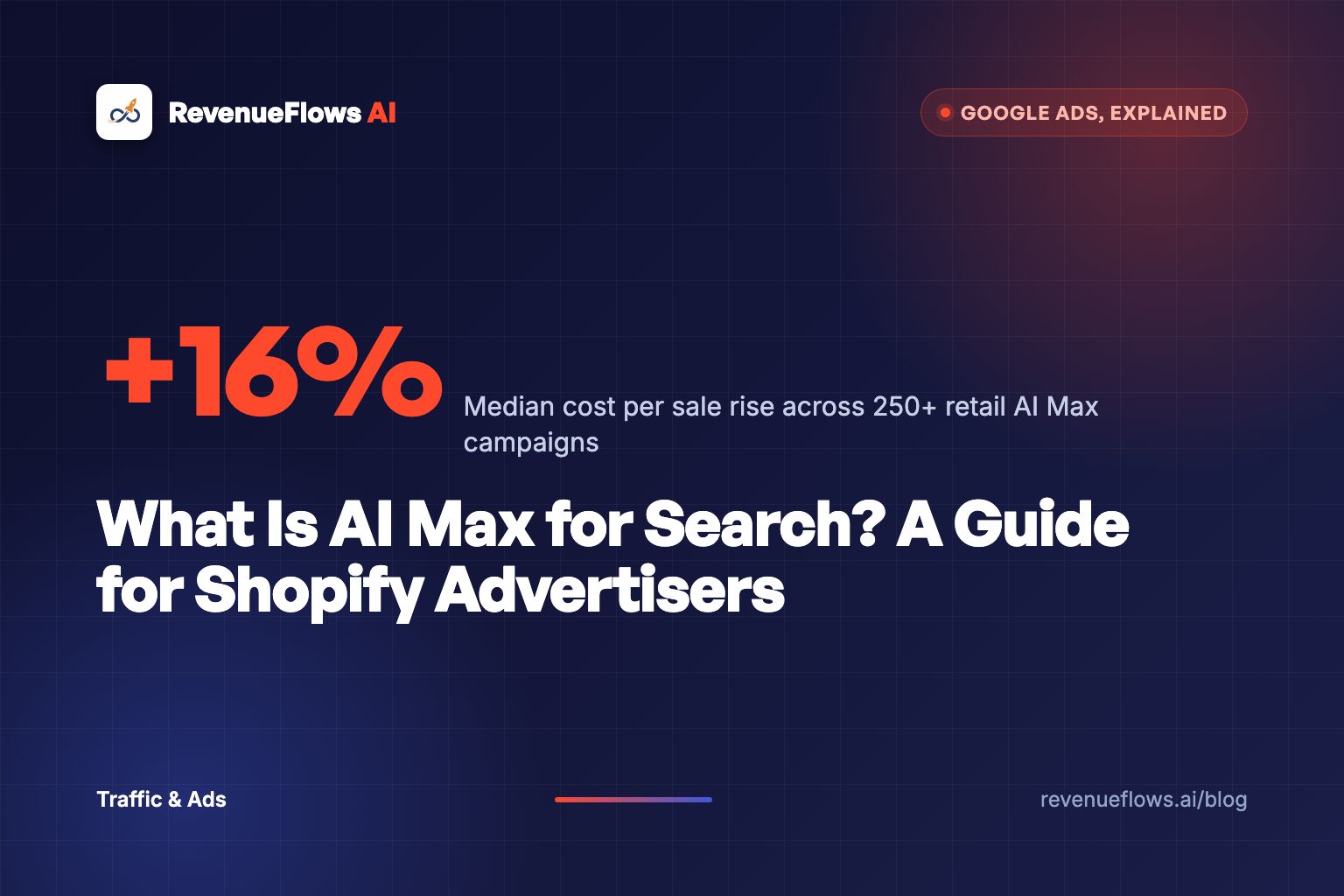
Smarter Ecommerce, a Google Ads agency for retailers, reviewed more than 250 retail campaigns using AI Max. In their guide to AI Max for Google Search, they report a median revenue lift of 13%. Sounds great. But the median cost per acquisition went up 16%. And return on ad spend ranged from 42% better to 35% worse than baseline. They're blunt about it: for retailers watching efficiency, the outcome is hard to predict.
So you probably get more sales. You may pay more for each one. And whether that trade is worth it depends on one number you control.
AI Max can buy you more clicks. Only your page decides what those clicks are worth.
Google's own reporting guidance for AI Max backs up the caution in a quieter way. It says to wait at least 2 weeks after turning it on before adding negative keywords, and to use negatives "sparingly." Translation: you're expected to let it spend for a while before you judge it.
Why does a thin product page make AI Max waste money?
Let me tell you what I see when I open most Shopify product pages that run Google traffic.
A title. A price. Five bullets: "Premium memory foam." "Breathable cover." "Machine washable." "Fits standard pillowcases." "30-night trial." That's the whole page.
Now hand that page to text customization. What can it write? "Premium memory foam pillow, breathable cover." That's it. Every competitor's page says the same thing, so every competitor's AI-written ad says the same thing. You're now paying to look identical in the auction.
And search term matching reads the same page to decide which searches you belong on. A thin page gives it almost nothing to work with: no buyer problems, no use cases, no "for side sleepers with neck pain." So it guesses wider. Wider guesses mean more clicks from people with weak intent.
Then final URL expansion picks a landing page. If your collection page or a blog post has more words on it than your product page, guess where some of your clicks go.
A rich page flips all three. It names the buyer, the problem, the objection and the outcome in plain words, so every AI Max feature has real material to work with. I wrote a full breakdown on writing a Shopify product page for Google Ads traffic if you want the section-by-section version.
How much can you afford to pay per AI Max click?
Here's the math. Run it on a store like this (a hypothetical).
Page as it is: conversion rate 1.5%, average order value $64. That means revenue per visitor is $0.96. On 10,000 clicks, that's $9,600. At a 60% gross margin, each visitor earns about $0.58 in gross profit, so $0.58 is your break-even cost per click. AI Max widens your reach and your average click costs $1.10. Now 10,000 clicks cost $11,000 to bring in $9,600. Return on ad spend: 0.87. You're paying Google to lose money faster.
Now watch what happens with the page rebuilt. Same traffic, same $1.10 clicks. Conversion rate 3.0%, average order value $82. Revenue per visitor is $2.46. On the same 10,000 clicks, that's $24,600. At 60% margin, break-even per click is about $1.48. Return on ad spend: 2.24.
Conversion rate x average order value x 10,000 clicks. Ad spend is $11,000 in both scenarios.
Nothing about AI Max changed between those two rows. The page did. More on that shift in revenue per visitor vs earnings per click.
The hypothetical is clean. Real stores are messier, and the real numbers can be bigger. A bedding brand we worked with had an adjustable pillow page at a 1.0% conversion rate and a $125 average order value: $1.25 per visitor, or $12,500 on 10,000 visitors. After the rebuild, that page ran at a 4.4% conversion rate and a $152 average order value. Revenue per visitor: $6.68. On the same 10,000 visitors, that's $66,800. See the full case study numbers. Real client numbers, not typical results, and not a promise of what your store will do.
At $1.25 per visitor, AI Max's wider reach is scary. At $6.68, you can afford to let it explore.
Should you turn AI Max on for your Shopify store?
My take, plainly. Turn it on when your page is ready to be read by a machine. Not before.
If your hero product page is thin, fix it first. AI Max will copy your weaknesses at scale. If your page is rich and converting, test AI Max in one campaign, leave a control running, and give it the 2 weeks Google asks for. If you also run Performance Max or Shopping, watch for overlap; Smarter Ecommerce flags that many retailers run several automated campaign types that end up matching the same searches. And if you're thinking about where Google sits in your overall mix, the ecommerce traffic strategy guide lays out how the channels stack. Meta made the same move with Advantage+ sales campaigns, and Google's AI Mode shopping results read your pages the same way.
Frequently asked questions
Is AI Max the same as broad match? No. Broad match is one ingredient. AI Max adds text customization, final URL expansion, and brand and URL controls.
Does AI Max increase conversions for ecommerce stores? Often, at a cost. Retail data from 250+ campaigns showed a median 13% revenue lift with a 16% higher cost per acquisition.
Will Google turn on AI Max automatically? For campaigns on automatically created assets or campaign-level broad match, upgrades began in September 2026. Dynamic Search Ads follow in February 2027.
How long should I wait before changing it? At least 2 weeks, per Google's own reporting guidance.
What to do next
Open the product page that gets the most Google clicks. Pull last month's conversion rate and average order value for it, multiply them, then multiply by your gross margin. If that break-even number is lower than what you pay per click today, leave AI Max off and fix the page this week. The page is what AI Max reads first.
Book Your Profit Audit
AI Max writes your Google ads from your product page, so a thin page now costs you twice: weaker ads and weaker conversions. Book a profit audit and we'll show you what each Google click is worth on your store today, then rebuild a high-converting product sales page in less than 15 minutes.
Or go here to check it out → revenueflows.ai
P.S. AI Max can find you a thousand new searches by Friday. It can only write ads as good as the page it reads.
Frequently asked questions
What is AI Max for Search campaigns?
AI Max is a set of AI features you switch on inside an existing Google Search campaign. It matches your ads to searches beyond your keyword list, writes extra headlines and descriptions from your landing page, and can send clicks to a different page on your site than the one you picked.
Is AI Max the same as broad match?
No. Broad match is one keyword match type. AI Max includes broad match and keywordless matching, then adds text customization, final URL expansion, brand controls and URL controls on top, so it changes both who sees your ad and what the ad and landing page say.
Does AI Max increase conversions for ecommerce stores?
Sometimes. Google says advertisers typically see 14% more conversions or conversion value at similar efficiency, but Smarter Ecommerce's review of 250+ retail campaigns found a median 13% revenue lift with a 16% higher cost per acquisition. Measure your own cost per sale before you trust either number.
Will Google turn on AI Max automatically?
For some campaigns, yes. Google says campaigns using automatically created assets or the campaign-level broad match setting started upgrading to AI Max in September 2026, and Dynamic Search Ads auto-upgrade was pushed to February 2027.
How long should I wait before changing an AI Max campaign?
Google's own help page says to wait at least 2 weeks after turning on AI Max before making changes like adding negative keywords. Use that time to watch the search terms report and the landing pages report.