Ecommerce Traffic Strategy: Meta, Google Shopping, Affiliates, PR
Every channel guide tells you where to buy clicks. Almost none tell you what a click is worth to you. Here's the traffic plan that starts with that number, then works through Meta, Google Shopping, affiliates, PR, tracking and Q4.

Every traffic guide I read starts with channels. I start with one number.
Here's the answer up front. An ecommerce traffic strategy is the plan for which channels send visitors to your store, in what order, and how much you can afford to pay for each one. And the most you can pay for a click is set by one thing: your revenue per visitor multiplied by your margin. So the plan runs in this order. Fix the product page that sets that number. Then feed it. Meta to create demand, Google Shopping to capture it, affiliates and creators to borrow trust, digital PR for authority and AI citations, and a tracking layer (the Conversions API plus your own first-party data) so the ad algorithms learn from real sales instead of guesses.
That's the whole strategy. The rest of this guide is how to run each piece in 2026, now that AI does most of the targeting and bidding for you.
Your ad account doesn't decide how much you can pay for a click. Your product page does.
Why does the product page decide how far your ads can scale?
Because every channel sends visitors to the same place, and that place sets the price ceiling.
I learned this the expensive way. Early in my first brand, I thought scaling meant finding cheaper clicks. I'd sit in the ad account moving budgets around, proud when cost per click dropped a few cents. Meanwhile the page those clicks landed on was a spec sheet that closed about one visitor in a hundred. I was negotiating the price of the audition while the performance lost the audience.
Here's the math that fixed my thinking. Run it on a store like this (a hypothetical example, not a client). Conversion rate 1.2%, average order value $95. That means revenue per visitor is $1.14. On 10,000 visitors, that's $11,400 in revenue.
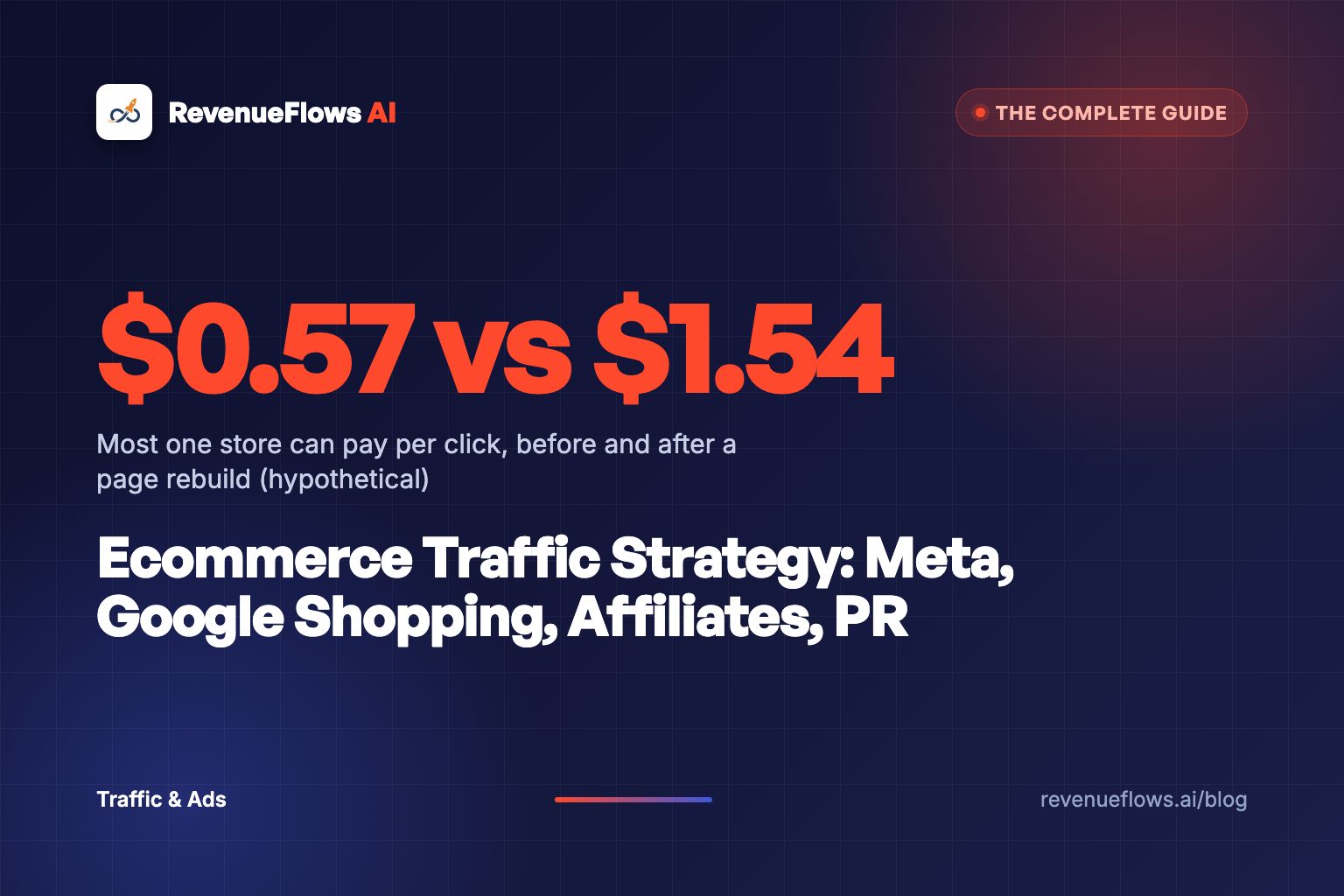
Now say the margin after product cost, shipping and payment fees is 50%. Each visitor is worth $0.57 in gross profit. So $0.57 is the most this store can pay for a click and break even on the first order. Pay $0.60 and you lose money on every sale before you even count overhead.
Now rebuild the page. Conversion rate 2.4%, average order value $128. Revenue per visitor is $3.07. On the same 10,000 visitors, that's $30,720. At the same 50% margin, each visitor is worth $1.54 in gross profit, so the store can now pay up to $1.54 per click and still break even.
Same product. Same ad account. The ceiling on what you can bid went from $0.57 to $1.54.
Revenue per visitor x 50% margin. Before: 1.2% x $95 = $1.14 per visitor. After: 2.4% x $128 = $3.07 per visitor.
Watch what happens when both versions of the store buy the same traffic at $1.00 a click. Spend $10,000 on 10,000 clicks. The old page brings in $11,400 in revenue and $5,700 in gross profit, a loss of $4,300. The rebuilt page brings in $30,720 in revenue and $15,360 in gross profit, a profit of $5,360. Same clicks. Same bill from Meta. One store is bleeding and the other is printing.
That's why the store with the better page wins the auction. It can bid more, stay in the auction longer, and still keep money. The formula is short enough to write on a napkin:
- Revenue per visitor = conversion rate x average order value.
- Break-even cost per click = revenue per visitor x margin.
- Break-even return on ad spend = 1 divided by margin.
- Target cost per click = revenue per visitor x (margin minus the profit you want to keep).
At a 50% margin, break-even return on ad spend is 2.0. If you want to keep 15% of revenue as profit, you're working with 35% of revenue for ads, so the old page can pay about $0.40 a click and the rebuilt page about $1.08. I go deeper on why this beats every other ad metric in revenue per visitor vs earnings per click, and if you've never pulled the number for your own store, start with how to calculate Shopify revenue per visitor.
Multiply either revenue per visitor number the calculator gives you by your own margin. That's your break-even cost per click, today and after the rebuild.
Now the real numbers. Our bedding client started at a conversion rate of 1.0% and an average order value of $125, so revenue per visitor was $1.25. After the rebuild: 3.5% and $231, so revenue per visitor was $8.10. On 10,000 visitors, that's $12,500 before and $81,000 after. See the full case study numbers. Real client numbers, not typical results, and not a promise of what your store will do. Whatever their margin was, the ceiling on what they could pay per click moved up 6.5x with it, which is the whole game in paid traffic.
And one of the Amazon-to-Shopify products on that same page makes the point even harder. On Amazon it spent $2.69 on advertising per sale and kept $3.83 in net profit. On Shopify it spent $26.36 on advertising per sale, almost ten times more, and kept $48.27 per sale after paying for ads and inventory, because the average order value was $101.38 instead of $17.95. The store that can afford to spend more on ads is the store with the bigger order. The same lesson runs through the myth that more ads fixes conversion.
Cheaper clicks are a discount on the audition. A better page raises what every audition is worth.
Which traffic channel should you start with?
The one whose visitors already know the most about what they want, matched to a page that finishes their thought.
Every channel sends a different kind of visitor. A Google Shopping click saw your photo and price and chose you over five competitors. A Facebook click was watching a dog video thirty seconds ago. An affiliate click read someone else's review and arrives half sold. Same product page, three completely different conversations. The table below is how I map them, including what AI is changing about each one right now.
| Channel | What the visitor already knows | What AI changed | What the page has to do | Read the page guide |
|---|---|---|---|---|
| Meta (Facebook and Instagram) | Almost nothing. They saw one ad. | Andromeda picks who sees which ad. Creative is now the targeting. | Finish the exact sentence the ad started, in the first screen | Facebook ads traffic |
| Google Shopping | Your photo, price and rating vs. competitors | Performance Max and Smart Bidding set bids from your feed | Confirm the price and product instantly, then remove doubt | Google Shopping traffic |
| Google Search | The exact words they typed | Broad match and AI-driven search terms widen what you show for | Repeat their words back, answer the query first | Google Ads traffic |
| TikTok | One video, often from a stranger | Creative is the targeting here too | Match the video, then close fast on mobile | TikTok traffic |
| Affiliates | A third party's review or comparison | AI search tools now summarize those reviews | Pick up where the review left off, never restart the pitch | affiliate traffic |
| Creators and influencers | A person they trust, using your product | AI helps find creators whose audience matches your buyer | Prove they landed in the right place in two seconds | influencer traffic |
| Digital PR | An editor's recommendation | AI answer engines cite editorial coverage | Match the claim the article made about you | podcast traffic has the closest pattern |
| Retargeting | Your page. They already said no once. | Automated campaigns fold retargeting in | Answer the objection that made them leave | retargeting traffic |
If you only take one thing from that table, take this. The page for a cold Meta click and the page for a warm affiliate click should not say the same thing in the first screen. That single change moves more money than any bidding trick I know. For the full playbook on first-time visitors, read how to write a Shopify product page for cold traffic.
What changed at Meta after Andromeda, and why is creative now the targeting?
Meta rebuilt the step that decides which ads are even eligible to reach a person.
In December 2024, Meta's engineering team published how Andromeda works. It's the retrieval system: out of tens of millions of candidate ads, it picks a few thousand to send into ranking for each person. Meta reported a 10,000x increase in model capacity and a 6% recall improvement that delivered an 8% ads quality improvement on selected segments. Those are Meta's own numbers about its own system, so treat them as a direction, not a promise for your account.
Here's the thing that matters for you. When the system can read the ad itself this well, the ad does the targeting. A video about back pain for a mattress finds back-pain buyers. A static about cooling for the same mattress finds hot sleepers. You don't pick those audiences in Ads Manager anymore. You pick them in the creative.
So the old habit of making ten small variations of one winning ad (new background color, new first word, new button) gives the system very little to work with. To Andromeda those are mostly the same ad. What gives it room is angle diversity: genuinely different reasons to buy, shown to genuinely different people. We separate what Meta confirmed from agency guesswork in our post on the Meta Andromeda update.
In 2026 you don't choose your audience in Ads Manager. You choose it when you pick the angle.
This is exactly how we built the Meta ad studio inside RevenueFlows AI, and I'll tell you the order because the order is the point. It starts with research: reviews, competitor ads, the questions buyers ask. Then it pulls angles out of that research, each one a different reason a different person would buy. Then it writes copy for each angle. Then it turns the copy into static ads across a set of proven ad archetypes (the comparison, the testimonial, the problem callout, the offer, and so on). And it runs rules for picking winners and scaling them, so a founder doesn't kill an ad on day two or scale one on a lucky afternoon.
AI can now do the research-to-static-ad chain in minutes. What it can't do is decide what's true about your product. The angles have to come from real buyer language, which is why the research step comes first.
One warning. Angle diversity only pays if the landing page finishes each angle's sentence. If your cooling ad and your back-pain ad both land on a page that opens with thread count, the system will find the right people and the page will lose them. That's the core of our guide on the Facebook ads traffic product page, and the same logic applies to TikTok traffic, where creative carries even more of the targeting.
How should you set up Advantage+ sales campaigns?
With three switches on, two ad sets, and a creative plan that assumes the machine will do the audience work.
First, the name. What used to be Advantage+ shopping campaigns are now Advantage+ sales campaigns. Meta's developer documentation says a sales campaign counts as Advantage+ when three levers are all on: Advantage+ audience, Advantage+ campaign budget, and Advantage+ placements with no placement exclusions. The same page says the old shopping campaign API stops creating new campaigns in version 25.0 of the API, and legacy campaigns are blocked from edits in version 26.0. If you still have an old shopping campaign running, plan the move now instead of in November.
The same documentation also notes that the old existing-customer budget cap setting is deprecated for new campaigns. Meta's suggested replacement is to split one campaign into two ad sets: one that includes your existing customers and one that excludes them. That's how I'd set it up anyway, because it tells you something the blended number hides: how much of your "new" revenue is really old customers buying again. The full click-by-click walkthrough is in our Advantage+ sales campaigns setup guide.
Here's the setup I'd run on a Shopify store doing $10,000 to $100,000 a month:
- One Advantage+ sales campaign per country or margin band. Keep products with very different margins apart, because the campaign will chase revenue, and cheap products can soak up budget without paying for it.
- Two ad sets: new customers and existing customers. Use a customer list from Shopify for the include and exclude. Give the new-customer ad set most of the budget.
- Minimal targeting. Location and age where required. Nothing else. Let the creative find people.
- Five to eight genuinely different angles live at once. Different reasons to buy, not different colors on the same ad.
- Clean conversion data. Pixel plus Conversions API, deduplicated (more on this below), sending purchase value so the campaign bids for revenue, not just orders.
- Budget changes in steps. Raise slowly on winners and give each change a few days to settle before judging it.
Advantage+ is an engine. The creative is the fuel. The product page is the road it has to drive on.
What Advantage+ doesn't change is the ceiling from the first section. It'll happily spend your budget buying clicks for more than your page can pay back. Your break-even return on ad spend is still your break-even. Check it before every budget increase.
How do you structure a Google Shopping feed and campaigns?
Feed first, campaigns second. On Google, the feed is your ad copy.
Google Shopping ads are built from your Merchant Center product data. There's no headline field to write. The title in your feed is the headline, the image is the creative, and the price is the offer. Google's product data specification allows titles up to 150 characters and descriptions up to 5,000, and it asks that titles and prices match your landing page. It also has fields most Shopify feeds leave blank: product highlights, product details, and five custom labels (custom_label_0 through custom_label_4) that exist purely so you can organize campaigns.
Most Shopify feeds ship the product title straight from the store. "The Aurora" means something to you. It means nothing to someone who typed "cooling bamboo sheets queen." So the feed title has to carry the words people search: product type, key attribute, size or color, brand. That's what feed enrichment means, and it's one of the jobs AI does well today: rewriting thousands of titles and descriptions into search language, filling product highlights from your page copy, and flagging missing GTINs. One rule from Google's own spec I won't bend on: only provide a GTIN if you're sure it's correct. An AI guessing barcodes is a disapproval waiting to happen.
Then the campaign structure. Here's the split our Google presets use, and why:
- Hero products get their own campaign. Your top sellers by gross profit (usually 3 to 10 products) get separate budget and bids so they never fight the long tail for money.
- The long tail gets a second campaign. Everything else, with lower bids and its own budget.
- A cost-of-goods gate decides who's allowed in at all. Some products can't pay for clicks at any realistic bid, because product cost plus shipping leaves too little margin. Those get excluded, or they only show through remarketing. Tag them with a custom label and filter them out.
- Brand protection sits apart. A small search campaign on your own brand name, so a competitor or a reseller can't sit on top of people already looking for you.
- A retargeting ladder behind it all. Different messages for people who viewed a product, added to cart, or bought before.
That cost-of-goods gate is where most accounts leak. The long tail looks cheap per click and quietly loses money on every sale because the products inside it have skinny margins. Revenue per visitor times margin, product by product, tells you which ones belong.
And the page still has to close. A Shopping click already saw your price and picked you over the competitors underneath. The page's only job is to confirm that choice fast. The full breakdown is in writing a Shopify product page for Google Shopping traffic, and for text search ads, see writing a Shopify product page for Google Ads traffic.
On Google Shopping, your feed title is your headline. Most stores are running ads with a headline nobody searches for.
Performance Max vs Standard Shopping: which should you run?
Usually both, with a clear owner for each product.
Google describes Performance Max as one goal-based campaign that can serve across YouTube, Display, Search, Discover, Gmail and Maps. That reach is the appeal. The trade-off is control: Performance Max decides where your budget goes, and you see less of the search terms behind it.
The big rule change came in October 2024. Google told advertisers that instead of Performance Max automatically being prioritized over Standard Shopping, "normal auction dynamics will now apply and the campaign with the highest Ad Rank will serve," as Search Engine Roundtable reported from Google's announcement. Google's help page on how Performance Max interacts with other campaigns says the same general rule: the campaign with the highest Ad Rank is preferred, with one clear exception for search, where a keyword that exactly matches the person's query wins over Performance Max.
And inside Standard Shopping itself, campaign priority still works the old way. You set Low, Medium or High. The higher priority campaign bids first, and when its budget runs out, the next priority's bid is used.
So here's how I'd split it:
| Standard Shopping | Performance Max | |
|---|---|---|
| Best for | Hero products you want to control tightly | Long tail and extra reach across Google's channels |
| Where it shows | Shopping results and Shopping placements | YouTube, Display, Search, Discover, Gmail, Maps |
| Search term control | Full negative keyword control | Limited; negative keywords and brand exclusions available |
| What it needs from you | Clean feed, bids by product group | Clean feed, strong images and video, audience signals |
| Biggest risk | Missing reach you'd have gotten elsewhere | Spending on brand and retargeting it would have gotten anyway |
That last risk is real. A campaign judged on conversions will happily take credit for people who were already searching your brand name or already had items in their cart. That's why the brand protection campaign and brand exclusions matter: they keep the automated campaign honest about new demand.
If you're unsure which works better for your catalog, don't guess. Google has a built-in Standard Shopping vs Performance Max experiment that splits traffic between an existing Shopping campaign and a Performance Max campaign with similar settings. Run it on a product set with enough sales to read, and let the result decide.
Performance Max will always find conversions. The question is whether they're conversions you'd have gotten for free.
How do you build an affiliate program that actually recruits?
By recruiting like a brand partner, not posting an application form and waiting.
Most affiliate programs I audit have the same shape. A "join our affiliate program" link in the footer. A 10% commission. Forty sign-ups, three of whom ever sent a sale. The founder concludes affiliates don't work for their category.
Affiliates work fine. Passive affiliate programs don't. The people who drive real volume (review sites, comparison blogs, newsletter writers, creators with a buying audience) get pitched constantly, and they choose the brands that make them money. So the pitch has to answer their math, the same way your product page answers the buyer's.
Their math is earnings per click: commission times their conversion rate on your page. Here's the part nobody tells founders. Your product page sets their earnings too. A page that converts twice as well doubles what every affiliate earns per click at the same commission rate. That's usually a better recruiting argument than raising the commission.
Here's the recruiting sequence I'd run:
- Find who already ranks for your buyer's questions. Search your category plus "best," "review," "vs," and "alternative." Every site on page one is a prospect.
- Find who already mentions you or a competitor. They've shown they cover the category.
- Pitch with numbers. Commission rate, average order value, and what a typical visitor earns them. Real numbers from your store, not promises.
- Give them material that's easy to use. Product photos, a short comparison against the alternatives, honest drawbacks they can include (reviewers who show drawbacks get trusted more).
- Make the page finish their sentence. An affiliate who wrote "best for hot sleepers" should send people to a page that leads with cooling. Our guide to writing a Shopify product page for affiliate traffic goes through this in detail, and the creator version is in writing a product page for influencer traffic.
One compliance line you shouldn't skip. The FTC's endorsement guide FAQ says affiliates must disclose the relationship clearly, and it warns that shoppers might not understand what "affiliate link" means. Its example of clearer wording is along the lines of telling readers you get commissions for purchases made through links in the post. Put that expectation in your affiliate terms so your partners don't create a problem with your name on it.
Where AI changes this job: finding and qualifying prospects. What used to be a week of spreadsheet work (who ranks, who mentions competitors, who has a real audience) is now a few hours with AI research tools. The relationship part is still yours.
Does digital PR still work for ecommerce brands?
Yes, and it matters more now that AI answer engines decide which brands get named.
When someone asks ChatGPT or Google's AI Overviews for the best cooling sheets, the answer draws on what trusted sites have written. Gift guides, product roundups, trade coverage, comparison articles. A brand that shows up in editorial coverage has a far better shot at showing up in the answer. That's the new reason to do PR on top of the old ones (traffic, trust, and links).
But there's a line you shouldn't cross. Google's spam policies call out paid links that pass ranking credit as link spam, including links with keyword-stuffed anchor text in articles, guest posts or press releases distributed on other sites. Paying for placement is allowed as advertising, as long as those links carry a rel="sponsored" or rel="nofollow" attribute. So the "we'll get you in 50 publications" packages built on paid, followed links are a risk to your search rankings, not an asset.
The digital PR that works for a Shopify brand usually looks like this:
- Gift guide pitching on a calendar. Editors plan holiday guides months ahead. If you're pitching gift guides in November, you're late.
- Data angles. A small survey of your customers, or an honest look at your own sales patterns, gives a journalist a story instead of an ad.
- Founder expertise. Answering journalist requests in your niche, with specific numbers, builds a trail of quotes that AI engines pick up.
- Product seeding to editors. Send the product, no strings, with a one-page sheet of the claims you can back up.
- A landing page that matches the story. If an article calls you "the sheets that fixed my night sweats," the page it links to should open on exactly that.
Where AI changes this job: monitoring. AI tools can now track which answer engines mention your brand for your buyer's questions, which tells you whether the PR is working in the place buyers increasingly ask. It also drafts pitches fast. Resist sending them unedited. Editors can tell.
Paid links buy a risk. Earned mentions buy a place in the answer.
How do you track it all: Conversions API and first-party data?
By sending the ad platforms your real sales from your own systems, not only from the browser.
This is the least exciting section in the guide and the one that decides whether everything else works. Meta and Google now do the targeting and the bidding. They learn from the conversions you send them. Send them half your sales, and they learn from half the truth.
The browser pixel alone misses events. Ad blockers, browser privacy rules and flaky page loads all take a cut. The fix on each platform works the same way: send the conversions from the server too.
On Meta, that's the Conversions API. Meta describes it as a connection that sends your marketing data from your server, website platform, app or CRM to Meta, and says those events are used for measurement, reporting and delivery, the same as pixel events. You run it next to the pixel, not instead of it, and you deduplicate: each purchase carries the same event ID from both sources so Meta counts it once. On Shopify, the Facebook and Instagram app has a customer data-sharing setting that controls whether it sends events through the Conversions API. Check which level yours is on. It's one of the most common gaps I find.
On Google, it's enhanced conversions. Your conversion tag sends first-party customer data such as an email address, normalized and hashed with SHA256 before it leaves, so Google can match the sale to a signed-in account. Google also supports importing offline conversions, which matters if some of your sales close by phone, chat or invoice.
Then your own first-party tracking. The platforms will always grade their own homework in their favor. You need one source of truth you control: every visit, which channel it came from, which product page it hit, and whether it bought. We run first-party tracking on our own site for exactly this reason, and we give the Google side of our system conversion uploads so the bidding learns from real orders. When Meta claims 60 sales, Google claims 45 and Shopify shows 80 in total (a typical kind of mismatch, numbers for illustration), your own data is the tiebreaker.
The payoff from all this plumbing is simple. The algorithm finds more buyers like your real buyers. And you finally know revenue per visitor by channel, which tells you how much each channel can afford per click. A channel that sends visitors worth $0.60 can't be paid like one that sends visitors worth $2.40.
If traffic is landing and not converting at all, check tracking before you blame the page. Then check the page. The common causes are in Shopify traffic but no sales.
How should you plan Q4 and Black Friday ads?
Backwards from the day you want to scale, starting in September.
Black Friday is big enough to plan around. Shopify reported that its merchants sold $14.6 billion over the 2025 Black Friday Cyber Monday weekend, up 27% from the year before, with an average cart of $114.70 and a peak of $5.1 million a minute at 12:01 pm EST on Black Friday. Everyone else is bidding for that same shopper, which is why ad costs rise in Q4 and why a page with a low revenue per visitor gets priced out first.
Here's the calendar I'd give a founder today:
| When | What to do |
|---|---|
| September | Rebuild the hero product pages. Pull your break-even cost per click for each. Move any legacy Advantage+ shopping campaigns over. Check Conversions API and enhanced conversions. |
| Early October | Launch new angles on Meta. Test offers, not only creative. Clean the Merchant Center feed and fix disapprovals. |
| Late October | Pick winners. Kill losers. Build the Black Friday creative from the angles that won, not from scratch. |
| Early November | Warm up retargeting audiences. Load promotions into Merchant Center. Pitch any last gift guides. |
| Black Friday week | Scale proven ads only. Raise budgets on winners in steps. No brand new campaigns. |
| December | Shift to shipping deadlines and gift messaging, then last-minute digital or in-stock offers. |
Two rules I'd hold to. First, nothing untested launches the week of Black Friday. New campaigns need time for the delivery system to learn, and that week is the most expensive time of year to be learning. Second, raise order value before you cut price deeper. A bundle or a higher tier at the same discount raises revenue per visitor, which raises the cost per click you can afford, which keeps you in the auction when costs spike. A deeper discount does the opposite. The page-side playbook for all of this is in writing a Shopify product page for Black Friday traffic.
Black Friday doesn't reward the store with the biggest discount. It rewards the store that can still afford the click.
Start here: the full reading list
This guide is the hub. Every piece below goes deep on one channel or one part of the page, in the order I'd read them.
The economics first
- Revenue per visitor vs earnings per click: why this number beats every ad metric for deciding what to spend.
- How to calculate Shopify revenue per visitor: pull your own number in five minutes.
- The myth that more ads fixes conversion: what happens when you scale traffic into a page that can't close.
Meta ads in 2026
- The Meta Andromeda update: why your creative now does the targeting.
- Advantage+ sales campaigns setup guide: the three switches and the Shopify data Meta needs first.
The page for each channel
- Shopify product page for Facebook ads traffic
- Shopify product page for Google Shopping traffic
- Shopify product page for Google Ads traffic
- Shopify product page for TikTok traffic
- Shopify product page for YouTube traffic
- Shopify product page for affiliate traffic
- Shopify product page for influencer traffic
- Shopify product page for podcast traffic
The page for each kind of visitor
- Shopify product page for cold traffic
- Shopify product page for retargeting traffic
- Shopify product page for paid traffic
- Shopify product page for Black Friday traffic
When traffic isn't turning into sales
- Shopify traffic but no sales: the real causes
- The bedding product page teardown, the category behind our flagship case study.
FAQ
What is an ecommerce traffic strategy? The plan for which channels send visitors to your store, in what order, and how much you can pay for each. Revenue per visitor times margin sets the ceiling, so fix the page first, then feed it.
How much can I afford to pay per click? Revenue per visitor times your margin. At 1.2% and $95, revenue per visitor is $1.14, so a 50% margin breaks even at $0.57 a click.
Should I run Performance Max or Standard Shopping? Usually both. Standard Shopping for hero products you want to control, Performance Max for the long tail and extra reach. Since October 2024 they compete on Ad Rank for the same products, so give each product one owner.
What did Meta's Andromeda update change for advertisers? It rebuilt how Meta picks which ads can reach each person. The creative now does most of the targeting, so different angles beat small variations of one ad.
Do I need the Conversions API if I already have the Meta pixel? Yes. Run both and deduplicate with a shared event ID so Meta learns from more of your real sales.
When should I start planning Black Friday ads? September. Test angles in October, pick winners by late October, and only scale proven ads in November.
What to do next
Open Shopify analytics and pull two numbers for your best-selling product over the last 30 days: conversion rate and average order value. Multiply them. Then multiply that by your margin. Compare it with what you paid per click last month. If the click costs more than the visitor is worth, the next dollar belongs on the page, not in the ad account.
Book Your Profit Audit
Every channel in this guide sends visitors to the same product page, and that page sets the most you can pay for each click. Get your free profit audit and we'll show you where your revenue per visitor is leaking, then show you how to rebuild a high-converting product sales page in less than 15 minutes.
Or go here to check it out → revenueflows.ai
P.S. Cheaper clicks make the audition cheaper. A better page makes every audition worth more. Only one of those lets you outbid your competitors in November.
Frequently asked questions
What is an ecommerce traffic strategy?
An ecommerce traffic strategy is the plan for which channels send visitors to your store, in what order, and how much you can afford to pay for each one. The ceiling on what you can pay is set by revenue per visitor times your margin, so a good strategy fixes the product page first and then feeds it traffic from Meta, Google Shopping, affiliates, creators and PR.
How much can I afford to pay per click?
At break-even, the most you can pay per click is your revenue per visitor multiplied by your margin after product cost, shipping and fees. A store converting 1.2% at a $95 average order value earns $1.14 per visitor, so at a 50% margin it breaks even at $0.57 per click. Anything above that loses money on the first order.
Should I run Performance Max or Standard Shopping?
Most Shopify brands do well running both with a clear split: Standard Shopping for the hero products where you want control over bids and search terms, and Performance Max for the long tail and for reach across YouTube, Display, Discover and Gmail. Since Google's October 2024 change, the two compete on Ad Rank when they target the same products, so decide which campaign owns which product instead of letting them overlap.
What did Meta's Andromeda update change for advertisers?
Andromeda is Meta's ad retrieval system, the step that picks a few thousand candidate ads out of tens of millions before ranking them. Because the system now matches ads to people with far more model capacity, the creative itself does most of the targeting work. Different angles reach different buyers, so ten versions of one ad give it less to work with than five genuinely different ads.
Do I need the Conversions API if I already have the Meta pixel?
Yes. The pixel runs in the shopper's browser and misses events when browsers block it. The Conversions API sends the same events from your server or platform, and Meta uses those events for measurement, reporting and delivery. Run both, deduplicate them with a shared event ID, and the algorithm learns from more of your real sales.
When should I start planning Black Friday ads?
Start in September. Creative needs weeks of testing before costs rise, the product page needs to be finished before the traffic arrives, and new campaigns need time to exit learning. By November you should only be scaling ads that already proved themselves in October, never testing brand new ones.