
Subscribe and Save on Shopify: When It Raises Lifetime Value
A subscribe and save toggle doesn't raise lifetime value by existing. It pays off when the product runs out on a schedule and you fight for the second order like it's the first.

I used to think the subscribe and save toggle was free money. Every subscribe and save Shopify app pitches it that way.
Flip it on, knock 15% off, watch the recurring revenue stack up. Then I looked at what happened to those subscribers after the first box shipped, and the free money looked a lot more like a coupon with extra steps.
Here's the short answer. Subscribe and save on Shopify raises lifetime value when two things are true: the product runs out on a schedule (coffee, supplements, pet food, skincare refills), and you treat the second and third orders as the real sale. If the product doesn't run out on its own, or you ignore month two, the subscription discount mostly gives margin away to people who were going to cancel anyway.
The rest of this post is the math, the trap, and the month-two fix.
Why does subscribe and save on Shopify fail for so many stores?
Because the cancellations come fast, and almost nobody plans for them.
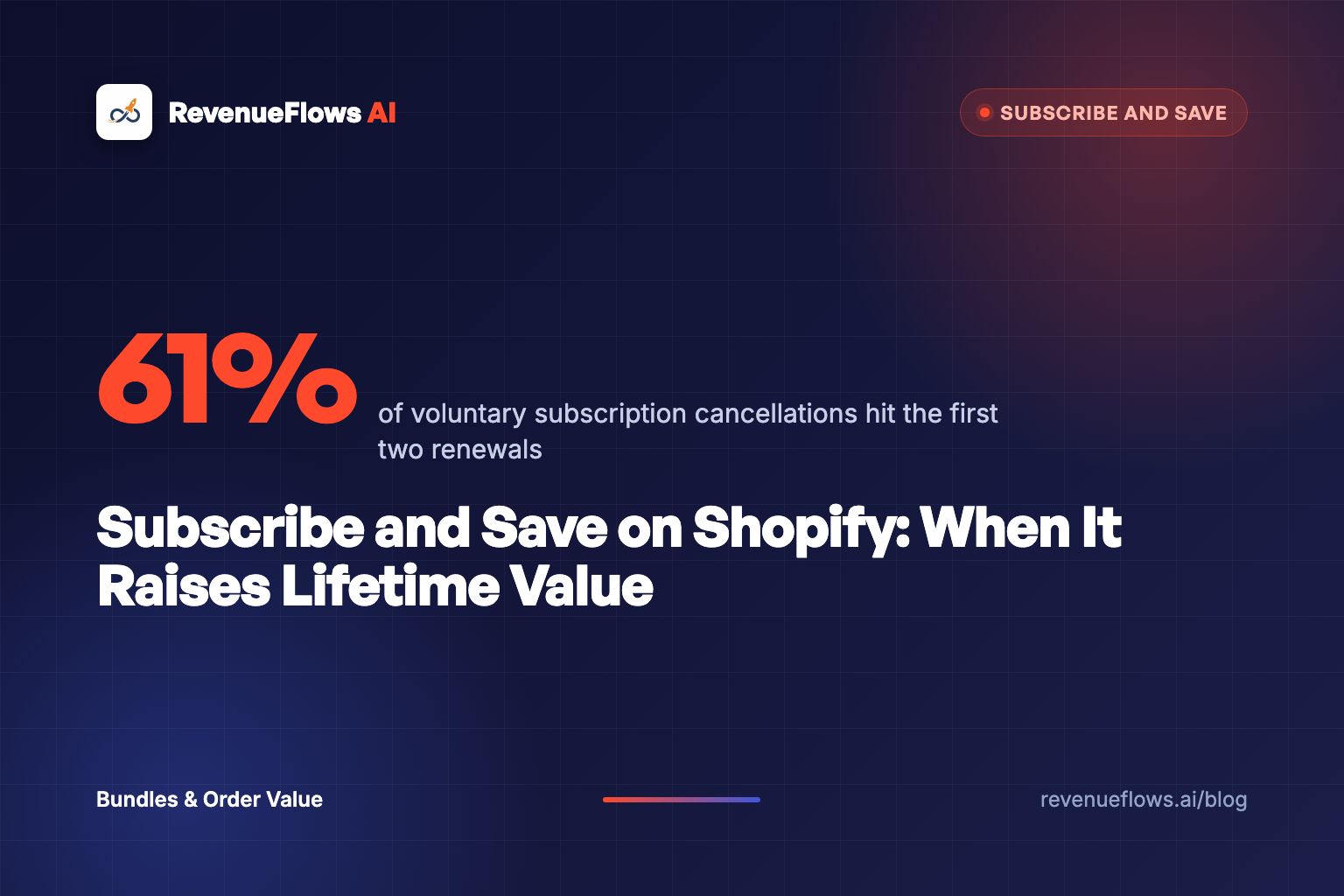
Recharge looked at renewal cycles across its subscription brands from July 2025 through March 2026. About 61% of voluntary cancellations happened at the first two renewals. About 72% happened within the first four. Churn peaked at the third cycle at 27.1%, then fell to 5.4% by cycle 12.
Read that again. A subscriber who makes it to month six is a very different animal from one in month two.
Your subscription program isn't decided at checkout. It's decided at the second charge.
And consumables get hit hardest. In the same Recharge data, first-renewal churn was 28.2% for food and beverage, 27.8% for pets and 26.5% for health and wellness. Those are exactly the categories where subscribe and save is supposed to shine.
So the toggle on the product page is the easy part. The hard part is the 60 days after it.
Which products actually raise lifetime value with a subscription?
A subscription formalizes a habit the buyer already has. If there's no habit, there's nothing to formalize.
Here's the test I run on any product before turning recurring orders on:
| Question | Subscription works | Subscription leaks margin |
|---|---|---|
| Does it run out on its own? | Yes, a 30-day tub of magnesium powder | No, a candle holder or a weighted blanket |
| Can you predict the refill date? | Within a week or so | Every customer is different |
| Does running out hurt? | The habit breaks, the dog has no food | Nobody notices |
| Would they reorder without a discount? | Many already do | Only with a coupon |
| Is the first order the full story? | No, the value is in orders 3 to 6 | Yes, one and done |
If you're mostly in the right column, skip the subscription. Your order value lever is the bundle or the tiered offer, and the average order value playbook covers which one fits.
What does a subscriber really earn you? Here's the math.
Run the math on a store like this (a hypothetical): a magnesium powder priced at $40, with a 15% subscription discount, so subscribers pay $34 a delivery.
Start with 100 subscribers and apply the Recharge cycle-by-cycle churn rates (24.1% at the first renewal, then 27.1%, 16.6%, 12.4% and 10.1%). After six deliveries you've shipped about 354 orders. At $34 each, that's about $12,040 from those 100 subscribers.
Now compare 100 one-time buyers at full price. Say 40 of them come back once in the same window (pull your real repeat rate from Shopify, this number is made up). That's 140 orders at $40, or $5,600.
The subscription more than doubles it. That's the case for it.
But here's the thing. Watch what happens when the subscription is used as a coupon.
One Amazon seller on the Seller Central forums said more than 85% of their Subscribe & Save signups cancelled right after the first discounted order. Different platform, same human behavior. Plug an 85% first-renewal cancel rate into the same hypothetical and those 100 subscribers produce about 150 orders, or roughly $5,108.
That's less than the one-time buyers paying full price.
Hypothetical $40 product, $34 subscription price. Subscriber curves use Recharge's renewal churn rates; the coupon-hunter line assumes 85% cancel at the first renewal.
Same toggle. Same discount. One version prints, the other bleeds.
Does the subscription discount hurt your first-order numbers?
Yes, a little, and you should know the size of it before you flip anything on.
Same hypothetical store. The product page converts at 2.5% and the average order value is $40. Revenue per visitor is 2.5% x $40 = $1.00. On 10,000 visitors, that's $10,000.
Now 40% of buyers pick the subscription at $34. Blended average order value drops to $37.60. If the conversion rate holds at 2.5%, revenue per visitor is 2.5% x $37.60 = $0.94. On the same 10,000 visitors, that's $9,400.
So you pay $600 up front on that traffic. You win it back only if those subscribers live past month two. That's why I'd rather have 20 subscribers who genuinely needed a refill than 200 who wanted 15% off once.
A subscription discount is a loan against future orders. Month two is when the loan comes due.
It's also why the discount size matters. Most subscription app vendors talk about something in the 10% to 15% range. I'd start at the low end, because every extra point attracts more of the coupon crowd and trains buyers the same way a permanent sale does. Discount fatigue shows where that road goes.
How do you keep subscribers past month two?
This is the whole game. Five moves, in order of how much money they protect.
1. Set the default interval from your order data, not the label. If the pouch says 30 servings but your customers actually reorder at day 36, a 30-day subscription buries them in product by month three. That's a top reason people cancel. Export your orders, find the median days between first and second purchase of that product, and make that the default. This is a good job for AI right now: paste the export into an assistant and ask for the median gap per product. Same logic as timing a Klaviyo replenishment flow.
2. Make skip and pause easier than cancel. Shopify's free Shopify Subscriptions app says customers can cancel, skip or pause, and supports weekly, monthly or yearly renewals with subscribe and save pricing. Turn on the self-serve management page from Shopify's setup guide and put "skip a delivery" right next to cancel. A buyer with too much product doesn't want to leave. They want a break.
3. Send a heads-up before the second charge. The first renewal is where the surprise lives. A short email three or four days before it ships, with a skip link, turns "wait, what is this charge?" into "oh right, I need that." It only works if it reaches the inbox, so check your Gmail and Yahoo sender setup before you count on it.
4. Put a save offer in the cancel flow. If you're on Recharge, its cancellation prevention tool lets you test discounts, gifts, skips and delays when someone tries to leave, and says its AI looks for patterns in cancellation reasons, products and top-performing offers. Recharge claims up to 33% of cancellations saved. That's the vendor's number, so test it on your own store before you believe it.
5. Hand true cancels to a winback, not a fourth reminder. Someone who left in month two isn't lost forever. They're just done for now. These winback flow examples show when to bring them back with an offer and when to wait.
Now watch the numbers on move one alone. In the hypothetical above, if better intervals and a pre-charge heads-up pulled first-renewal churn from 24.1% down to 15%, those 100 subscribers would ship about 385 orders instead of 354. That's about $13,077 instead of $12,040, or about $1,036 more per 100 subscribers, with no new traffic and no bigger discount.
You don't need more subscribers. You need the ones you already have to survive the second box.
Where does the product page fit in all this?
Right at the start. The page decides who subscribes.
A page that only says "Save 15%" next to the toggle recruits bargain hunters. A page that sells the outcome (the habit doesn't break, the refill shows up before you run out) recruits people who actually use the product. Those are the subscribers who make it to cycle six. AG1 is the cleanest example I know: the subscription sits first on the page and new subscribers get a free welcome kit with its dollar value printed on it, instead of a bigger code. I took the whole offer apart in the AG1 marketing strategy teardown.
And the page sets the first-order number every one of these calculations starts from. On the bedding brand we rebuilt, the product pages went from a 1.0% conversion rate and a $125 average order value (revenue per visitor $1.25) to a 3.5% conversion rate and a $231 average order value (revenue per visitor $8.10). On 10,000 visitors that's $12,500 versus $81,000. Real client numbers, not typical results, and not a promise of what your store will do. Bedding isn't a subscription product, but the lesson carries: the subscription multiplies whatever the page earns on order one.
What to do next
Pull one number this week: of everyone who subscribed 90 days ago, how many are still active after their second renewal?
If it's healthy, your subscription is raising lifetime value and the job is to grow it. If it's ugly, don't touch the discount yet. Fix the default interval and add the pre-charge heads-up first, then measure the next cohort the way cohort analysis on Shopify lays it out.
Book Your Profit Audit
A subscription only multiplies what your product page earns on the first order, so if that page is weak, every renewal starts from a weak number. Book a free profit audit and we'll show you where your page is leaking and how to rebuild a high-converting product sales page in less than 15 minutes.
Or go here to check it out → revenueflows.ai
P.S. A subscription built on a refill prints money for years. A subscription built on a coupon bleeds it by month two. The toggle looks the same on both.
Frequently asked questions
Is subscribe and save worth it on Shopify?
Yes, if your product runs out on a predictable schedule, like coffee, supplements, pet food or skincare refills. No, if it doesn't. Without a natural refill cycle, the subscription discount turns into a first-order coupon and most of those subscribers cancel before the second charge.
How much should a subscription discount be on Shopify?
Most subscription app vendors suggest somewhere around 10% to 15%. I'd start at 10% and only go higher if the extra subscribers stay past their second renewal. A bigger discount buys signups, and signups that cancel at month two are worth less than a full-price one-time order.
When do most subscribers cancel?
Early. Recharge's renewal data across its brands shows about 61% of voluntary cancellations happen at the first two renewals, with churn peaking near 27% at the third cycle. By cycle 12 it's down to about 5%. Your retention work belongs in months two and three.
Can I set up subscribe and save on Shopify for free?
Yes. Shopify's own Shopify Subscriptions app is listed as free in the Shopify App Store, offers subscribe and save pricing, and lets customers skip, pause or cancel. Paid apps like Recharge add deeper retention tools such as cancellation flows.
How does AI help reduce subscription churn?
Two places today. Recharge says its cancellation prevention AI finds patterns in cancellation reasons and products, so you see why people leave. And any AI assistant can read your order export and find the real number of days between first and second orders, so your default delivery interval matches how fast people actually use the product.