
Kaching Bundles vs Fast Bundle: Shopify Bundle Apps Compared
Kaching wins the quantity-break deal bar on the product page. Fast Bundle wins mix-and-match and frequently bought together. Here's how to pick by bundle type, with the listing numbers side by side.

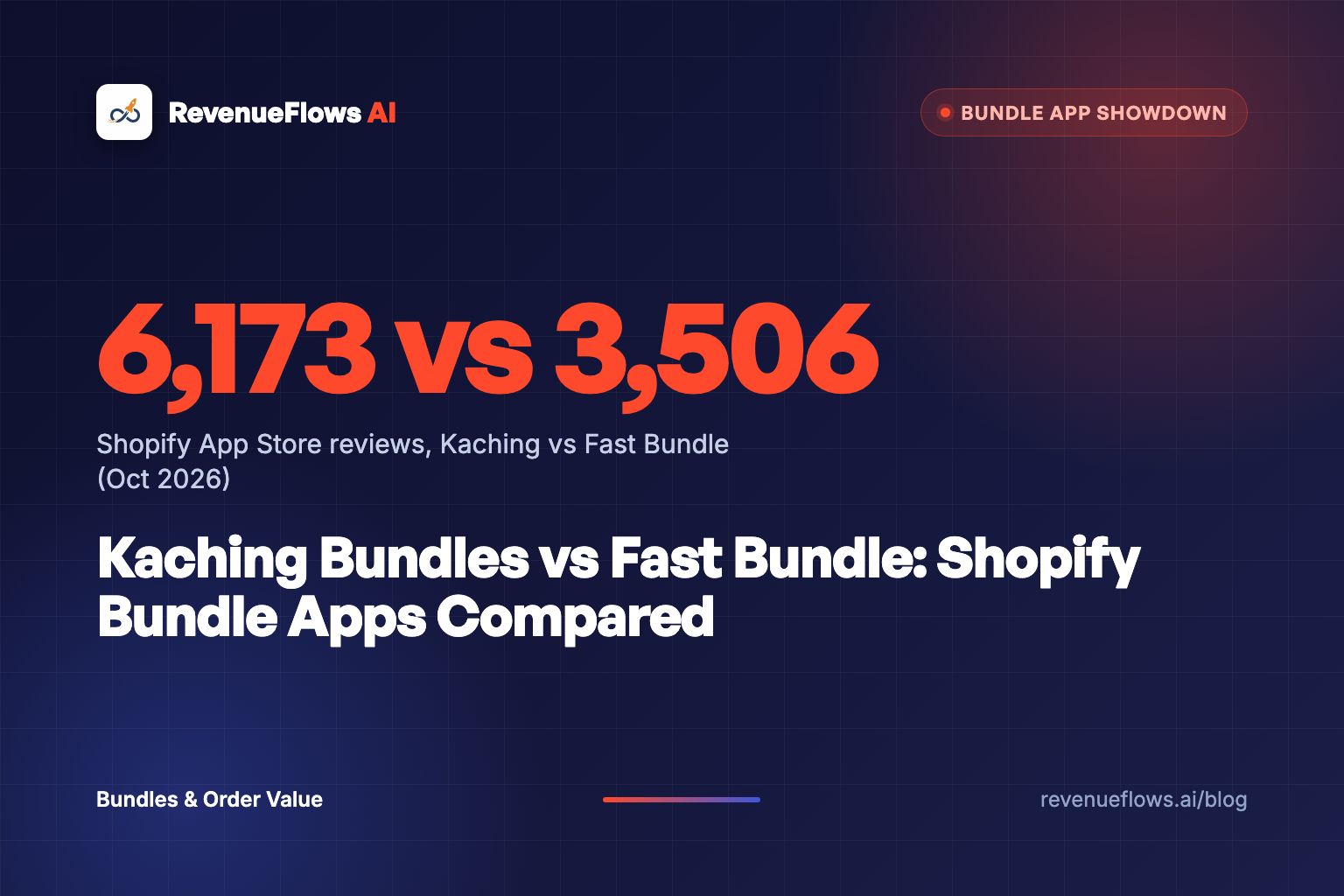
Most "kaching bundles vs fast bundle" comparisons pick a winner. That's the wrong question.
Here's the short answer. Kaching Bundles wins when your offer is more of the same product: buy 1, buy 2 and save, buy 3 and save more, stacked as a deal bar right under the price. Fast Bundle wins when your offer is different products sold together: mix-and-match kits, build-a-box, and frequently bought together. Both carry a 5.0 rating and the Built for Shopify badge. So pick by bundle type, then check your margin before you turn either one on.
That's the verdict. The rest of this post is the proof, the numbers from both listings, and the one thing neither app can fix for you.
Pick the app that matches the bundle your buyer already wants. A single-product store doesn't need a build-a-box engine, and a kit store doesn't need a deal bar.
What's the real difference between Kaching Bundles and Fast Bundle?
They solve two different buying moments.
Kaching is built around the product page buy box. Its Shopify App Store listing leads with quantity breaks, volume discounts, tiered pricing, BOGO and free gifts, set up in a drag-and-drop editor. The buyer is already sold on your product. Kaching's job is to make two feel smarter than one.
Fast Bundle is built around the basket. Its listing leads with mix-and-match, fixed bundles and custom kits through a Bundle Builder, plus AI-powered frequently bought together. Bundles can show on product pages, dedicated bundle pages, cart drawers and pop-ups. The buyer wants your serum. Fast Bundle's job is to get the cleanser and the moisturizer into the same order.
Both apps can technically do some of what the other does. Kaching lists mix-and-match and frequently bought together. Fast Bundle lists volume discounts and quantity breaks. But every app has a center of gravity, and the center is where the setup is easiest and the widget looks best.
How do the two apps compare side by side?
Every number below comes from the two Shopify App Store listings, opened on October 5, 2026. Third-party app prices change, so check the listing before you commit.
| Kaching Bundles App & Upsells | FBP: Fast Bundle & Upsell App | |
|---|---|---|
| Rating | 5.0 (98% five-star) | 5.0 (98% five-star) |
| Reviews | 6,173 | 3,506 |
| Launched | August 11, 2022 | November 26, 2020 |
| Built for Shopify | Yes | Yes |
| Strongest at | Quantity breaks, volume tiers, BOGO, free gifts | Mix-and-match, build-a-box, frequently bought together |
| Where offers show | Product page deal bar, progress bars | Product page, dedicated bundle pages, cart drawer, pop-ups |
| AI features on listing | None listed for bundles | AI frequently bought together, AI bundle image generator |
| A/B testing | Built in | Not listed |
| Entry plan | $14.99/mo, up to $1,000 additional revenue | $19/mo, up to $1,000 bundle sales |
| Middle plan | $29.99/mo, up to $5,000 additional revenue | $49/mo, up to $3,000 bundle sales |
| Top listed plan | $59.99/mo, up to $10,000 additional revenue | $139/mo, up to $10,000 bundle sales |
| Free trial | 7 days | 7 days |
| Languages | 9 | 10 |
Two lines in that table matter more than the rest.
First, the plan caps measure different things. Kaching caps on "additional revenue." Fast Bundle caps on "bundle sales." Each app counts with its own math, so don't compare the dollar tiers as if they were the same ruler.
Second, A/B testing. Kaching has it built in. That's a big deal for a deal bar, because the difference between "Save 10%" and "Save $9.60" on the same tier is something you should let buyers vote on instead of guessing.
Is Kaching Bundles worth it? (a Kaching Bundles review)
If you sell one hero product that people reorder, yes. Supplements, coffee, candles, socks, pet chews. Anything where "I'll take three" is a natural sentence.
Merchant reviews on the listing keep praising two things: no-code setup and fast support. That matches what I see when founders show me their stores. The Kaching deal bar is usually the cleanest-looking element in the buy box.
But here's the thing. A quantity break is a discount. And the buyer most likely to tap "buy 2, save 15%" is the buyer who was going to buy two anyway.
Run the math on a store like this (a hypothetical). A $48 product that costs $14 to make.
- One unit at full price: $34 profit.
- Two units at 15% off ($81.60): $53.60 profit.
- Two units at full price ($96), the order you would have gotten from your loyal buyer anyway: $68 profit.
That loyal buyer just took $14.40 off your margin. Multiply by every repeat customer and the deal bar starts quietly bleeding. I broke this down fully in do quantity breaks increase average order value, and the short version is this: test the tier depth, don't guess it. Kaching's built-in A/B testing is exactly the tool for that job.
Is Fast Bundle worth it? (a Fast Bundle review)
If your catalog has natural pairings, yes. Skincare routines. Kitchen sets. Coffee plus grinder plus filters. Anywhere the buyer needs a second thing to get the full result from the first thing.
This is also where the AI angle is real today, and I checked it on the listing before writing this. Fast Bundle's frequently bought together recommendations are AI-powered, and it ships an AI image generator for bundle visuals. That's useful for a catalog of 40 or 400 products, where hand-picking every pairing is weeks of work nobody does.
A cross-product bundle also protects margin better than a quantity break. You're adding value to the order (a second product the buyer didn't have) instead of subtracting price from the same product. More on that logic in how to use product bundles to increase average order value.
Now the honest flag. On July 18, 2026, Shopify pulled Fast Bundle from the App Store after a security attack, as a precaution, according to this Let's Metrix write-up. Fast Bundle reported no sign of store or shopper data exposure. Per Fudge's incident timeline, Shopify reviewed the incident and penetration-test reports, restored the app to limited visibility on July 30, and the listing was live with an install button by August 3. It's back and Built for Shopify. If you had it installed in July, check that your bundles were restored.
A deal bar asks "how many?" A bundle builder asks "what else?" Install the app that asks the question your buyer is already asking.
Which one should you install for your bundle type?
Use this. It's the whole decision on one screen.
| Your store | Install | Why |
|---|---|---|
| 1 to 3 hero products, consumable or reorderable | Kaching | Quantity tiers right in the buy box, with A/B testing |
| Gift sets, routines, kits, build-a-box | Fast Bundle | Mix-and-match and Bundle Builder are its core |
| 50+ SKUs with obvious pairings | Fast Bundle | AI frequently bought together does the pairing work |
| Free gift with purchase or BOGO promo | Either | Both list BOGO and gifts; choose by the rest of your offer |
| Low margin (under 50% gross) | Neither yet | Run the margin math first, every tier is a discount |
If you're still weighing other tools, the wider field is in Shopify bundle app alternatives. And if Black Friday is the reason you're shopping for an app this week, read Black Friday bundle ideas that protect your margin before you set any tier.
What can't either bundle app fix?
Here's the math. Take the same hypothetical store: 10,000 visitors a month, conversion rate 2.0%, average order value $48. Revenue per visitor is $0.96. On 10,000 visitors, that's $9,600.
Add a well-tested quantity-break deal bar and say average order value rises to $61 while conversion rate holds at 2.0%. Revenue per visitor becomes $1.22. On the same 10,000 visitors, that's $12,200.
Good. Now watch what happens if the page itself gets better at closing. Conversion rate 3.0%, average order value $61. Revenue per visitor $1.83. On the same traffic, $18,300.
Conversion rate x average order value x visitors. Hypothetical numbers for illustration.
A bundle app only works on the buyers who already decided to buy. It's an amplifier. Put it on a page that converts 2 people in 100 and it amplifies 2 people.
That's why I care more about the page than the app. One Amazon product we moved to Shopify sold for $29.95 on Amazon and kept $7.73 of net profit per sale. On Shopify, with a page built to sell a bigger order, average order value hit $177.75 and net profit was $78.87 per sale, after paying for ads and inventory. See the full case study numbers. Real client numbers, not typical results, and not a promise of what your store will do.
No deal bar on earth gets a $29.95 product to $177.75 on its own. The page made the bigger order make sense first. The bundle just gave it a button. And some products give a bundle far less room than others, which is the whole lesson of our pillow product page case study. If you want the full playbook beyond apps, start with how to increase average order value on Shopify.
What to do next
Open your top-selling product's page and answer one question: does your buyer want more of this product, or this product plus something else?
More of it, install Kaching and A/B test two tier depths for 14 days. Plus something else, install Fast Bundle and build one kit around your best seller. Not both on day one.
Book Your Profit Audit
Before you pay for a bundle app, find out how many buyers your page is actually sending into it. We'll show you where your revenue per visitor is leaking and how to rebuild a high-converting product sales page in less than 15 minutes.
Or go here to check it out → revenueflows.ai
P.S. A bundle app amplifies a page that sells. On a page that doesn't, it just amplifies the leak.
Frequently asked questions
Is Kaching Bundles or Fast Bundle better?
Kaching is the better pick for quantity breaks and buy-more-save-more deal bars on a single product page, and it has A/B testing built in. Fast Bundle is the better pick for mix-and-match kits, build-a-box and frequently bought together across different products.
How much does Kaching Bundles cost compared to Fast Bundle?
On their Shopify App Store listings in October 2026, Kaching runs $14.99, $29.99 and $59.99 a month, capped by additional revenue generated. Fast Bundle runs $19, $49 and $139 a month, capped by bundle sales. Both offer a 7-day free trial.
Is Fast Bundle still on the Shopify App Store?
Yes. Shopify pulled Fast Bundle on July 18, 2026 after a security attack, then restored it after reviewing the incident and penetration-test reports. The listing was live again by August 3, 2026, and Fast Bundle reported no evidence of store or shopper data exposure.
What is the best quantity bundle app for Shopify?
For quantity breaks specifically, Kaching Bundles is the most reviewed option, with a 5.0 rating from 6,173 reviews in October 2026. Before you install any quantity bundle app, check your margin, because every tier is a discount handed to buyers who might have bought two anyway.
Can I run Kaching and Fast Bundle on the same store?
You can, but stacking two apps that both apply discounts on the product page invites conflicting offers and a cluttered buy box. Pick one app per job: one for quantity tiers, or one for cross-product bundles, and test before adding the second.