
How to Write a Shopify Product Page for Cold Traffic
Cold traffic converts at 0.5% to 1.2% on a normal product page. Here's what to change so a stranger who has never heard of you stays past the first screen.

I spent about two years blaming the ad account for something the page was doing.
Every time cold traffic underperformed, the answer was another audience test, another creative angle, another round of budget shuffling. The page stayed exactly where it was, because the page was "already converting." It was converting warm people. Nobody told me those were two different jobs. Creative testing still matters, and I lay out how to test Facebook ad creative in 2026, but no new angle fixes a page built for someone else.
So here's how to write a Shopify product page for cold traffic, in one line: write it for a stranger who has no idea who you are, no reason to believe you, and three seconds of patience. Everything else follows from that.
The size of the difference is not subtle. Cold paid social traffic converts somewhere around 0.5% to 1.2% on a normal product page, while warm traffic from email and retargeting runs 3% to 5%. Pages written for strangers land closer to 2% to 3.8% on the same cold clicks.
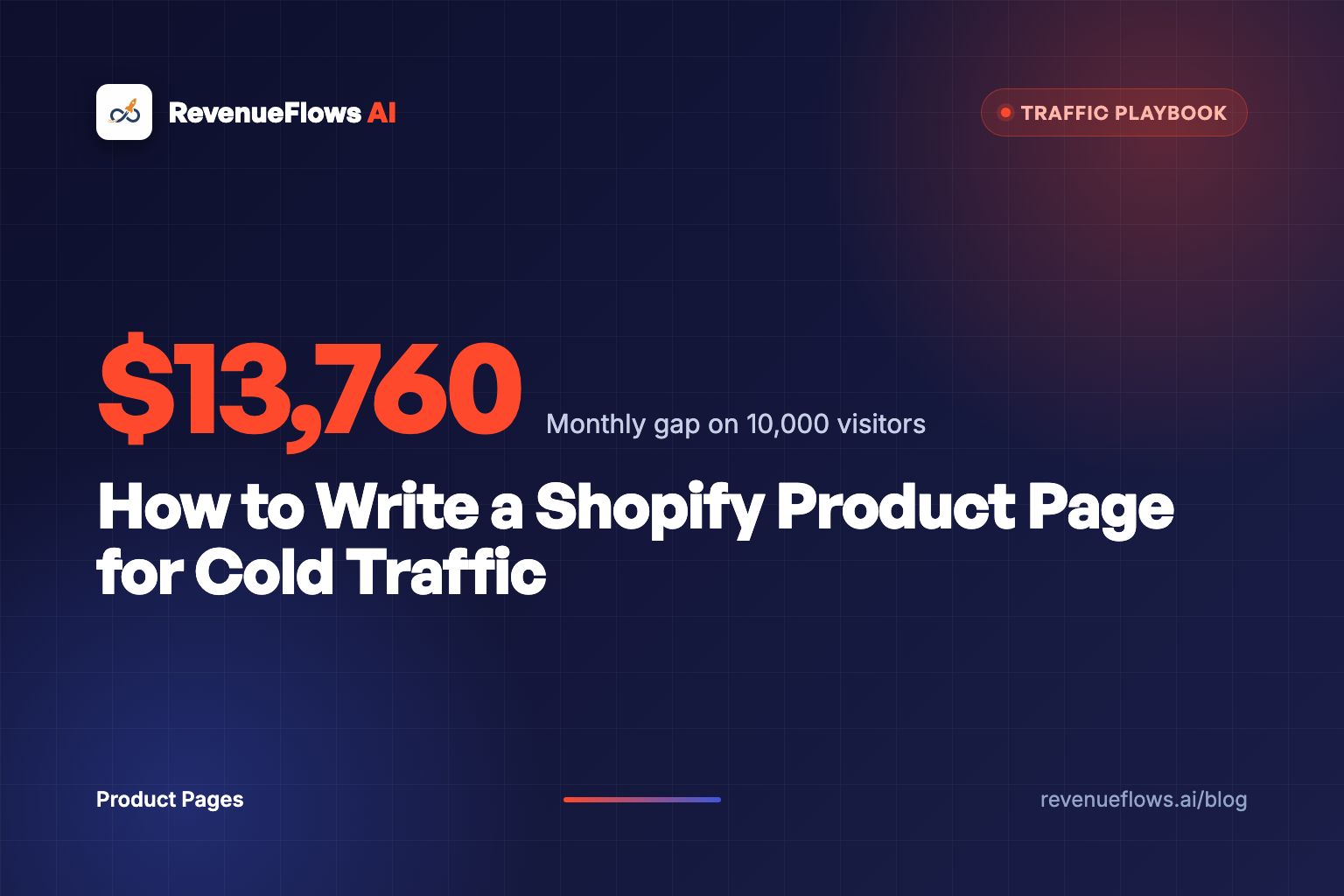
Here's the math on a store like this. Conversion rate 0.8%, average order value $75. Revenue per visitor: $0.60. On 10,000 cold visitors, that's $6,000.
Now make the five changes below. Conversion rate 1.9%, average order value $104, because a stranger who believes you buys the bundle instead of testing you with the cheapest variant. Revenue per visitor: $1.98. Same 10,000 visitors, same ad spend: $19,760.
A $13,760 gap, and not one new click involved.
What makes cold traffic different from every other visitor?
Three things are missing, and your page is written as though none of them are.
A warm visitor arrives with brand recognition, some trust, and a reason. They searched your name, or they got the email, or they saw you three times last week. Your product page can open with the product because the person already agreed to care about it.
A cold visitor was scrolling. Your logo means nothing to them. They don't know whether you'll ship, whether the reviews are bought, or whether you exist in twelve weeks. And they weren't shopping at all until eleven seconds ago.
That's the polarity that decides the page. Warm traffic asks "is this the right one." Cold traffic asks "is this real."
A product page written for warm traffic answers questions about the product. A page written for cold traffic answers questions about you. Most stores only built the first one, then bought traffic that needed the second.
Does your first screen repeat the promise from the ad?
Change one, and it carries more weight than the other four combined.
The ad sold something specific. Maybe it was "stop waking up at 3am sweating." The click lands, and the page says "Cooling Bamboo Sheet Set, 400 thread count, OEKO-TEX certified." Technically the same product. Emotionally a different planet.
That gap has a name: message match. And it's the most common leak I find on cold traffic pages, because the ad gets written by whoever runs media and the page gets written by whoever runs the store, and the two documents never meet.
The fix is mechanical. Take the exact promise in your top-spending creative and make it the first line above the price:
| What the ad said | What the page usually says | What the page should say |
|---|---|---|
| Stop waking up sweating | 400 thread count bamboo | Sleep through the night without kicking the covers off |
| Never untangle a cord again | 6,000 Pa suction, LiDAR | It cleans while you're at work and empties itself |
| Fits in a carry-on | 42L capacity, polycarbonate | Carry-on legal on 23 airlines, checked at zero of them |
One line. Free to change. It's the difference between a visitor recognising the page and a visitor bouncing back to the feed.
What has to be true in the first three seconds?
A cold visitor makes a stay-or-go decision before they've read a paragraph. Three things have to survive that moment.
They need to know what the thing is, who it's for, and that other humans have already bought it and lived. Not a brand story. Not your founder photo. Not a carousel of lifestyle shots that could belong to any of forty brands.
So put one specific customer sentence up next to the price, and make it the sentence that names the objection. "I was sure a robot vacuum would choke on my golden retriever. Six weeks, zero tangles." That beats 900 star ratings sitting below the fold, because a cold visitor doesn't scroll looking for reassurance nobody promised them.
Then the boring stuff, visible without a click: what shipping costs, how long it takes, and what happens if they hate it. Shopify's own landing page benchmarks keep pointing back at the same lever, which is that clarity in the first viewport moves conversion more than anything below it.
How do you build trust with somebody who has never heard of you?
Cold traffic buys evidence, and there are only four kinds worth putting on the page.
- Customer language. Real sentences with specifics in them, not "Great product, love it!"
- Photos that aren't yours. Customer images do a job your studio shoot can't, because the studio shoot proves you have a budget, not that the product works.
- A number you'd be embarrassed to fake. "4,182 units shipped since March" is worth more than "loved by thousands."
- The unflattering fact. Publish the thing that costs you a sale. It's the cheapest trust you will ever buy.
That last one is the move most founders won't make. And it's the one that separates you from the four other brands running the same creative angle at the same audience this week. I go deeper on it in how to write a Shopify product page for Facebook ads traffic, where the same logic applies at the channel level rather than the temperature level.
Should cold traffic get its own landing page?
Here's where I'll break with most media buyers.
Build a separate landing page and you've now got two URLs to maintain, your reviews live on one of them, your schema lives on the other, and in four months the landing page is quietly out of date because nobody remembered it existed when the product changed.
Rewrite the product page instead. It works for paid, organic and email at once, it keeps the review count in one place, and it's the page Google already knows about. A product page that survives a stranger will not hurt your warm traffic. Warm buyers skim past the reassurance they didn't need; cold buyers stop and read it.
The exception is a genuine offer page: a bundle, a quiz result, a limited drop with its own economics. That earns a separate URL because it's a different product, not a different temperature.
What this looks like on a real catalog
If you sell 60 products, don't rewrite 60 pages for cold traffic. You'll stall by week two.
Take the three products your ad account actually spends on. Rewrite those. That's the same approach behind the bedding brand result we publish: three hero products, not the whole store. Before: conversion rate 1.0%, average order value $125, revenue per visitor $1.25. After: conversion rate 3.5%, average order value $231, revenue per visitor $8.10. On 10,000 visitors, that's $12,500 before and $81,000 after. You can see the full case study numbers on our results page. Real client numbers, not typical results, and not a promise of what your store will do.
The teardown format works the same way for a single category. Shopify robot vacuum product page optimization walks the five gaps in one high-ticket niche, and Shopify cold plunge product page optimization does it where freight and install decide a $4,000 order.
Cold traffic doesn't need more budget. It needs a page that assumes nothing, promises the same thing the ad did, and tells the truth early enough to be believed.
Frequently asked questions
What conversion rate should I expect from cold traffic? Between 0.5% and 1.2% on a standard product page, against 3% to 5% for warm traffic. Pages rewritten for strangers land nearer 2% to 3.8%, so most of the gap is writing, not targeting.
Should cold traffic go to a product page or a landing page? Rewrite the product page. A second URL splits your reviews and your schema, and most stores never keep it current. The exception is a genuine bundle or quiz offer with its own economics.
What is message match? The first line on the page repeats the exact promise that earned the click. If the ad sold "stop waking up sweating" and the page opens with thread count, the visitor doesn't recognise where they landed and leaves.
How many reviews does a cold visitor need? Placement beats volume. One specific customer sentence that names the objection, sitting next to the price, outperforms hundreds of star ratings below the fold.
Does cold traffic need a discount? Usually no. Conversion rate 0.8% at a $75 average order value is $0.60 per visitor. Conversion rate 1.9% at $104 is $1.98. On 10,000 visitors that's $6,000 against $19,760, with the price left alone.
Book Your Profit Audit
Five changes. No new creative, no audience rebuild, no extra ad spend. Just a page that stops assuming the visitor already likes you.
If you'd rather see it done than do it, get your free profit audit and we'll show you exactly where your revenue per visitor is leaking on cold clicks, then rebuild a high converting product sales page in less than 15 minutes so you can point your next campaign at it.
Frequently asked questions
What conversion rate should I expect from cold traffic?
Cold paid social traffic typically converts between 0.5% and 1.2% on a standard product page, against 3% to 5% for warm traffic like email and retargeting. Pages written specifically for strangers tend to land in the 2% to 3.8% band, so the gap is a writing problem long before it is a targeting problem.
Should cold traffic go to a product page or a landing page?
Send it to a product page that has been rewritten for strangers. A separate landing page splits your reviews, your schema and your maintenance across two URLs, and most stores never keep the second one current. Fix the page you already have and it works for paid, organic and email at the same time.
What is message match and why does it matter for cold traffic?
Message match means the first line a visitor reads repeats the exact promise that made them click the ad. A cold visitor has about three seconds of patience and no reason to hunt. If the ad sold quieter sleep and the page opens with bamboo fibre density, the click is already gone.
How many reviews does a cold visitor need to see?
Volume matters less than placement. One specific customer sentence that names the objection, sitting above the fold next to the price, does more for a stranger than 900 star ratings buried below the fold. Cold visitors do not scroll to go looking for reassurance they have not been promised.
Does cold traffic need a discount to convert?
Usually no, and discounting cold traffic is how stores train buyers to wait. Run the math on a store like this: conversion rate 0.8% at a $75 average order value is $0.60 per visitor, while 1.9% at $104 is $1.98. On 10,000 visitors that is $6,000 against $19,760, with the price untouched.