
How to Write a Shopify Product Page for Affiliate Traffic
Affiliate traffic lands already sold by somebody else. Most product pages start the pitch over from zero and lose the sale in the first screen. Here's how to finish the promise instead.

Here's a question worth asking before you recruit one more partner: what does your product page say to a visitor who has already been sold?
Because that is the whole difference with this channel.
The rule for how to write Shopify product page for affiliate traffic is one line: finish the promise somebody else already made.
Start from the fact that the visitor did not arrive curious. They arrived convinced. Somebody they trust, a reviewer, a niche blogger, a coupon site, a YouTuber with 40,000 subscribers, already made the argument, handled two objections, and named the exact product. Your page has one job, which is to finish that promise. Most pages do the opposite. They start the pitch over from the top, in brand voice, with a hero image and a tagline nobody asked for, and the visitor's certainty leaks out through the floor.
Referral and affiliate clicks tend to convert at the high end of ecommerce channels because they arrive pre-qualified. That head start is yours to lose in the first screen.
Why does affiliate traffic bounce off a page that works fine for everything else?
Because your page was built for a stranger.
A Facebook click is cold. It needs the hook, the proof, the objection handling, the whole ladder. So that is what most product pages are: a ladder from zero. Then affiliate traffic lands on step one of a ladder it already climbed, and the visitor feels the reset. He came in reading "the 8mm amplitude one is the only massage gun that actually reaches the glutes" and he lands on "Premium Percussive Therapy. Redefined."
Those are two different conversations. He clicked for the first one.
Cold traffic needs to be convinced. Affiliate traffic needs to be confirmed. Same page, two completely different jobs.
The tell shows up in your analytics as a high add-to-cart rate with a weirdly low click-through from the landing page, or as a segment that converts fine on mobile and dies on desktop where the buyer opens the review in the other tab and compares your wording to it side by side.
What does affiliate traffic already know when it lands?
Three things, and they are all specific.
It knows the exact product, usually including the variant, the size, or the model number the affiliate named. It knows one or two reasons to buy, phrased in the affiliate's words, not yours. And, half the time, it knows there is supposed to be a code.
Everything you write should assume those three and continue from there. What it wants next is narrow: is this the same product I just read about, is the price what I was told, and is there any reason not to do this now.
How do you write the page for it?
Six moves. None of them require a rebuild.
1. Echo the affiliate's language in the first 100 words. If the review sold "8mm amplitude for glutes and hamstrings," the words "8mm amplitude" belong above the fold, not in a specs table on tab three. The visitor is doing a match check, and he does it in about four seconds. Give him the match.
2. Land him on the exact variant. Not the collection. Not the parent product with six unselected options. The affiliate said "the 16 inch, in walnut." That is what should be pre-selected, in the cart, priced, with the walnut image on screen. Every extra choice you make him repeat is a place to reconsider.
3. Show the code applied, not the code available. Pre-apply the discount in the affiliate link and display it on the page as an applied line: "Partner price, $109, discount applied." A visitor who has to hunt for a working code goes to a coupon aggregator, and that aggregator is happy to hand him a competitor.
4. Quote the referrer near the buy box, when it helps. One line from the review, attributed, sitting beside the button. This does real work for editorial and creator traffic because the buyer chose that voice. Skip it for cashback and coupon traffic, where the visitor is transactional and wants the price, the shipping date, and the return window.
5. Answer the one objection the affiliate could not. Reviewers cover performance. They almost never cover your return policy, your warranty terms, your shipping speed, or what happens when a part fails in month seven. Those are the questions that stall a pre-sold buyer, and they are yours to answer. Trust signals like a clear return policy carry outsized weight on referred traffic precisely because the affiliate skipped them.
6. Put the order size lever right there. A pre-sold buyer is the cheapest person on your site to sell a second item to. The bundle, the refill, the extra attachment, the two year protection plan. This is where your average order value moves, and it is the number your commission comes out of.
| What the visitor is thinking | What most pages show them | What holds the sale |
|---|---|---|
| "Is this the one he reviewed?" | Brand tagline and hero shot | The affiliate's exact words, in the first screen |
| "The blue one, 16 inch." | Unselected variant picker | The named variant, pre-selected and priced |
| "Where's my code?" | Empty discount field at checkout | Discount pre-applied and visible on the page |
| "Can I trust the shop, not just him?" | Nothing | Returns, warranty, ship date near the button |
| "Anything else I'll need?" | Related products carousel | The refill or bundle, priced as one decision |
What about coupon and cashback traffic specifically?
Treat it as a different audience wearing the same channel label.
Editorial and creator traffic is warm and person-led. Coupon traffic is price-led and it is often already in your funnel, one tab over, mid-checkout, looking for a code before it commits. Writing both the same way is how brands conclude that "affiliate traffic doesn't convert" when what they have is one segment being served the wrong page.
For the coupon segment, strip it back. Price, savings shown as applied, shipping cost, delivery date, return window. No brand story. He is not reading it.
What does this do to revenue per visitor?
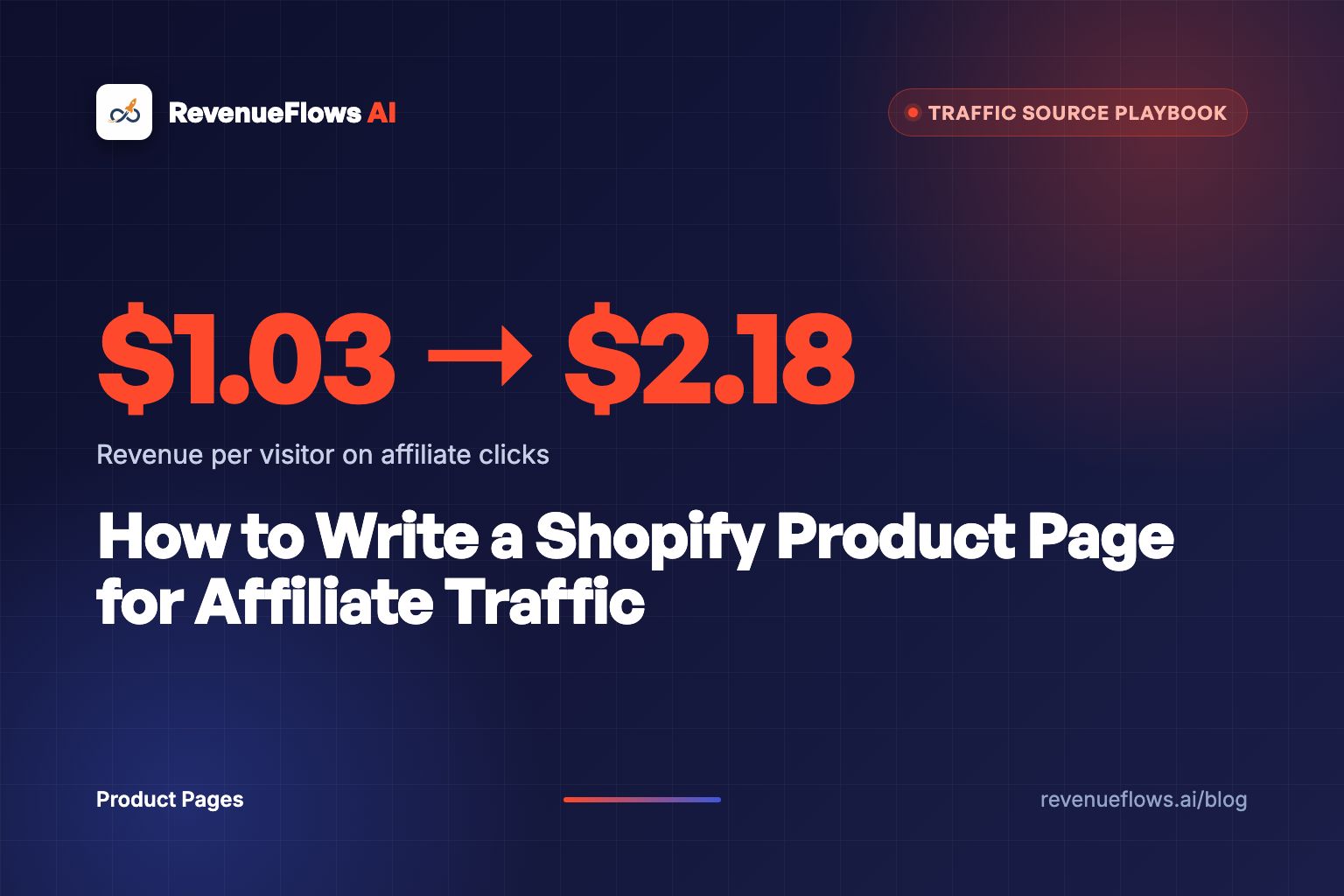
Run the math on a store like this, hypothetically. Affiliate traffic converting at 1.2% with an $86 average order value. That means revenue per visitor is $1.03. On 10,000 affiliate clicks, that's $10,300.
Now the page confirms instead of re-pitching, the variant is pre-selected, the code is applied, and the refill bundle sits under the button. Conversion rate 2.1%, average order value $104. Revenue per visitor: $2.18. Same 10,000 clicks, same partners, no new recruiting: $21,800.
That's $11,500 a month, and your commission rate did not change.
The same mechanism showed up on a bedding brand stuck at a revenue ceiling. Before, their conversion rate was 1.0% and their average order value was $125. That means their revenue per visitor was $1.25. On 10,000 visitors, that's $12,500. After we rebuilt their top three product pages: conversion rate 3.5%, average order value $231, revenue per visitor $8.10. On the same 10,000 visitors, that's $81,000, a 6.5x lift. See the full case study numbers. Real client numbers, not typical results, and not a promise of what your store will do.
A partner program does not have a traffic problem. It has a landing problem, and the landing is a page you already own.
When is the affiliate the problem, not the page?
Sometimes it really is the partner.
If a publisher is sending you clicks from a "best 12 X of 2026" listicle where your product is number nine and the copy is scraped from your own specs, that reader is not pre-sold. He is browsing. No page rewrite fixes browsing traffic, and you should price that partnership accordingly.
Same with incentivized clicks and traffic from tools that promise volume. Watch for a segment that adds to cart at a normal rate and then converts at a fraction of it. That pattern is usually a partner quality issue, not a copy issue, and I would rather you cut the partner than keep rewriting the page for it.
The honest test is per-partner revenue per visitor. Segment it, sort it, and act on the bottom third.
What to do next
Pick your single highest-volume affiliate partner. Open their review or their page, read it as your buyer does, then click through to your product page and read that immediately after. The gap between those two documents is the sale you are losing.
Close that gap on one product this week. A pre-sold buyer with a stalled question behaves exactly like a skeptical buyer, which is why the same answers work on both. And the higher the price, the more the missing operational answers cost you, which is what makes a golf simulator product page so unforgiving and a massage gun product page so easy to fix in an afternoon.
Get your free profit audit and we'll show you exactly where your affiliate clicks are leaking, then rebuild that page into a high-converting product sales page in less than 15 minutes.
P.S. Go read the last review that sent you 200 clicks, then count how many of its exact phrases appear anywhere on the page it points to. If the answer is zero, you are paying commission to restart a conversation somebody already finished for you.
Frequently asked questions
Does affiliate traffic convert better than paid traffic?
Usually yes, because the visitor arrives pre-sold by a person or a review they already trust rather than by an ad they scrolled past. That advantage is fragile. If your page reintroduces the product from scratch instead of continuing the argument the affiliate already made, you hand back the head start in the first screen.
Should affiliate traffic go to a product page or a dedicated landing page?
Send it to the product page for a single named product, and to a dedicated page only when the affiliate is selling a bundle, a comparison, or an offer your catalog page cannot express. The deciding question is whether the visitor can buy the exact thing the affiliate described within one screen of landing.
Why do coupon site visitors abandon at checkout?
Because they came for a specific code and the code either fails, stacks badly, or is nowhere on the page. A visitor who hunts for a working code in another tab is a visitor you have handed to a competitor's coupon page. Pre-apply the discount in the link and show it applied on the product page.
Should you show the affiliate's name on the product page?
Show the source when it is a person or publication your buyer chose to trust, using their words as a short quote near the buy box. Do not do it for anonymous coupon and cashback traffic, where the visitor cares about the price and the return policy, not the referrer.
How do you measure whether affiliate traffic is profitable?
Segment revenue per visitor by referrer, not conversion rate. A partner sending 1.2% conversion at an $86 average order value earns you $1.03 per click, while a partner at 2.1% and $104 earns $2.18. Commission is paid out of that second number, which is why fixing the page changes which partnerships make sense.