
Alexa for Shopping Ranking Factors: Which Listings Get Named
Amazon has never published how its AI picks products. So stop buying formulas and run the test yourself: shopper questions in, named listings out, then compare what the winners have in common.

Everybody selling an Amazon AI course this fall has a ranking formula. Amazon hasn't published one.
Here's the honest answer on Alexa for Shopping ranking factors. Amazon says its assistant answers from listing details, customer reviews and community Q&As, plus what it knows about the shopper. It has never released weights. The best public studies point the same direction: products under 4.0 stars almost never get named, most picks are Prime and FBA, and organic rank predicts surprisingly little. So the only ranking factors you can trust are the ones you measure on your own category. This post gives you the study design to do it in about 6 hours.
I'll show you what the published research found, where it stops, and the exact spreadsheet I'd use to find out which listings get named in your niche and why.
What do we actually know about Alexa for Shopping ranking factors?
Less than the gurus claim. More than nothing.
Start with the facts from Amazon itself. On May 13, 2026, Amazon renamed Rufus to Alexa for Shopping. Amazon's launch announcement says the new assistant combines Rufus's product knowledge with Alexa+'s knowledge of you, and that "your conversations, browsing, and purchases on Amazon" make it more helpful. It sits in the main search bar of the Amazon app and website, in its own chat window, and on product detail pages. It's free for signed-in U.S. customers. Amazon also says Rufus helped more than 300 million customers research, compare and buy in 2025.
Then there's the original Rufus page, which now carries a note that Rufus was renamed. Amazon wrote that Rufus was trained on its product catalog, customer reviews, community Q&As and information from across the web, and that it "generates answers based on listing details, customer reviews, and community Q&As."
That's the whole official list. Three inputs you control or influence (listing details, reviews, Q&A), one you partly influence (what the web says about you), and one you can't touch at all (the shopper's own history).
Notice what's missing. No word on organic rank. No word on ad spend. No word on sales velocity.
Amazon told you what the assistant reads. It never told you what it rewards. Everything past that line is a guess until you test it.
There's one more official clue worth knowing. Amazon's science team published a system called COSMO at the SIGMOD 2024 database conference. Per Amazon Science, COSMO mines search queries paired with purchases, and products bought together, to learn relationships like "used for audience" or "used for event." Their example links slip-resistant shoes to pregnant women. Amazon hasn't said COSMO powers Alexa for Shopping. But it shows how Amazon thinks about matching a product to a need: through the situation the buyer is in, described in plain words.
That's the thread to pull on. The assistant matches situations. Your listing either names the situation or it doesn't.
How does Alexa for Shopping recommend products, according to the published studies?
Three studies are worth reading. Two looked at Rufus before the rename. One looked at Alexa for Shopping after it. None of them is ours, and I'm citing each one with its own caveats, because the caveats matter as much as the numbers.
| Study | When | Sample | What it measured |
|---|---|---|---|
| AMALYTIX Rufus pattern analysis | Published Nov 25, 2024 | 1,300+ recommended ASINs from the top 500 generic U.S. search terms | Ratings, reviews, Prime, FBA, organic rank, titles, images, A+ |
| Mars United Commerce and Profitero+ | Published Dec 1, 2025 | 1,000+ products from about 300 prompts over 2 months | Reviews, ratings, overlap with page 1 search |
| Autopilotbrand, reported by Marketplace Pulse | Captured May and June 2026 | 12,810 recommendations from 1,963 non-branded queries, one U.S. account | Organic rank and sponsored placement vs AI picks |
Here's what each one found.
The rating floor. AMALYTIX found Rufus didn't appear to recommend anything below a 4.0 average rating. The median recommended product sat at 4.5 stars, with the middle half between 4.3 and 4.7. Mars United landed in the same spot: Rufus only recommended products rated 4 stars or higher.
Review volume. The AMALYTIX median was 2,991 reviews, with the middle half running from 640 to 12,733. Mars United reported an average of roughly 9,000 reviews, and found products with a single review were recommended only 0.2% of the time.
Fulfillment. In the AMALYTIX set, 94.2% of picks were FBA and 92.1% were Prime eligible. 98.4% were in stock.
Content. Median title length was 166 characters. Median image count was 7. 55.1% of picks had A+ content and 32.1% had A+ Premium. 41.8% carried the Amazon's Choice badge.
Organic rank. This is where it gets strange. The median organic rank of a recommended product was 41 in the AMALYTIX data. Only 7.3% held rank 1.
Mars United found the same gap from the other side. Only 22% of page 1 search results also showed up in Rufus recommendations, and 36% of Rufus picks weren't on page 1 at all.
Then the 2026 data, after the rename.
Source: Autopilotbrand data reported by Marketplace Pulse, 12,810 recommendations, one U.S. account. A snapshot, not a benchmark.
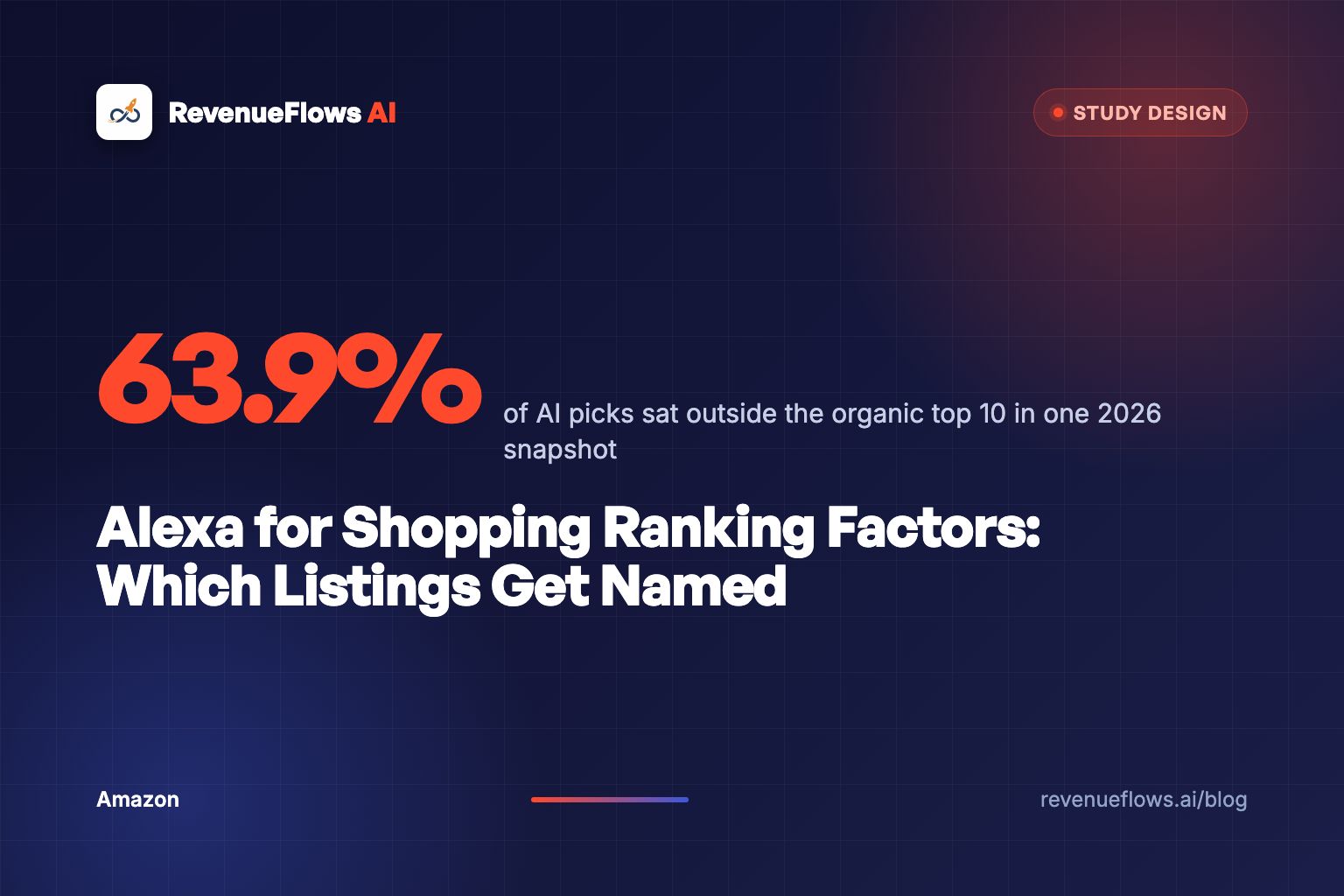
63.9% of the assistant's picks sat outside the organic top 10 for the matching search. 40.9% never appeared on the visible results page at all. Only 14.3% were running a sponsored listing on that page, and 83% of those already ranked organically.
If you paid for your rank and your ads, and the assistant named someone on page 3, you didn't lose a ranking battle. You lost an answer.
Why can't you copy these numbers straight into your listing plan?
Because every one of these studies has the same three holes. And I'd rather you hear it from me than find out after you've rewritten 40 listings.
Hole one: correlation. AMALYTIX says it plainly on its own page: correlation does not equal causation. A median of 7 images among picks doesn't mean the 7th image gets you named. Big brands with 9,000 reviews also tend to have 7 images, A+ Premium and FBA. The assistant might be rewarding the reviews, and the images just came along for the ride.
Hole two: one account. The Marketplace Pulse report calls its own data "a single snapshot from one US account, captured early." Amazon says the assistant uses your browsing and purchase history. So a different shopper with a different history may see different picks. Nobody has published a multi-account study of Alexa for Shopping that I could verify this session.
Hole three: the assistant changed. Two of the three studies measured Rufus. Rufus was renamed and merged with Alexa+ in May 2026. Amazon says the product knowledge carried over, which is why I still think the Rufus findings are useful. But "useful" and "current" aren't the same word.
Here's the part nobody seems to notice. None of the three studies scored attribute completeness, and none checked whether the listing's text actually answered the question the shopper asked. Those are the two things you control most directly. They're also the two things the official Amazon description points at hardest: "listing details" and "community Q&As."
So the gap in the public research is the exact place your money is.
The published studies measured what big brands have. Your study should measure what any seller can fix by Friday.
I sold on Amazon for years. Every algorithm change came with a wave of people selling certainty about it. The ones who did well were never the ones who bought the certainty. They were the ones who ran 30 searches on their own category and wrote down what they saw.
How do you run your own Alexa for Shopping ranking study?
Here's the design. It costs nothing but time, and the first round takes about 6 hours for one category.
- Write 30 real shopper questions for one category.
- Ask each question 3 times, on 2 different days.
- Log every product the assistant names, in order.
- Run the matching keyword search and log page 1.
- Score every named and skipped listing on 10 attributes.
- Compare named listings against skipped ones, band by band.
- Change one thing on your listing, wait 14 days, rerun.
Now the details that make it hold up.
Step 1: Write questions shoppers actually ask
Don't write keywords. Write sentences. And spread them across 5 question types, 6 of each:
| Question type | Example (insulated tumbler category) | What it tests |
|---|---|---|
| Best of | "What's the best 40 oz tumbler for long road trips?" | General pick logic |
| Use case | "Which tumbler keeps ice overnight in a hot car?" | Whether listings name the situation |
| Constraint | "Will a 40 oz tumbler fit a Honda Civic cup holder?" | Whether specs are stated in text |
| Comparison | "Is a straw lid or a flip lid better for a tumbler in a backpack?" | Whether listings handle the tradeoff |
| Problem | "My tumbler lid leaks when it tips. Which one doesn't?" | Whether reviews and Q&A back the claim |
Pull the wording from your own 1 to 3 star reviews, your community Q&A, your competitors' 3 star reviews and your customer service inbox. If you can't find 30 questions there, you don't know your buyer well enough yet. That's a finding too.
Step 2: Control the account problem
The assistant knows who's asking. So pick one approach and write it down before you start.
The cleanest version: use one signed-in account that hasn't browsed your category, and never click a product during the study. If you have a second account with a different history, run 10 of the 30 questions on it as a check. If the named products barely overlap, personalization is doing heavy lifting in your category, and you should weight your findings down.
Ask each question 3 times on day 1 and 3 times on day 2. AMALYTIX reran 10 keywords 5 extra times each to test consistency. You want the same thing on a smaller scale: a product named in 5 of 6 runs is a real pick. A product named once is noise.
Step 3: Log every named product
For each run, record the ASIN, the brand, the position in the answer (first named, second named, and so on), and the exact sentence the assistant used about it. That sentence is the most valuable cell in the sheet. It tells you which words from the listing or reviews the assistant chose to repeat.
Step 4: Log the matching search
For each question, run the plain keyword version in the regular search ("40 oz tumbler"). Log the page 1 organic results and the sponsored ones. The page 1 listings the assistant never named are your control group. Without a control group, you're just describing winners, which is exactly the trap the published studies fell into.
Step 5: Score every listing on 10 attributes
This is the sheet. One row per ASIN, named or skipped.
| Column | How to score it |
|---|---|
| Named rate | Runs where it was named, out of 6 |
| Star rating | From the detail page |
| Review count | From the detail page |
| Price | Current price on the day you check |
| Prime / FBA | Yes or no |
| Attribute completeness | Filled fields in the "Product information" section, out of the most filled competitor in your set |
| Answer in text | Does the title, a bullet or A+ text state the answer to the question, in words? Yes, partial, no |
| Answer in reviews | Do at least 3 reviews mention the answer? Yes or no |
| Q&A coverage | Is the question, or a close version, answered in community Q&A? Yes or no |
| Organic rank | Position on the matching keyword search |
Two notes. Attribute completeness from the outside is rough, because you can only see what Amazon displays. On your own listings, use the full attribute list in Seller Central instead. And "answer in text" must be scored by someone who didn't write the listing. Sellers grade their own copy generously. I've done it myself.
Step 6: Compare named vs skipped, band by band
Now group the rows into bands and read the share named in each one. This is the chart the whole study builds toward:
| Attribute completeness band | Listings in band | Named at least 5 of 6 runs | Share named |
|---|---|---|---|
| 0 to 49% | your count | your count | your % |
| 50 to 74% | your count | your count | your % |
| 75 to 89% | your count | your count | your % |
| 90 to 100% | your count | your count | your % |
Do the same for "answer in text" (yes, partial, no), for rating (under 4.0, 4.0 to 4.4, 4.5 and up) and for review count (under 100, 100 to 999, 1,000 and up). If the share named climbs cleanly as completeness climbs, and it holds inside each rating band, you've found something the public studies couldn't show you.
That last part matters. Check it inside rating bands. If every complete listing is also a 4.6 star giant, completeness isn't proving anything yet.
Step 7: Change one thing and rerun
Pick your own listing that scored "no" on answer in text for 5 or more questions. Rewrite only the bullets and attributes so they answer those questions in plain words. Don't touch price, images or ads. Wait 14 days. Rerun the same 30 questions on the same account.
If your named rate moves and nothing else changed, that's the closest thing to proof a seller can get.
Six hours, 30 questions and one honest spreadsheet will teach you more about your category than every guru deck about Amazon's AI combined.
Do Amazon AI recommendations still care about keywords and organic rank?
Yes, just less than you'd hope.
Regular keyword search still exists, and plenty of shoppers still type "40 oz tumbler" and scroll. Your title and backend terms still carry that traffic. I covered what carried over from the Rufus days in the Rufus listing playbook that still works in 2026, and the side-by-side of what changed is in the Alexa for Shopping listing fixes.
But here's the thing. The data says rank and recommendation are two different races. In the AMALYTIX set the median pick ranked 41st. In the 2026 snapshot almost two thirds of picks sat outside the top 10. You can win the keyword and still not get named when a buyer asks a full question.
So read the two races separately in your study. A listing that ranks top 3 but never gets named is telling you its copy is a spec sheet. A listing on page 3 that gets named in 6 of 6 runs is telling you its copy answers something real. Open it. Read the bullets. That's your competitor now, whatever its rank says.
This shift isn't only on Amazon, by the way. ChatGPT, Google and Perplexity all shortlist products from plain-language questions. If you want the wider picture, the AI shopping agents explainer lays out how each one works. And if you sell on Shopify too, the agentic commerce checklist covers the 40 store-side fixes those agents read.
What is getting named actually worth?
Here's the math on a hypothetical listing. Run the math on a store like this, not on a promise.
A $29.95 insulated tumbler. Unit session percentage (Amazon's conversion rate) of 12%. That means revenue per visitor is $3.59 (12% x $29.95). On 10,000 sessions a month, that's $35,940.
Now say getting named in assistant answers adds 1,500 sessions a month, and those shoppers convert at the same 12%. That's 180 more orders. At $29.95, that's $5,391 more a month, with no new ad spend.
Hypothetical. 10,000 sessions before, 11,500 after being named. Sessions x conversion rate x price. Illustration only, not a forecast.
I'd guess the real effect is bigger, because a shopper who typed a full question is usually closer to buying than one who typed two words. But I can't prove that with public data, so I didn't put it in the chart. That's the standard I'd hold your study to as well.
And remember the ceiling. Every one of those sales still pays Amazon's referral fee. On our Amazon page we lay out the math: platforms like Amazon take 15% of every sale, which is $150,000 in referral fees for every $1 million you sell.
Compare that to a product that got its own page. One animal repellent we moved from Amazon to Shopify went from a $17.95 Amazon price and $3.83 net profit per sale to a $101.38 average order value and $48.27 net profit per sale, after paying for ads and inventory. See the full case study numbers. Real client numbers, not typical results, and not a promise of what your store will do. The product-level walkthrough lives in the Amazon to Shopify case study.
Getting named on Amazon gets you the sale. Owning the page decides how much of the sale you keep.
What patterns should you expect to find?
I won't hand you results I didn't measure. But I can tell you what to watch for, based on what Amazon says the assistant reads and what the three studies show.
Expect a hard floor. If your listing sits under 4.0 stars, two separate studies say you'll rarely get named. Fix the product or the expectation gap that's causing the low reviews before you touch the copy. No bullet rewrite beats a 3.7.
Expect the answer sentence to come from somewhere. When you log the exact sentence the assistant used about a product, check where it came from. Was it a bullet? An attribute? A review? If it's mostly reviews in your category, your listing text is being skipped, and the fastest fix is stating the answer in your own bullets so the assistant has a seller-written version to quote.
Expect constraint questions to be the easiest wins. "Will it fit," "is it dishwasher safe," "how heavy is it." These have one right answer, and most listings bury it or leave it out. A competitor whose second bullet says "2.9 inch base fits most car cup holders" has a good shot at being named for the Honda Civic question. A listing that never states the base width has none.
Expect big brands to win best-of questions. With a median of 2,991 reviews among picks in one study and an average near 9,000 in another, "what's the best X" questions will lean toward volume. Smaller sellers should focus their study on use case, constraint and problem questions, where specificity can beat size.
If you want the full rewrite process for the copy side, the fatal flaw we keep finding in Amazon listing audits goes bullet by bullet. And for fees, Q4 deadlines and the rest of the year, the Amazon selling guide for 2026 is the hub.
Frequently asked questions
What are the Alexa for Shopping ranking factors? Amazon hasn't published them. It says the assistant answers from listing details, reviews and community Q&As plus the shopper's history, and independent studies found almost nothing named under 4.0 stars, heavy Prime and FBA share, and weak ties to organic rank.
How does Alexa for Shopping recommend products? It reads the question, then answers from catalog data, reviews, community Q&As and web information, plus the shopper's own history. A listing that states the answer in plain words gives it something to quote.
Does organic rank decide which products Amazon's AI recommends? Not on its own. In 12,810 recommendations captured in May and June 2026, 63.9% of picks sat outside the organic top 10, though that was one U.S. account.
Do sponsored ads get my product named? The public data says no. Only 14.3% of picks in that snapshot were running a sponsored listing on the page, and 83% of those already ranked organically.
How do I test which of my listings get named? Write 30 shopper questions, ask each 3 times on 2 days, log every named product, and compare named listings against the page 1 listings the assistant skipped.
What to do next
Tonight, open a blank sheet and write 30 questions for your best-selling category: 6 best-of, 6 use case, 6 constraint, 6 comparison, 6 problem. Pull every one from real reviews and Q&A.
Tomorrow, ask them. Write down every product that gets named and the exact sentence the assistant used.
That sheet is your ranking factor list. Nobody else has it.
Book Your Profit Audit
Amazon's AI decides which listing gets named, and your own product page decides how much you keep when the buyer says yes. Get your free profit audit and we'll show you where each product is leaking revenue, then show you how to rebuild a high-converting product sales page in less than 15 minutes.
Or go here to check it out → revenueflows.ai
P.S. A formula you bought tells you what someone else guessed. A study you ran tells you what Amazon's AI actually named. Run the study.
Frequently asked questions
What are the Alexa for Shopping ranking factors?
Amazon hasn't published them. Amazon says the assistant answers from listing details, customer reviews and community Q&As, plus the shopper's own history. Independent studies of Rufus picks found almost nothing under 4.0 stars, heavy Prime and FBA share, and weak ties to organic rank, so run your own test before you trust anyone's formula.
How does Alexa for Shopping recommend products?
It reads the shopper's question, then answers from what Amazon knows about each product: the catalog data, reviews, community Q&As and information from across the web, plus the shopper's own browsing and purchase history. That's why a listing that states the answer in plain words has a better shot at being named.
Does organic rank decide which products Amazon's AI recommends?
Not on its own. In 12,810 recommendations captured in May and June 2026, 63.9% of the picks sat outside the organic top 10 for the matching search, and 40.9% never showed on the visible results page at all. That was one U.S. account, so treat it as a strong signal, not a law.
Do sponsored ads get my product named by Alexa for Shopping?
The best public data says ads aren't the lever. Only 14.3% of picks in the May and June 2026 snapshot were running a sponsored listing on that search page, and 83% of those already ranked organically anyway.
How do I test which of my listings get named?
Write 30 real shopper questions per category, ask each one 3 times on 2 different days, log every product the assistant names, then compare the named listings against the page 1 listings it skipped on rating, reviews, attributes and whether the bullets answer the question.