
Triple Whale vs Northbeam for D2C Attribution in 2026
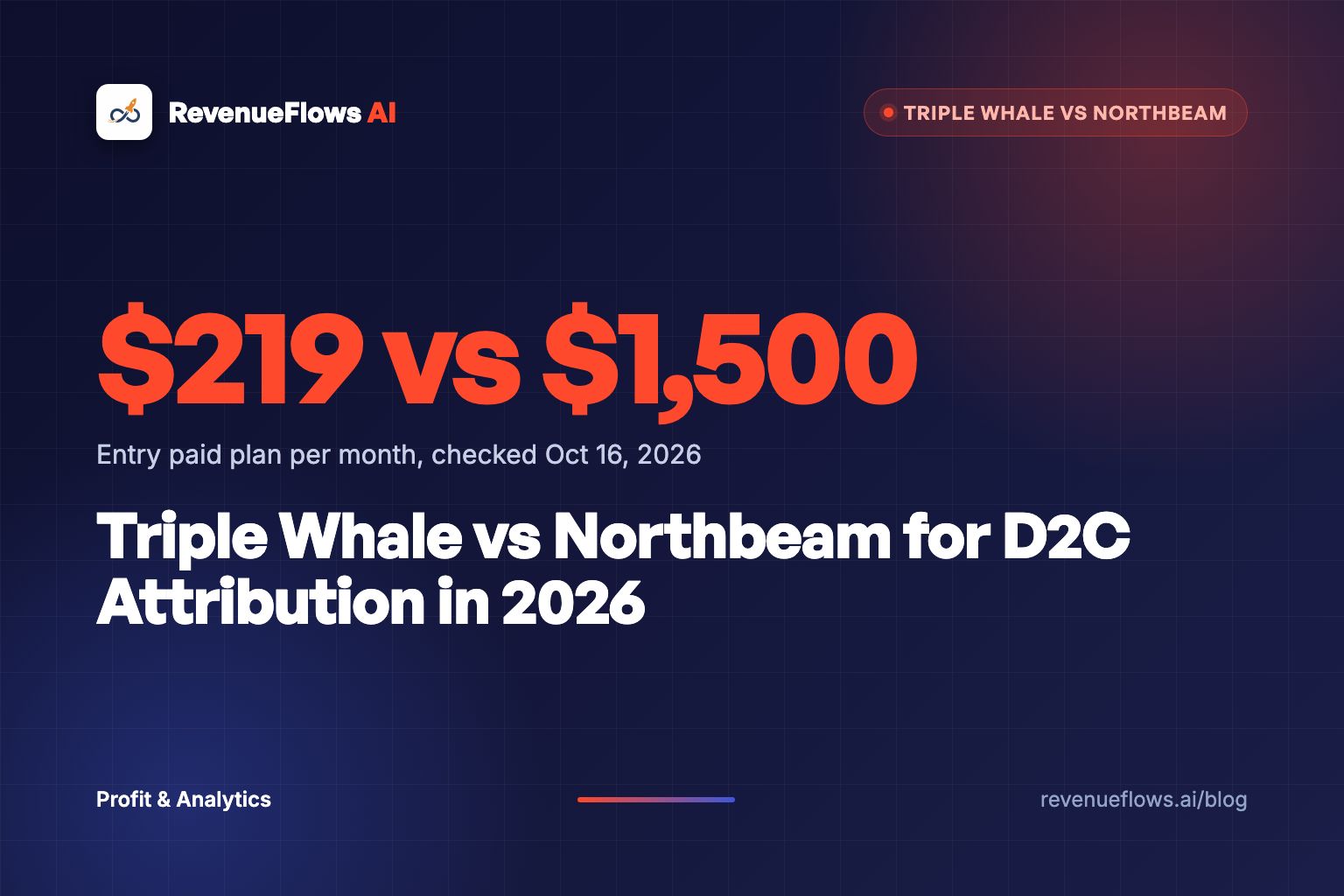
Triple Whale vs Northbeam is a $219 question against a $1,500 question. One is a dashboard your whole team can run. The other is a measurement program for brands with an analyst. Here's the split, checked on both vendors' pages today.

Most founders asking this are asking the wrong question.
Here's the short answer on Triple Whale vs Northbeam. Triple Whale is the all-in-one dashboard: attribution, profit, creative reports and an AI operator, with a free plan and a $219 a month Foundation plan on its Shopify listing. Northbeam is the measurement specialist: first-party multi-touch attribution, view-through credit, media mix modeling and incrementality, starting at $1,500 a month on its own pricing page.
If you spend under about $1.5M a year on ads and nobody on your team owns measurement full time, pick Triple Whale. If you spend six figures a month across five or more channels and you have an analyst who will live in the models, Northbeam earns its price.
That's the verdict. The rest is the table, the math, and the thing neither tool can fix.
Why are D2C founders choosing between Triple Whale and Northbeam?
Because the ad platforms grade their own homework.
Meta says it drove 140 orders. Google says it drove 90. TikTok claims 35. Shopify shows 180 orders total. Somebody's lying, or more honestly, everybody's counting the same buyer. Even Shopify and GA4 won't agree on the same store, and Shopify analytics vs Google Analytics explains why. An attribution tool is the referee. It drops its own pixel on your store, follows each buyer across clicks and devices, and splits the credit one way.
So the search makes sense. But I'll say the quiet part. I've sat in on budget meetings where the attribution debate ate the whole hour and nobody asked what happened to the buyers after they landed. The referee decided who scored. Nobody asked why the team kept missing open shots.
Hold that thought. We'll come back to it.
An attribution tool tells you which ad gets the credit. It can't tell you why most of the people it sent left without buying.
What does Triple Whale do best?
Breadth, and speed to a first useful dashboard.
The Triple Whale Shopify listing calls it an AI operating system for ecommerce. It shows 4.1 stars from 93 reviews, and 18% of those reviews are one star, so read the recent ones before you install. It launched in December 2020.
Here's what the plans include, per that listing:
- Free: 10 users, ad, Amazon, email and SMS integrations, a 12-month lookback, and first and last click attribution from the Triple Pixel.
- Foundation, $219 a month ($2,190 a year): multi-touch attribution, subscription data, custom dashboards and Moby, the AI operator that answers questions about your numbers.
- Automate, $749 a month ($7,490 a year): Moby automations, creative generation and autonomous actions.
One warning. Triple Whale's own pricing page shows no dollar figures at all when I opened it today. It asks for your annual gross merchandise value (under $1M, $1M to $10M, $10M to $100M, $100M+) and then says "Book a walkthrough." So the listing prices are your floor, and a bigger store should expect a quote. Its comparison table puts the heavy measurement (MMM, incrementality and multi-touch attribution in one place, which it calls Compass) on the Enterprise plan, through sales.
Where Triple Whale wins is the operator view. Profit, cohorts, creative, product analysis and attribution live in one tab your media buyer and your ops lead will both open.
What does Northbeam do best?
Depth. Northbeam is built for one job, and it's the job you hire an analyst for.
Northbeam's pricing page prices by annual ad spend, and today it lists four plans:
- Growth, custom quote: for brands spending under $200K a month, sold through a Northbeam agency partner.
- Starter, $1,500: for brands spending under $1.5M a year on ads. First-party multi-touch attribution across every ad channel, Northbeam Apex (custom attribution fed back to the ad algorithms), view-through conversions through C+DV, and the Northbeam MCP.
- Professional, $3,500 a month: for teams spending up to $500K a month. Unlimited users, data exports and integrations, any ecommerce platform (not only Shopify), a dedicated media strategist, and an incrementality add-on.
- Enterprise, custom: above $500K a month, with MMM+ and incrementality as add-ons.
The MMM+ page pitches daily model training and budget changes "daily, not quarterly," and claims it's the only media mix model that can ingest native multi-touch data. I can't verify that "only" claim. What I can say is the design: Northbeam wants to give a measurement team three lenses on the same spend.
Triple Whale is a dashboard your whole team can run. Northbeam is a measurement program somebody has to own.
How do Triple Whale and Northbeam compare side by side?
Every line below comes from Triple Whale's Shopify listing and pricing page or Northbeam's pricing and product pages, opened October 16, 2026. Prices are monthly list prices.
| Triple Whale | Northbeam | |
|---|---|---|
| Built for | All-in-one Shopify operator dashboard | Dedicated ad measurement |
| Free option | Free plan, first and last click | None listed |
| Entry paid plan | $219 Foundation (Shopify listing) | $1,500 Starter |
| Next plan | $749 Automate | $3,500 Professional |
| Prices by | Annual gross merchandise value | Annual ad spend |
| Prices on own pricing page | No, "Book a walkthrough" | Yes for Starter and Professional |
| Multi-touch attribution | Foundation and up | Every plan |
| Media mix modeling | Compass, Enterprise plan | MMM+, Enterprise add-on |
| Incrementality testing | Compass, Enterprise plan | Add-on from Professional |
| Profit and cohort reports | Yes | Not the focus |
| AI layer | Moby AI operator and automations | Northbeam MCP |
| Dedicated human help | Enterprise success coverage | Media strategist from Professional |
What does each tool cost on a real ad budget?
Here's the math on a hypothetical store. A supplement brand selling a $100 magnesium bundle. $20,000 a month on ads across Meta, Google and TikTok. 50,000 visitors a month, conversion rate 1.6%, average order value $100. That means revenue per visitor is $1.60. On 50,000 visitors, that's $80,000 a month.
Now the first-year bill at list price.
Monthly list price x 12, from Triple Whale's Shopify listing and Northbeam's pricing page, checked Oct 16, 2026. Triple Whale quotes larger stores by gross merchandise value.
Northbeam Starter costs that store $18,000 a year, about 1.9% of its $960,000 in revenue. Triple Whale Foundation costs $2,628, about 0.3%. The gap is $15,372 a year.
So here's the test I use. If the pricier tool costs more than 1% of revenue, it has to move a budget decision every single month to pay for itself. For Northbeam to beat Foundation on this store, its better credit split has to find $1,281 a month in wasted spend that Triple Whale wouldn't. On a $20,000 budget, that's 6.4% of everything you spend. Possible. Not something I'd bet on at this size.
What do both tools miss?
Back to the open shots.
Both tools split credit for the $20,000. Neither one changes what a visitor is worth once they land. A perfect attribution model still feeds every click into the same page converting at 1.6%.
Watch what happens if the bundle's page goes from 1.6% to 2.2% and the average order value climbs from $100 to $112. Revenue per visitor becomes $2.46. On the same 50,000 visitors, that's $123,200 instead of $80,000. That's $43,200 more a month, from traffic you already paid for.
That's the number no attribution upgrade produces. Moving 6% of your budget to a better campaign is a nudge. Making every click worth 54% more is a different business.
I've watched it happen on real stores. On one bedding client's Copper Bamboo Sheets, conversion rate went from 1.0% to 4.3% and average order value from $125 to $221. Revenue per visitor went from $1.25 to $9.50. On 10,000 visitors, that's $95,000 instead of $12,500. See the full case study numbers. Real client numbers, not typical results, and not a promise of what your store will do.
No attribution model found that $82,500. The page made it.
Attribution decides where the next dollar goes. The product page decides what that dollar comes back as.
Where does AI fit into attribution now?
Both vendors bolted AI on this year, and they picked different jobs for it.
Triple Whale's Moby is the operator. On Foundation it answers questions about your data, and on Automate it runs automations and generates ad creative. Northbeam's MCP opens your attribution data to an AI assistant you already use, so you can ask it questions in plain English.
Useful, both. But I'd keep my hand on the wheel. An AI reading attribution built on messy UTMs and missing product costs gives you a confident wrong answer, faster. Get cost per item into Shopify first. Our ecommerce profit analytics guide covers that setup, and contribution margin for ecommerce covers the number your attribution should be judged against.
Triple Whale vs Northbeam: which should you pick?
- Pick Triple Whale if you spend under about $1.5M a year on ads, you want attribution and profit in one tab, or you want to start free.
- Pick Northbeam if you spend six figures a month across many channels, a real share of it goes to video and view-through placements, and someone on your team will own MMM and incrementality.
- Pick neither yet if you can't say what each order left you after product cost, shipping, fees and ads. A profit tracker answers that for far less. Our Triple Whale alternatives and BeProfit alternatives breakdowns price those out, and Lifetimely vs Peel covers the cohort side.
What to do next
Open your ad accounts today and add up last month's spend. Multiply by 12. Under $1.5M, start on Triple Whale's free plan and see if first and last click already answer your budget questions. Then work out revenue per visitor on your top product page: conversion rate times average order value. If that number is under $2, fix the page before you pay for a sharper referee. Revenue per visitor vs conversion rate shows why that number beats conversion rate alone.
Frequently asked questions
What is the difference between Triple Whale and Northbeam? Triple Whale is an all-in-one Shopify dashboard with attribution, profit reports and the Moby AI operator. Northbeam is a dedicated measurement platform with first-party multi-touch attribution, view-through credit, MMM and incrementality.
How much does Triple Whale cost compared to Northbeam? Triple Whale's Shopify listing shows Free, $219 and $749 a month. Northbeam's pricing page lists Starter at $1,500 and Professional at $3,500 a month.
Is Northbeam more accurate than Triple Whale? Neither publishes an independent accuracy test, so nobody can honestly say. Northbeam's view-through credit and media mix model matter most when much of your spend goes to placements people see but don't click.
Which attribution tool is better for a store under $10M a year? Triple Whale for most stores that size. Northbeam's Starter plan has to save more than $18,000 a year in wasted spend to pay for itself.
Do Triple Whale and Northbeam offer media mix modeling and incrementality testing? Yes, at the top of each range. Triple Whale bundles both into Compass on Enterprise. Northbeam sells MMM+ on Enterprise and incrementality from Professional up.
Book Your Profit Audit
Triple Whale or Northbeam will tell you which ad sent the buyer. Get your free profit audit and we'll show you how much your top page leaks after that click and how to rebuild a high-converting product sales page in less than 15 minutes.
Or go here to check it out → revenueflows.ai
P.S. A better referee doesn't make the team score more. Fix the page the clicks land on, then argue about who gets the credit.
Frequently asked questions
What is the difference between Triple Whale and Northbeam?
Triple Whale is an all-in-one Shopify dashboard with pixel-based attribution, profit and creative reports, and an AI operator called Moby. Northbeam is a dedicated measurement platform built around first-party multi-touch attribution, view-through credit, media mix modeling and incrementality, priced for brands with large ad budgets.
How much does Triple Whale cost compared to Northbeam?
Triple Whale's Shopify App Store listing shows a free plan, Foundation at $219 a month and Automate at $749 a month. Northbeam's pricing page lists Starter at $1,500 a month for brands spending under $1.5M a year on ads and Professional at $3,500 a month. Both were checked on October 16, 2026.
Is Northbeam more accurate than Triple Whale?
Neither vendor publishes an independent accuracy test you can check, so nobody can honestly call one more accurate. Northbeam adds view-through credit and a media mix model on its main plans, which matters most when a big share of spend goes to channels people see but don't click.
Which attribution tool is better for a store under $10M a year?
Triple Whale, for most stores at that size. Its free plan and $219 Foundation plan cover multi-touch attribution and profit reporting, while Northbeam's $1,500 Starter plan only pays for itself when your ad spend is big enough that a better budget split saves more than $18,000 a year.
Do Triple Whale and Northbeam offer media mix modeling and incrementality testing?
Both do, at the top of their range. Triple Whale bundles MMM, incrementality and multi-touch attribution into Compass on its Enterprise plan. Northbeam sells MMM+ as an Enterprise add-on and incrementality as an add-on from the Professional plan up.