
TikTok Shop vs Amazon for Product Brands in 2026
TikTok Shop's referral fee looks like half of Amazon's. Add a creator commission and a $50 order can cost you more than FBA. Here's the fee math, and why the smart play is using TikTok to fill Amazon and Shopify.

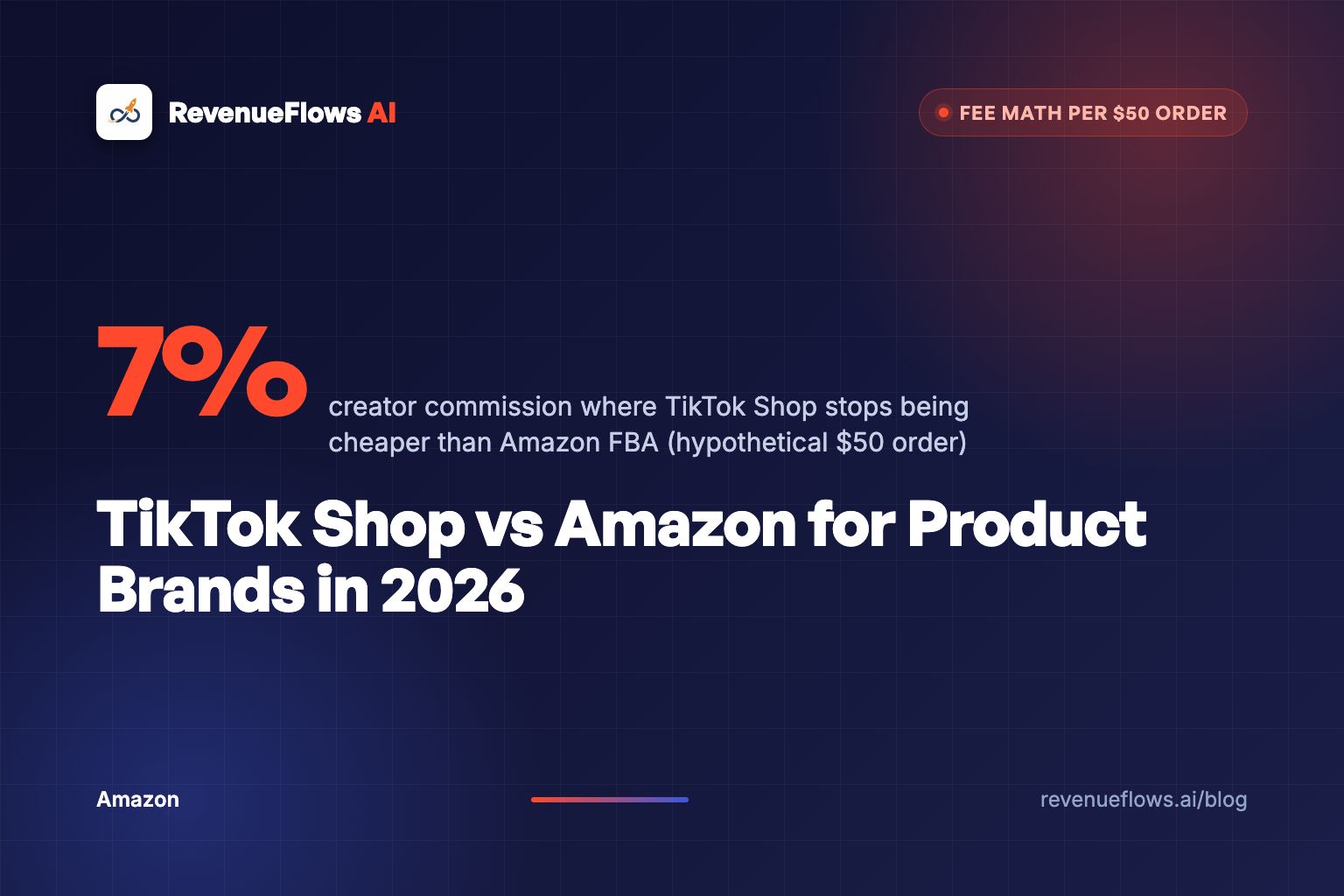
TikTok Shop is the cheapest marketplace in America right up until the first creator posts.
Here's the short answer on TikTok Shop vs Amazon. TikTok Shop's referral fee is 6% to 8% for most US categories. Amazon's is 15% in most categories. So on the sticker, TikTok wins by a mile. But almost nobody sells on TikTok Shop without creators, and creators get paid a commission you set, often 10% to 20% of the sale. Run a $50 order through both, with the same shipping cost, and any creator commission above about 7% makes TikTok Shop the more expensive place to sell.
That doesn't make TikTok Shop a bad deal. It makes it a different tool.
Amazon catches demand. TikTok Shop creates it. The brands winning in 2026 use TikTok to light the fire and let Amazon and their own Shopify store catch the buyers who walk away from the video and go search.
Let me show you the math, then the play.
What does TikTok Shop actually charge in 2026?
Start with TikTok's own words. Its category referral fee page lists 6% for most US categories, 5% for five jewelry sub-categories, and 5% for pre-owned. Its fee formula page spells out how the 6% is calculated: on what the customer pays plus any platform-funded discount, minus tax. Shipping isn't in that base, and there's no separate payment processing line in the formula.
Now the wrinkle. Several seller guides report that TikTok raised the standard US rate for most non-food categories from 6% to 8% on August 4, 2026. Be Bold Digital's write-up flags the same gap I hit while researching this: the public table was last revised in May and still shows 6%. So check the rate on your own settlement statement. In this post I run the math at 8%, because I'd rather you plan on the higher number and be pleasantly surprised.
Then the line most sellers forget to model. Creator commission.
TikTok's standard affiliate commission page gives the formula: revenue minus refunds, times the commission rate. You pick the rate. And the market picks for you, because creators promote whatever pays. One 2026 benchmark puts the average US TikTok Shop affiliate commission at 13.02%, with beauty and wellness at 15% to 30%.
On TikTok Shop, the referral fee is the price of the shelf. The creator commission is the price of the customer.
What does Amazon charge on the same $50 order?
Amazon's pricing page puts the referral fee at 15% for most categories, with a $0.30 minimum, plus $39.99 a month for the Professional plan.
Then fulfillment. For a large standard item weighing 12 to 16 ounces in the $10 to $50 price band, the 2026 FBA fee is $4.60, per AMZ Prep's rate table, and Amazon added a 3.5% fuel and logistics surcharge on top of fulfillment fees from April 17. That's $4.76 per unit. And from October 15 through January 14, Amazon's holiday peak fees add an average of $0.32 per unit, with the surcharge applied on top of that too. I broke down the full stack in the Amazon FBA fee changes for 2026.
So Amazon's fee on a $50 order, outside peak season: $7.50 referral plus $4.76 fulfillment. $12.26. (Amazon fulfilling orders from your own Shopify store drops the referral fee entirely, a fee stack I ran in Buy with Prime on Shopify.)
TikTok Shop fees vs Amazon: the $50 order, side by side
Here's the fair comparison. TikTok Shop fulfillment costs vary with how you ship (your own warehouse, a 3PL, or Fulfilled by TikTok), so to isolate the platform difference I gave the TikTok order the same $4.76 fulfillment cost as FBA. That's an assumption. Everything else comes from the sources above.
| Fee on a $50 order (hypothetical) | Amazon FBA | TikTok Shop, no creator | TikTok Shop, 10% creator | TikTok Shop, 20% creator |
|---|---|---|---|---|
| Referral fee | $7.50 (15%) | $4.00 (8%) | $4.00 (8%) | $4.00 (8%) |
| Fulfillment | $4.76 | $4.76 (assumed) | $4.76 (assumed) | $4.76 (assumed) |
| Creator commission | $0 | $0 | $5.00 | $10.00 |
| Total fees | $12.26 | $8.76 | $13.76 | $18.76 |
| Share of the $50 sale | 24.5% | 17.5% | 27.5% | 37.5% |
8% TikTok referral, 15% Amazon referral, $4.76 fulfillment on both, creator commission on price. Outside Amazon peak season.
Here's the math that matters. TikTok saves you $3.50 on the platform side ($12.26 minus $8.76). A creator commission eats that $3.50 at 7% of a $50 sale. Anything above 7%, and the TikTok order costs more than the Amazon order. If your category really is still at 6%, the saving is $4.50 and the break-even moves to 9%.
Now look at the benchmark average again. 13.02%.
Most TikTok Shop sellers are paying more per order than they'd pay Amazon. They just can't see it, because the bill arrives in two pieces.
Want your own numbers instead of mine? Plug them in here.
So why would an Amazon seller touch TikTok Shop at all?
Because the fee table measures the wrong thing.
Amazon is a search engine with a checkout. The buyer shows up already wanting a garlic press, types "garlic press," and picks one of the ten on page one. You're fighting for demand that already exists. That's demand capture.
TikTok is the opposite. Nobody opens the app looking for your garlic press. A creator shows it crushing a whole bulb in one squeeze, and a buyer who wasn't shopping suddenly wants it. That's demand creation. And demand doesn't stay put.
Some of those viewers buy in the app. Plenty don't. They open Amazon because their card is saved and Prime ships tomorrow, or they Google the brand and land on your Shopify store. Fospha's data on beauty brands shows TikTok Shop's unified return on ad spend is 20% higher when Amazon sales are counted. That's money TikTok generated that TikTok's dashboard never shows you.
And the pool is getting bigger. SmartScout, citing eMarketer, puts US TikTok Shop sales at a projected $23.41 billion in 2026, up from $15.1 billion in 2025.
So the creator commission that looked like a bleed in the table is really the ad budget for your Amazon listing and your Shopify store. Judge it that way.
Sell on TikTok Shop or Amazon: which one fits your product?
Here's how I'd split it.
| Question | Leans Amazon | Leans TikTok Shop |
|---|---|---|
| Do buyers search for it by name? | Yes, it's a known need (filters, chargers, supplements by ingredient) | No, it needs a demo before anyone wants it |
| Does it look good on video in 5 seconds? | Doesn't matter | Has to |
| Margin after fees and a 13% creator cut? | Thin margins live here | Needs room for creators |
| Who controls the customer? | Amazon does | TikTok does |
| Where does it shine in your stack? | Catching demand | Creating demand |
Notice the fourth row. Neither one hands you the customer.
I learned that the hard way. Years ago I had a top-selling Amazon product and woke up one Tuesday to a suspended account. The listing, the reviews, the buyers, gone overnight, because none of it was mine. So my answer to "TikTok Shop or Amazon?" is a third thing. Use both to drive buyers. Bank them where you own the relationship.
Where does the TikTok demand land, and is that page ready?
This is the part nobody models. TikTok sends a buyer who's half-sold by a 40-second video. They land on your Amazon listing or your Shopify page. If that page reads like a spec sheet, the creator did the hard part for nothing.
On Shopify, the landing page decides almost everything, because you keep more of each sale. Our real Amazon-to-Shopify case studies show it plainly. One rodent repellent sold at $29.95 on Amazon and netted $7.73 per sale after a $4.49 referral fee (15%), shipping, inventory and ads. On Shopify, with a page built to sell a bigger order, the average order hit $177.75 and net profit came to $78.87 per sale, after paying for ads and inventory. Real client numbers, not typical results, and not a promise of what your store will do.
Same product. Different shelf. Different page.
Now run the math on a store like this, a hypothetical. A creator sends 1,000 people to your Shopify page. At a 1.5% conversion rate and a $50 average order value, your revenue per visitor is $0.75. That's $750 from the spike. Rebuild the page so it converts 3% at a $65 average order value, and revenue per visitor becomes $1.95. Same 1,000 visitors, $1,950. The creator charged you the same either way.
TikTok lights the fire. Amazon and Shopify are where you either catch the buyer or watch them walk.
Here's where AI changes the job. Rebuilding a product page used to mean a copywriter, a designer and three weeks. Now you drop in a product URL and the AI writes the copy, designs the images and builds the page in less than 15 minutes. That matters for TikTok specifically, because a viral moment doesn't wait three weeks. If you want the page-level playbook for this traffic, read how to write a Shopify product page for TikTok traffic, and for the per-visitor math on both platforms, see Shopify vs Amazon revenue per visitor. The bigger Amazon picture is in our Amazon selling guide for 2026.
What to do next
Take your best-selling Amazon product. Run it through the TikTok Shop fee calculator above with three commission rates: 10%, 15% and 20%. If even 10% leaves you with almost nothing, TikTok Shop as a standalone store is a trap for that product. Then ask the better question: if a creator sent 1,000 people to search for it next week, would your Amazon listing and your Shopify page close them?
If the answer is "I'm not sure," fix the page first. The creators can wait a week. A wasted viral spike can't be re-run.
For the full Amazon fee picture and why sellers are moving their winners to their own stores, see the Amazon fee math nobody shows you.
Book Your Profit Audit
TikTok can create the demand, but the page it lands on decides whether you get paid or just pay the creator. Book your free profit audit and we'll show you where your listing and product page are leaking buyers, then show you how to rebuild a high-converting product sales page in less than 15 minutes.
Or go here to check it out → revenueflows.ai
P.S. TikTok Shop's low fee is the bait. The creator commission is the bill. Spend it to fill the page you own, not the shelf you rent.
Frequently asked questions
Is TikTok Shop cheaper than Amazon for sellers?
On the platform fee alone, yes. TikTok Shop's referral fee runs 6% to 8% for most US categories versus Amazon's 15% in most categories. But TikTok Shop sales usually come through creators you pay a commission, and on a hypothetical $50 order any commission above about 7% makes TikTok Shop more expensive than Amazon FBA.
Should I sell on TikTok Shop or Amazon?
Most product brands should use both, for different jobs. Amazon captures buyers who already know what they want and search for it. TikTok Shop creates demand through creator video, and a share of that demand ends up buying on Amazon or your own Shopify store.
What are TikTok Shop fees vs Amazon fees in 2026?
TikTok's own fee page lists a 6% referral fee for most US categories, and several seller guides report a move to 8% from August 4, 2026, so check your Seller Center. Amazon charges a 15% referral fee in most categories plus FBA fulfillment, about $4.60 for a 12 to 16 ounce large standard item, with a 3.5% surcharge on top.
Is TikTok Shop worth it for Amazon sellers?
Yes, if you judge it as a demand engine instead of a standalone store. Fospha's data shows TikTok Shop's unified return on ad spend comes out 20% higher when the Amazon sales it influences are counted. Judge it on in-app orders alone and you'll cut the thing feeding your Amazon listing.
How much commission do TikTok Shop affiliates take?
You set the rate, not TikTok. One 2026 benchmark puts the average US TikTok Shop affiliate commission at 13.02%, with beauty and wellness running 15% to 30%. TikTok calculates it on revenue minus refunds.