
TikTok Landing Page: What Changes vs Your Meta Page
TikTok visitors arrive younger, faster and mid-scroll. The page that closes your Meta traffic makes them read before it shows them anything, so they swipe back. Here's what to change.

I'll say the uncomfortable part first. If your TikTok ads are getting clicks and no sales, the ad is probably fine. The page is the problem, and it's probably the page that's been closing your Meta traffic for two years.
Here's the short answer. A TikTok landing page has to finish the video the visitor just watched. That means the same product, the same hook and ideally the same clip in the first screen, the price and one buy button right there, and a path to the offer that takes two taps instead of five. Your Meta page was built for someone who reads. Your TikTok ads landing page has to work for someone who was watching a dance video eight seconds ago.
Same product. Different visitor. Different page.
Why does your Meta landing page fail on TikTok traffic?
Because a different person shows up.
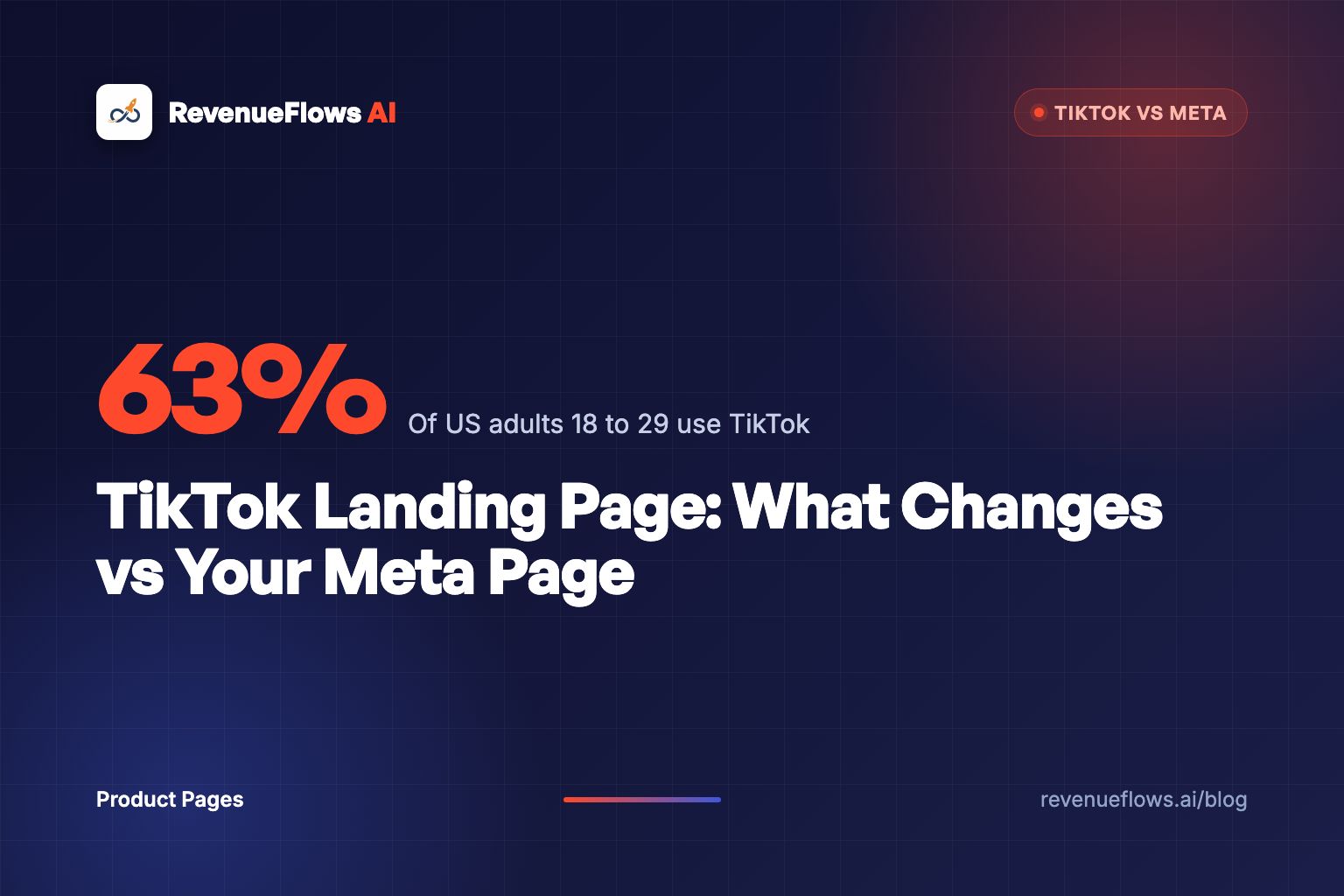
Look at who's on each app. Pew Research's 2025 social media fact sheet found that 63% of US adults aged 18 to 29 use TikTok, against 30% of those 50 to 64. Facebook runs the other way. It peaks with 30 to 49 year olds at 80%. And Pew's full 2025 report says roughly half of 18 to 29 year olds open TikTok every single day, compared with just 5% of adults 65 and older.
So your Meta buyer is often a 41-year-old who clicked a carousel, scrolled your page, read three reviews and bought. Your TikTok buyer is often 24, holding the phone in one hand, and halfway back to the feed before your hero image loads.
I see this in Shopify Community threads every week. One merchant posted that 600 visitors from TikTok ads over 14 days produced zero purchases, and asked if checkout was broken. Checkout was fine. The replies told him to add a favicon and a better search bar. Nobody told him the page never showed the thing the video sold.
Meta traffic gives your page a chance to explain. TikTok traffic gives it one screen.
That's the polarity. A page built for a reader, shown to a scroller.
What changes on a TikTok landing page vs Meta?
Not the product. Not the price. The order things show up in, and how much the visitor has to do before they see proof.
Here's how I'd split it:
| Page element | Meta landing page | TikTok landing page |
|---|---|---|
| First screen | Product photo, headline, star rating | The ad's video clip (muted, captioned), price, buy button |
| Headline | Benefit statement | The exact hook from the video, word for word |
| Proof | Written reviews, before and after photos | Creator clips and video reviews, two or three, near the top |
| Copy length | Can run long, reader scrolls | Five short lines above the first video review |
| Path to the offer | Scroll, read, pick a variant, add to cart | Bundle preselected, one tap to cart, one tap to pay |
| Price | Often below the fold | Visible in the first screen, every time |
| Speed tolerance | Some patience | Close to none |
Notice what's on the left. Nothing wrong with it. It's a good page for someone who came to evaluate.
The TikTok visitor didn't come to evaluate. She came because a 15-second clip made her curious, and curiosity dies fast.
What goes above the fold on a TikTok landing page?
Four things. In this order.
- The clip from the ad, autoplaying muted with captions.
- The hook from the ad as your headline.
- The price and the offer, already selected.
- One buy button that stays on screen as she scrolls.
That's the whole first screen. Everything else goes below it.
The clip matters most. When the page opens on the same video she just watched, she knows she's in the right place without reading a word. When it opens on a white-background studio photo, it feels like a different product, and she taps back.
The hook matters second. If the ad said "the pillow that ended my neck pain," the headline says that. Not "Premium Memory Foam Pillow." Message match is old advice for Meta too, but on TikTok the gap between ad and page is wider, because the ad is a person talking and the page is usually a catalog. I go deeper on matching the page to the ad in how to write a Shopify product page for TikTok traffic.
And then there's speed. TikTok's own landing page loading guidance tells advertisers to design for mobile first, cut redirects, delay non-essential media and load third-party scripts so they don't block the page. Count the apps on your product page. Every review widget, popup and upsell script you added for Meta traffic is a second this visitor won't give you.
One compliance note while you're in there. TikTok's ad review checklist requires company information, policies and local-currency prices to be visible on the page, and text and buttons readable without zooming. Shorter page, yes. Missing footer, no.
How short should the path to the offer be?
Shorter than feels comfortable.
On a typical Meta page the buyer scrolls, reads, picks a size, picks a color, picks a quantity, adds to cart, opens the cart, then checks out. That's a lot of decisions for someone who was watching a cooking video a minute ago.
On a TikTok page, make the decisions for her. Preselect the bestselling variant. Put the bundle you want her to buy in the default spot. Turn on the express wallets so payment is a thumbprint. Two taps from the clip to paid.
Here's the math. Run it on a store like this, a hypothetical: a $64 posture corrector getting 10,000 TikTok clicks a month, sent to the Meta page.
Conversion rate 0.7%, average order value $64. That means revenue per visitor is $0.45 (0.7% x $64 = $0.448, rounded). On 10,000 visitors, that's $4,480. If those clicks cost $0.60 each, you spent $6,000 to make $4,480 in revenue.
Now send the same 10,000 visitors to a TikTok version of the page. Same product. The clip from the ad on top, the hook as the headline, a two-pack preselected. Say conversion rate climbs to 1.6% and average order value to $72 because more buyers take the two-pack. Revenue per visitor becomes $1.15 (1.6% x $72 = $1.152, rounded). On the same 10,000 visitors, that's $11,520.
Conversion rate x average order value x visitors. Meta page: 0.7% x $64. TikTok page: 1.6% x $72.
Same ads. Same spend. A losing campaign turned into a winning one by changing what the first screen shows.
Plug your own TikTok numbers in here:
That's a hypothetical. For real numbers, here's one product we rebuilt for a bedding brand, their Copper Bamboo Sheets. Conversion rate went from 1.0% to 4.3% and average order value from $125 to $221, taking revenue per visitor from $1.25 to $9.50. On 10,000 visitors, that's $12,500 before and $95,000 after. See the full case study numbers. Real client numbers, not typical results, and not a promise of what your store will do.
The cheapest click on TikTok is still expensive if it lands on a page built for someone else.
How is AI changing TikTok landing pages?
Two ways, and both make the old excuse ("I can't build a separate page for every channel") go away.
AI makes the video. TikTok has built generative tools into its ad platform. In April 2026, MediaPost reported that TikTok added ByteDance's Dreamina video model to Symphony, so advertisers can generate video from text prompts, images and reference clips. That means more hooks, tested faster. It also means more ads pointing at the same tired product page, which is where most brands will lose the gains.
AI makes the page variant. This is the part I care about. Writing one TikTok version of a product page used to take a copywriter and a designer a week. Now an AI tool can take the winning ad's hook, write the five short lines that go above the first review, pull the right creator clips into the proof section and rebuild the first screen in minutes. Three hooks winning? Three page variants, each one matching its ad.
Honestly, I think this is the biggest change in paid traffic this year. Not the targeting. Meta's own system now reads your creative to decide who sees it, which I broke down in the Meta Andromeda update, and TikTok has always worked that way. The creative is the targeting. So the page has to match the creative, every version of it.
If you want a fast read on how your current page holds up before you rebuild it, run it through the free tool below.
When should TikTok traffic go to the same page as Meta?
Sometimes it should. Here's the exception.
If your Meta ads are already short UGC clips, and your Meta page already opens on video with the price and one button up top, you might not need two pages. Plenty of brands running Advantage+ with creator content have drifted toward a TikTok-style page without meaning to. (The setup side of that is in my Advantage+ sales campaigns guide.) And if you're still deciding which clips deserve the budget, my Facebook ads creative testing framework covers how Meta reads a new concept now.
The other exception is the product. A $400 piece of furniture needs explaining no matter where the click came from. Keep the video-first top, but let the page run longer below it.
And check the product's clock before you build anything. A lot of TikTok demand burns out fast, which I measured in the TikTok viral products lifespan study. Build the TikTok page for products with staying power, not this week's trend.
Wait, one more. Don't send TikTok traffic to your homepage or a collection page. Ever. The visitor saw one product. Make her hunt for it and she's gone.
What to do next
Open your top TikTok ad on your phone. Watch it, tap through, and screenshot the first screen of the page it lands on. If that screenshot doesn't show the same product, the same words and a price, that's the first thing to fix. For how every page on your store fits together, start with the AI product pages guide, and for a seasonal example of the same idea, see these Black Friday landing page examples.
Book Your Profit Audit
TikTok clicks are cheap until they land on a page built for a different buyer, then every one of them leaks. Book a free profit audit and we'll show you where your TikTok traffic is dropping off, then rebuild a high-converting product sales page in less than 15 minutes.
Or go here to check it out → revenueflows.ai
P.S. Your Meta page is built for a reader. Your TikTok buyer is a scroller. Give her the one screen she'll actually look at.
Frequently asked questions
What makes a good TikTok landing page?
The first screen has to show the same product, the same hook and ideally the same video as the ad, plus the price and one buy button. TikTok visitors arrive mid-scroll and decide in seconds, so proof goes in video form near the top and the path to checkout is two taps, not five.
Should TikTok ads go to the same landing page as my Meta ads?
Usually not. Meta traffic skews older and is more used to clicking out and reading, so a longer page with text proof can work there. TikTok traffic skews younger and lands in the middle of a scroll. Build a TikTok version of the same product page with video first and a shorter path to the offer, then test it against your Meta page.
Why is my TikTok traffic not converting on Shopify?
The most common cause is a mismatch between the video and the page. The visitor clicked on a 15-second clip and landed on a wall of text, a slow page, or a collection grid where the product from the video isn't even the first thing they see. Fix the first screen before you touch targeting.
How fast does a TikTok ads landing page need to load?
As fast as you can make it on a phone. TikTok's own guidance tells advertisers to build the page for mobile first, cut redirects, lazy-load non-essential media and drop non-essential scripts. Every extra second is time for a thumb to tap back to the feed.
Can AI build a TikTok landing page for me?
AI can now write the page variant for each ad hook, cut your best video into a first-screen clip and draft the short benefit lines. TikTok's Symphony tools also generate ad video inside Ads Manager. You still decide the offer and check every claim, because the page has to match what the ad promised.