
Q4 CPM Increase: Why Ad Costs Spike and How to Plan
Every Q4 the same thing happens: big advertisers flood the auction and your cost per order climbs. The stores that keep their margin buy customers in October and sell to them by email in November.

Every October I get the same message from a founder, almost word for word.
"My ads were fine in September. What happened?"
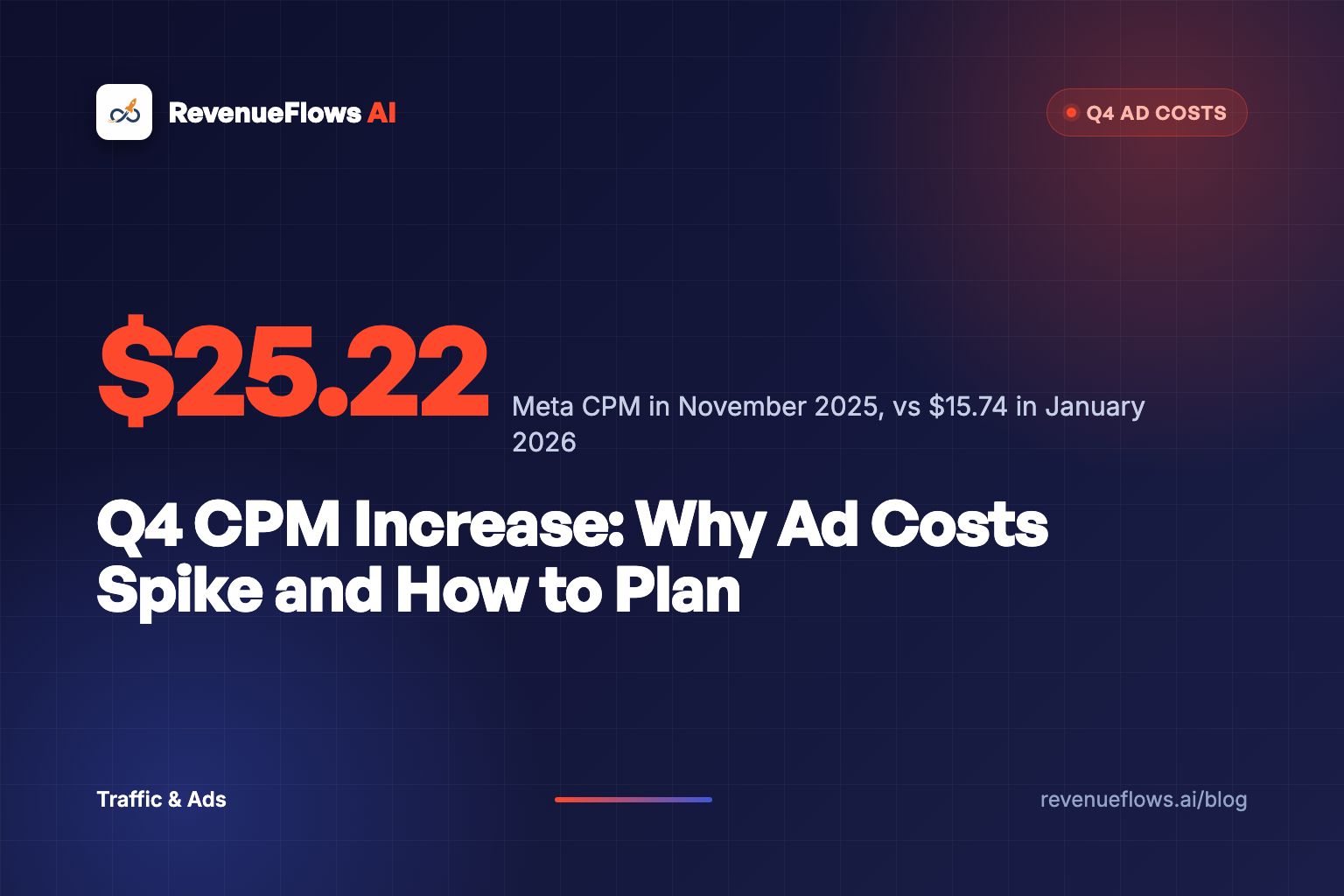
What happened is Q4. The Q4 CPM increase is the yearly jump in what you pay per 1,000 ad impressions from October through December, when big retailers pour their holiday budgets into the same auction you're bidding in. The number of people scrolling stays about the same. The number of advertisers chasing them doesn't. On Meta, aggregated 2025 benchmarks show the CPM going from $19.96 in September to $21.69 in October to $25.22 in November, then dropping to $15.74 by January.
So here's the plan that keeps your margin intact:
- Buy new customers in October, while clicks still cost October money.
- Capture every email and phone number you can before November 1.
- Sell to that list in November instead of paying peak prices for strangers.
- Fix the product page so each expensive click is worth more.
Black Friday is November 27 this year. You have about eight weeks. Let's use them.
Why do CPMs increase in Q4?
Supply and demand, with a twist most founders miss.
The supply is attention. Your buyers don't get extra hours in the day in November, so the feed has roughly the same room for ads it had in August.
The demand is budgets. In Q4 every big retailer, every marketplace, every brand that sits out the rest of the year shows up with a holiday budget and a deadline. They're bidding for the same eyeballs as your $84 coffee bundle. Many of them are happy to pay more per impression than you can, because they're playing for market share or a once-a-year gift buyer.
Here's what that looks like in the public data. Rule1's monthly Meta benchmarks track the CPM across a 13-month window:
Monthly Meta CPM from Rule1's aggregated 2025 benchmarks. Your account's numbers will differ; the shape is the point.
Rule1 puts the holiday crunch at 25% to 35% above the annual mean. Other datasets show a different height for the same mountain. Superads, working from more than $3 billion of ad spend, saw e-commerce CPMs rise 65% from October into November 2025, then fall 42% into December. And Gupta Media's tracker found Cyber Monday 2024 was the most expensive day of that year on Meta, at $17.70, 138% above the 2024 average of $7.43.
Different accounts, different absolute numbers. Same story every time. October rises, Black Friday and Cyber Monday are the summit, and January is the floor. Whether November or December holds the monthly peak depends on whose data you read.
You don't control the Q4 CPM increase. You control when you buy, who you buy, and what each click is worth when it lands.
What does a Q4 CPM increase do to your cost per order?
Here's the math, on a store like this one. A hypothetical specialty coffee brand selling a three-bag bundle at $84.
Click-through rate is 1.8%, so 1,000 impressions buys 18 clicks. The product page converts at 2.5%, so it takes 40 clicks to get one order.
After the beans ($22), shipping ($8) and payment processing at 3% ($2.52), every order has $51.48 left to pay for ads and profit.
Now run that through the real CPM curve:
| Month | Meta CPM (Rule1, 2025) | Cost per click | Ad cost per order | Profit per order |
|---|---|---|---|---|
| September | $19.96 | $1.11 | $44.36 | $7.12 |
| October | $21.69 | $1.21 | $48.20 | $3.28 |
| November | $25.22 | $1.40 | $56.04 | minus $4.56 |
| January | $15.74 | $0.87 | $34.98 | $16.50 |
Same ads. Same page. Same coffee. In September every order makes $7.12. In November every order loses $4.56, and the dashboard shows sales going up the whole time.
That's the trap. Revenue climbs, the founder scales into it, and the profit leaks out through a hole nobody's looking at.
A founder on the Shopify Community wrote it plainly in a thread on running ads during BFCM: "CPMs jump a lot and it becomes really easy to burn cash." Every reply in that thread lands on the same fix. Warm audiences, not cold ones.
Before you set any Q4 budget, find your own break-even line. For the coffee bundle it's $84 divided by $51.48, a break-even return on ad spend of 1.63.
Why should you buy customers in October instead of November?
Because an October customer costs less, and you get to sell to them again in November for close to nothing.
I'll admit something. For years I treated October as the warm-up month. Small budgets, a little testing, save the firepower for Black Friday. That's backwards. October is the last month of the year when a new customer is still cheap enough to be worth buying.
Run the hypothetical. Same $20,000 of ad spend, two plans.
Plan A: hold it all for November. At $56.04 per order you get about 357 orders. At minus $4.56 each, you lose about $1,630. And you've got 357 new customers you paid peak price for.
Plan B: spend it in October. At $48.20 per order you get about 415 orders. At $3.28 each, you make about $1,360. Those 415 buyers are now on your email list going into the biggest gifting month of the year, and reaching them in November costs you zero CPM.
Then you add every email capture from October on top of that: the quiz, the early-access list, the "first look at the holiday bundle" signup. The playbook for that is in how to grow an email list before Black Friday, and it's the most underrated job in Q4.
A customer you buy in October is an asset in November. A customer you buy in November is a bill.
How does email protect your margin when ad costs spike?
Email is the one channel in Q4 where the price of attention doesn't go up.
The auction charges you more for every impression in November. Your list doesn't. A send to 8,000 subscribers costs the same on November 27 as it did on September 27.
Klaviyo's own numbers show where the holiday money landed. In its BFCM 2025 recap, filed with the SEC, Klaviyo reported $3.8 billion in attributed value over the weekend, up 27% year over year. Revenue from repeat customers grew 13.5%, faster than revenue from new buyers. Email and text drove 42% of total revenue for its brands. And discounts dropped 10% while consumer spending rose 11%.
Read that again. Repeat buyers outgrew new buyers, during the most expensive week to find new buyers. The brands that won weren't the ones that outbid the auction. They were the ones that didn't need to.
This is also where AI is doing real work right now. Klaviyo says usage of its AI-driven product recommendations jumped 45% year over year, and revenue from those messages rose 71%. That's the machine picking which bundle each subscriber sees, based on what they bought or browsed. For a coffee brand it means the October buyer who ordered dark roast gets the dark roast gift set in November, not a generic "30% off everything" blast.
The November send schedule is in these Black Friday email campaign ideas. The automated flows that should already be running underneath it are in our Klaviyo flows guide.
So the Q4 split I'd steal looks like this. Ads find people in October. Email sells to them in November. Ads in sale week go mostly to warm audiences and retargeting. Our Black Friday Facebook ads strategy walks through the week-by-week budget.
What makes an expensive click worth paying for?
The page. It's the only lever on this whole list that changes what a click is worth instead of what it costs.
Go back to the hypothetical coffee brand. In November, a click costs $1.40. At a 2.5% conversion rate and an $84 average order value, revenue per visitor is $2.10. But only $51.48 of each order is left for ads, so each visitor brings in $1.29 of contribution. You pay $1.40 to earn $1.29. Losing money on every click, politely.
Now the page gets fixed before the November freeze. The bag's one question (why this coffee at this price) gets answered above the fold. Conversion rate moves to 3.2%. Same $84 average order value. Revenue per visitor: $2.69. Contribution per visitor: $1.65. Now that same $1.40 click returns $1.65. Cost per order drops to $43.78, and every November order makes $7.70 instead of losing $4.56.
Same auction. Same CPM. Same ad. The page decided which side of zero you land on.
On real pages, the swing can be a lot bigger than that hypothetical. One bedding brand's Cooling Bamboo Sheets went from a conversion rate of 1.0% at a $125 average order value, which is $1.25 per visitor, to a conversion rate of 4.3% at a $254 average order value, which is $10.92 per visitor (see the full case study numbers). Real client numbers, not typical results, and not a promise of what your store will do. The point for Q4 is simple. When the page earns more per visitor, the November auction stops being scary.
How Meta fits beside Google Shopping, affiliates and organic is in our ecommerce traffic strategy guide. But none of those channels survive a page that can't close.
You rent the auction in Q4. You own the page and the list. Spend the next eight weeks on the two things you own.
What to do next
Open your Meta ads manager today and write down your last-30-day CPM, cost per click and cost per order. Then multiply your CPM by 1.16, the rise from October to November in the 2025 benchmark data, and recompute your cost per order. If that November number is above what's left of an order after product, shipping and fees, you already know which plan you're running: buy in October, sell by email in November.
Book Your Profit Audit
The Q4 CPM increase is coming whether you plan for it or not, but what each of those pricier clicks earns is decided on your product page. Grab a profit audit and we'll show you where your hero page is leaking revenue per visitor before November, then how to rebuild a high-converting product sales page in less than 15 minutes.
Or go here to check it out → revenueflows.ai
P.S. You can't make a November click cheaper. You can buy the customer in October and make the click worth more. One of those is a plan. The other is a hope.
Frequently asked questions
Why do CPMs increase in Q4?
Because the number of people scrolling barely changes in Q4, while the number of advertisers bidding for them jumps. Big retailers drop their holiday budgets into the same auction you're in, so every 1,000 impressions costs more. Aggregated 2025 benchmarks put Meta's CPM at $21.69 in October and $25.22 in November.
How much do CPMs go up on Black Friday?
It depends on the dataset, but the direction never changes. Gupta Media measured Meta's Black Friday 2024 CPM at $16.85 and Cyber Monday 2024 at $17.70, which was 138% above that year's average of $7.43. Plan for your sale-week clicks to cost more than any other week of the year.
When do Q4 Facebook ads costs come back down?
January. In the 2025 benchmark data the CPM fell from $22.04 in December to $15.74 in January, the low point of the year. That's why January is a great month to buy new customers and a terrible month to have no plan for them.
How should a Shopify brand plan for the Q4 CPM increase?
Buy customers in October while clicks are cheaper, capture every email you can, then sell to that list in November instead of paying peak prices for cold traffic. Set a profit floor per order first, and fix the product page so each click is worth more before the auction gets expensive.
Is it worth running ads during Black Friday at all?
Yes, if the math clears your profit floor. Spend sale week on warm audiences and retargeting, where conversion is highest, and let email carry the rest. Cold prospecting at November prices only works when your page converts well enough to absorb the higher cost per click.