
De Minimis Rule Change: What It Means for DTC Brands
The $800 duty-free parcel is gone, the EU's €150 one went with it, and the UK's is next. Here's what the de minimis rule change does to a brand shipping from an overseas warehouse, with the margin math shown.

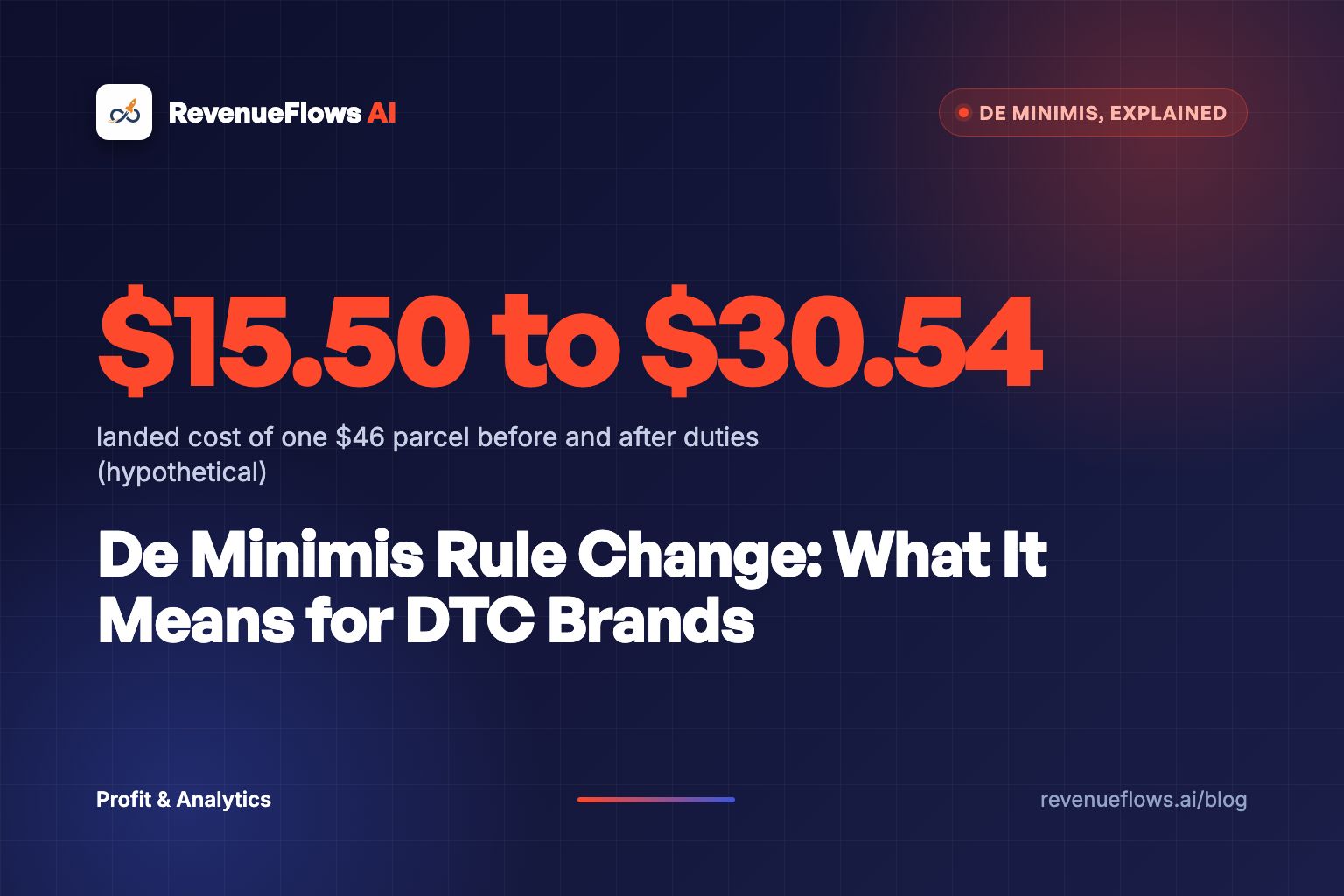
The cheapest shipping lane in ecommerce closed on a Friday.
August 29, 2025. Before that morning, a parcel worth $800 or less could land in the US from anywhere with no duty and almost no paperwork. After it, every parcel pays. That's the de minimis rule change in one sentence, and if you ship direct from an overseas warehouse, your cost per order moved overnight and your product page didn't.
Here's the short answer, October 2026. The $800 exemption is suspended for every country and every shipping mode, including the mail. A parcel pays the same tariff stack a pallet pays, and it pays it on the price your customer paid, not on what the factory charged you. The EU killed its €150 exemption on July 1, 2026. The UK has scheduled the end of its £135 relief. Nothing about this is temporary.
Current rules first, with sources. Then the math on a hypothetical brand, so you can see where the margin went. It didn't vanish. It moved to a cost line most founders haven't added yet.
What exactly changed with the de minimis exemption?
Four moves, in order.
- July 30, 2025. The White House signed Executive Order 14324, suspending duty-free de minimis treatment for all countries from 12:01 a.m. on August 29, 2025. Postal parcels got a six-month bridge of flat $80, $160 or $200 per-item duties by origin tier.
- February 20, 2026. The Supreme Court struck down the IEEPA tariffs. The same day, a new order continued the de minimis suspension and pointed postal duties at the new 10% Section 122 surcharge, effective February 24, 2026.
- June 24, 2026. CBP published two interim final rules that made the suspension indefinite by regulation. KPMG's summary of the rules also notes that the One Big Beautiful Bill Act ends the exemption in statute on July 1, 2027.
- July 24, 2026. The Section 122 surcharge expired and, per the Penn Wharton Budget Model, was replaced by new Section 301 duties of 10% or 12.5% on goods from 60 economies. Zonos's US tariff tracker puts China and Vietnam at 12.5% and notes that from the same date normal duties apply to postal shipments for the first time.
So the question founders keep asking me, "is de minimis coming back?", has a clean answer. No. Suspended by order, confirmed by regulation, scheduled for deletion by Congress.
De minimis wasn't a loophole. It was a subsidy. And the subsidy was paying for a business model that only worked while the parcel was invisible to customs.
Why does a parcel pay more duty than a pallet?
Here's the part the tariff headlines skip, and it's the whole reason this hits direct-from-overseas brands harder than importers.
Duty is charged on customs value. CBP's customs value guide defines transaction value as the price actually paid or payable for the merchandise when sold for export to the United States. Import a pallet to a US warehouse and that sale is you buying from the factory. Ship one parcel straight to a buyer in Ohio and the sale for export is the retail sale. Confirm your own setup with your broker, but the direction is ugly: the same 24% stack lands on $46 instead of $9.
Run the math on a store like this, a hypothetical. A silk pillowcase brand selling at $46, fulfilling one parcel at a time from a warehouse in Guangdong. Factory cost $9.00. Parcel shipping to the US $6.50. Payment and packaging $3.00 per order. Assume the broker confirms a 24% duty stack on this product and origin (standard rate plus the new Section 301 surcharge, both made up for this example) and a $4.00 per-parcel clearance fee from the carrier.
| Cost line | Before Aug 29, 2025 | After (parcel from Guangdong) | After (bulk into a US 3PL) |
|---|---|---|---|
| Factory cost | $9.00 | $9.00 | $9.00 |
| Freight to the US | $6.50 per parcel | $6.50 per parcel | $0.90 per unit (ocean, allocated) |
| Duty | $0.00 | 24% x $46 = $11.04 | 24% x $9 = $2.16 |
| Entry fees and clearance | $0.00 | $4.00 per parcel | $0.45 per unit (fees, drayage, receiving) |
| US domestic shipping and pick/pack | $0.00 | $0.00 | $7.70 |
| Landed cost per order | $15.50 | $30.54 | $20.21 |
Factory, freight, duty and fees per order. Payment and packaging ($3.00) excluded.
Margin per order at $46, after the $3.00 of payment and packaging: $27.50 before, $12.46 after. Same product, same price, same customer. The de minimis rule change took $15.04 a sale, 55% of the margin, without touching anything the customer can see.
The bulk importer keeps $22.79 a sale. Worse than the old world, nearly double the parcel model. The catch is cash: you buy inventory before you sell it.
Every line of this sheet is in the landed cost calculation worksheet, or plug your numbers in here:
What are the new postal rules and who has to file?
Mail was the last soft spot, and CBP closed it on July 24, 2026.
Per CBP's e-commerce FAQs, mail shipments valued at $2,500 or less now go through a new postal informal entry process. Entry can only be made by the owner or purchaser of the goods, or a licensed customs broker they designate. The filer needs a bond on file in ACE eBond before anything moves, and duties are paid through Pay.gov by the 7th day of the month after the parcel arrives. From October 22, 2026, goods claiming free trade agreement treatment or subject to partner agency rules get pushed into a regular entry.
Read that filer rule again. The owner or purchaser. If your overseas 3PL has been "handling customs" through the post, ask them today whose name and whose bond are on your parcels. Many founders are about to learn the answer is nobody.
Is the EU and UK de minimis change the same thing?
Close enough that you should plan for all three at once.
EU. From July 1, 2026, the €150 customs duty exemption is gone. FedEx's EU customs page explains the replacement: a flat €3 customs duty on every line of the import declaration regardless of value, plus a €2 handling fee the Commission expects by November 1, 2026. A six-line order now carries €18 of duty before the handling fee. The flat fee is kinder than a percentage on a $46 pillowcase, and crueller on a $9 one.
UK. On July 13, 2026 the government confirmed, per KPMG's note, that the £135 relief will be repealed and replaced with a mandatory customs framework by October 2028 or earlier.
Here's the thing. Three governments, one call, inside a year. The era where a small parcel moved cheaper than a pallet is over everywhere your customers live.
What should a DTC brand actually do about it?
I've watched three responses to the de minimis rule change this year. Two of them lose.
Eat it. The pillowcase founder keeps $46 on the page and pockets $12.46 instead of $27.50. On 280 orders a month, that's $4,211 of margin gone, every month. That's how a store ends up like the $60K brand that was actually losing money: revenue flat, profit bleeding, founder confused.
Surcharge it. A "duties and fees" line on the doorstep. On August 24, 2026, Shopify Managed Markets stopped supporting delivered duty unpaid everywhere it supports delivered duty paid, so customers pay duties at checkout, not at the door. Right decision. A surprise bill at the door is a refused parcel, a refund and a one-star review. But moving the duty to checkout only changes where the buyer sees it. The page still has to justify it.
Make the page carry it. This is the one that works. Duty is a percentage of the order, so a bigger order pays more duty. But the per-parcel costs (the $6.50 shipping, the $4.00 clearance) are fixed. Spread them over a bigger order and the margin comes back faster than the duty takes it.
Watch what happens. Same hypothetical brand, 20,000 visitors a month. Today the page converts 1.4% at a $46 average order value. That means revenue per visitor is $0.64, and on 20,000 visitors that's $12,880 from 280 orders. At $12.46 margin per order, the store keeps $3,489 before ads.
Now the page leads with a two-pack at $74 (two pillowcases, one parcel), explains why silk at this price beats the $9 one on Amazon, and answers the question the international buyer is silently asking: "what will this actually cost me at my door?" Say conversion rate moves to 2.0% and average order value to $74. Revenue per visitor is $1.48. On the same 20,000 visitors, that's $29,600 from 400 orders.
Per order: factory $18.00, parcel shipping $8.00, duty 24% x $74 = $17.76, clearance $4.00, payment and packaging $3.00. Cost $50.76, margin $23.24. On 400 orders, $9,296 kept before ads instead of $3,489. The duty bill went up on every order. The profit went up anyway.
A tariff is charged on the order. Your fixed costs are charged on the parcel. The page decides which one grows faster.
Here's a real one, because the page-over-cost lesson didn't start with tariffs. We moved an Amazon animal repellent product to its own Shopify store. Landed cost was $4.50 per unit in both places. On Amazon it sold at $17.95 and netted $3.83 a sale. On Shopify, the same $4.50 landed cost, a $24.95 price and a page built for bigger orders pushed average order value to $101.38 and net profit to $48.27 per sale, after paying for ads and inventory. The full fee breakdown is on our results page. Real client numbers, not typical results, and not a promise of what your store will do.
Same cost line. Different page. 12.6 times the profit per sale (Shopify vs Amazon revenue per visitor has the channel math). If some units still sell on Amazon, that side moved too: the 2026 FBA fee changes stack a fuel surcharge and peak fees on every unit.
Where does AI change this job?
Two places, and neither is "let the AI pick your tariff code." Your broker owns that.
First, the cost sheet. Paste your carrier's duty invoices and your last 90 days of orders into an AI assistant and ask for landed cost per order by country, flagging any order where duty plus fixed fees crossed 40% of the price. Minutes, not an afternoon, and it tells you which products the parcel model no longer supports.
Second, the page. The new price needs new copy: the two-pack logic, the "delivered, duties included" promise, the answer to "why silk from you and not the $9 one." That's a rewrite of the hero, the offer block and the FAQ, and it's what RevenueFlows AI builds from a product URL in under 15 minutes. Pair it with the international buyers product page guide, fold the new landed cost into the weekly numbers in the ecommerce profit analytics system, and use the tariff pricing strategy worksheet to decide how much of the increase goes into price.
What to do next
Take your best-selling product and your last 20 US orders. Add up the duty and clearance fees the carrier actually billed, divide by 20, and write that number next to the price. If it's more than a fifth of the price, the parcel model is eating this product alive, and the page is the only lever that moves fast enough to save it.
Book Your Profit Audit
The de minimis rule change raised the cost of every parcel you ship. The fix lives on the page that sells it. On a profit audit we show you how much margin each order is leaking after duties, and how to rebuild a high-converting product sales page in less than 15 minutes.
Or go here to check it out → revenueflows.ai
P.S. The government raised your cost per order once. A page that can't defend its price raises it again on every visit.
Frequently asked questions
Is the $800 de minimis exemption still suspended in 2026?
Yes. The White House suspended duty-free de minimis treatment for every country on August 29, 2025, continued it by executive order on February 20, 2026, and CBP made the suspension indefinite by regulation on June 24, 2026. Congress also wrote the end of the exemption into law for July 1, 2027. Parcels under $800 pay regular duties now.
What duties does a small parcel pay now that de minimis is gone?
The same stack a pallet pays: the normal tariff rate for the product's code, plus any Section 301 or Section 232 duties that apply to its origin. Since July 24, 2026, that includes international mail. The value the duty is charged on is the price paid for the goods when they were sold for export to the US, so a direct-to-consumer parcel is dutied on the retail price, not the factory cost.
Does the de minimis rule change apply to postal shipments too?
Yes. CBP's new postal informal entry process took effect July 24, 2026 for mail shipments valued at $2,500 or less. Entry can only be made by the owner or purchaser, or a licensed customs broker they designate, with a bond on file and duties paid through Pay.gov by the 7th day of the following month.
Did the EU and UK end de minimis as well?
The EU removed its €150 customs duty exemption on July 1, 2026 and now charges a flat €3 duty per line of the customs declaration, with a €2 handling fee expected by November 1, 2026. The UK confirmed in July 2026 that its £135 relief will be repealed by October 2028 or earlier.
Should a DTC brand switch to delivered duty paid at checkout?
If you ship cross-border, yes. Shopify Managed Markets stopped supporting delivered duty unpaid on August 24, 2026, so customers in those markets pay duties at checkout instead of at the door. A duty bill on the doorstep is the fastest way to turn a sale into a refused parcel.