
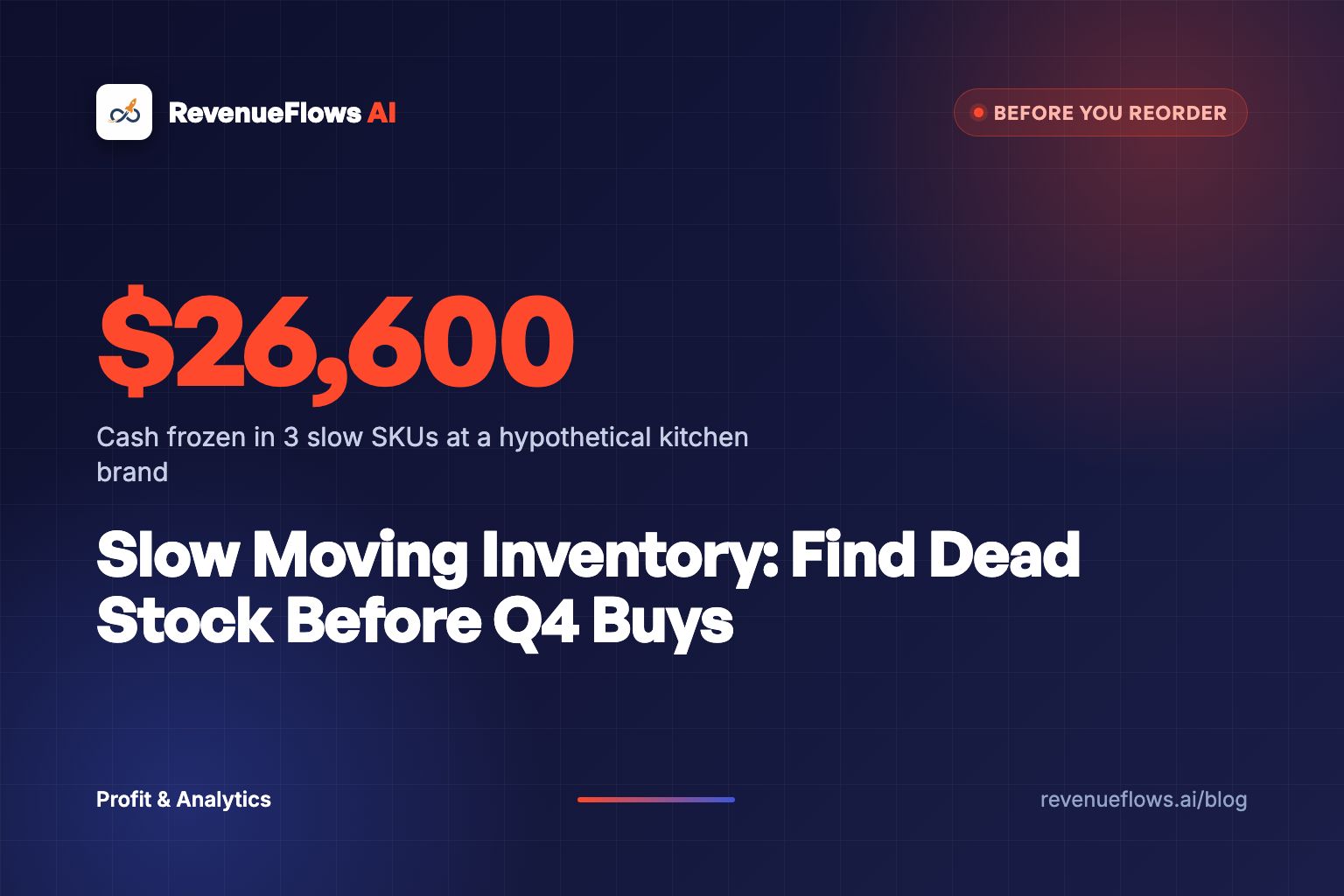
Slow Moving Inventory: Find Dead Stock Before Q4 Buys
Your Q4 purchase order is a bet, and slow moving inventory is the cash you can't bet with. Here's how to find it in three Shopify reports and move it with bundles and new offers before you reorder.

Your Q4 purchase order is a bet.
And most founders place it with last year's leftovers still sitting in the warehouse, quietly holding the cash that should be riding on the winner.
Slow moving inventory is stock that still sells, but so slowly it'll sit for months before it's gone. Dead stock is the extreme version: it has stopped selling. Both do the same damage before Q4. They freeze cash you already spent, so your best seller gets a smaller reorder. The fix is to find them in three Shopify reports this week and move them with a bundle or a new offer before you sign the purchase order.
That's the whole post. Now let me show you the math, because the math is what makes you move.
What is slow moving inventory, really?
Here's my working definition, and it's an opinion, not an accounting standard:
Slow moving inventory is any product with more than 180 days of stock left at its current sales pace. Dead stock is any product with zero sales in the last 90 days. The first is a cash leak. The second is a cash grave.
Accountants will talk about carrying costs and obsolescence. Fine. But the founder version is simpler.
Every unit on that shelf is money you already paid a supplier. It can't buy ads. It can't fund the skillet reorder. It can't cover the Q4 inventory for the product people actually want.
Run the math on a store like this, a hypothetical kitchen brand heading into October:
| Product | Units on hand | Landed cost | Sold per month | Cash frozen | Days of stock left |
|---|---|---|---|---|---|
| Cast-iron skillet (hero) | 900 | $22.00 | 600 | $19,800 | 45 |
| Walnut cutting board | 1,100 | $13.00 | 45 | $14,300 | 733 |
| Silicone lid set | 2,000 | $4.50 | 60 | $9,000 | 1,000 |
| Skillet handle sleeve | 1,500 | $2.20 | 110 | $3,300 | 409 |
The skillet runs out in 45 days. It needs a Q4 reorder: 1,000 units at $22 is $22,000.
The three slow products hold $26,600. That's more than the entire skillet reorder, sitting in boxes.
Units on hand times landed cost. Skillet reorder is 1,000 units at $22.
The store didn't have a cash problem. It had a shelf problem.
How do you find dead stock in Shopify?
You don't need a new app for the first pass. Shopify ships the reports already. Open Analytics, then Reports, and filter to the Inventory category. The Shopify inventory reports documentation lists all of them. Three matter before a Q4 buy.
- ABC product analysis. Grades each variant by its share of revenue over the last 28 days. A is the top 80% of revenue, B the next 15%, C the last 5%. Your slow stock lives in C.
- Products by sell-through rate. Units sold divided by units sold plus units still in stock. Low number, slow product.
- Inventory remaining per product. Ending stock divided by average daily sales over the last 28 days. This is your days-of-stock-left column.
Now watch what happens when you run the kitchen brand through the sell-through math over 90 days.
The skillet sold 1,800 units with 900 left: 1,800 divided by 2,700 is a 66.7% sell-through. The cutting board sold 135 with 1,100 left: 10.9%. The lid set sold 180 with 2,000 left: 8.3%. The handle sleeve sold 330 with 1,500 left: 18.0%.
One product is printing. Three are sleeping.
If you're on Amazon too, Amazon's own dead stock guide for sellers points you to the FBA inventory dashboard and Inventory Performance Index for the same job. Different shelf, same leak.
Can AI find your aged inventory for you?
Partly, and it's getting faster every month.
Shopify's own Sidekick guide (published March 2026) gives this example prompt, word for word: "Show current inventory value, slow‑moving stock, and near‑term cash needs. Recommend three actions (liquidate, bundle, reorder) that improve cash coverage in the next 30 days and link to execute."
That's a real shift. A year ago this was a spreadsheet job for a Sunday afternoon. Now you can ask the admin in plain English and get the aged inventory list back with suggested moves.
But here's the thing. AI is good at the finding. It's not yet good at the selling.
Sidekick can tell you the walnut board has 733 days of stock left. It can't tell you why nobody's buying it, or write the offer that gets it into a cart. That part still takes a person who understands the buyer. Or a system trained on offers that already sold.
I'd use the AI for the diagnosis every Monday. Then do the next part by hand.
Should you bundle, splinter or clear slow stock?
Here's where most founders go straight to the discount button. I get it. It's the fastest lever in the admin.
It's also the most expensive one. A 30% off sale on the cutting board trains your list to wait, cuts margin on every unit, and tells new buyers the product wasn't worth full price. We broke that down in whether discounts actually lift conversion rate.
So discount last. Use this order instead.
| Move | Use it when | What it does to cash |
|---|---|---|
| Bundle with the hero | The slow product pairs naturally with your best seller | Moves slow units at full value inside a bigger order |
| Offer splinter | The product is fine but aimed at the wrong buyer | Finds a new buyer without touching the price |
| Clearance or liquidation | Zero sales in 90 days and no natural pairing | Turns dead stock back into cash, at a loss |
Bundle it with the winner. The skillet already gets the traffic. Build a "Skillet Starter Kit": skillet, walnut board and lid set for $89. Bought separately, that's $64 plus $38 plus $19, which is $121. The kit costs $39.50 in landed product ($22 plus $13 plus $4.50), leaving $49.50 before fulfillment. The skillet alone leaves $42.
So the kit earns $7.50 more per order and drags two slow units out the door every time it sells. Shopify's free Bundles app handles fixed bundles and multipacks, with inventory updated in real time across the kit and its parts. If you want pairing ideas, we worked through 11 of them, with the math, in Black Friday bundle ideas.
Splinter the offer. The lid set isn't a bad product. It's a bad offer on a bad page. Nobody wakes up wanting a silicone lid set. But the person hosting Thanksgiving for 14 people wants their leftovers covered. Same product, new page, new buyer: "The Leftovers Kit," lid set plus handle sleeve, $24, positioned as a host gift. That's one product splintered into a second offer, with no price cut. The same move works for the holidays: box slow units into holiday gift sets at a new price point.
Clear what's truly dead. Anything with zero sales in 90 days and no natural pairing goes to clearance, a liquidator or donation. Take the loss, free the shelf, and stop paying to store a mistake.
A slow product is usually a fine product stuck inside the wrong offer. Change the offer before you change the price.
What does the bundle do to revenue per visitor?
This is the part founders skip, and it's the part that pays.
Say the skillet page converts at 2.0% with a $64 average order value. That means revenue per visitor is $1.28. On 10,000 visitors, that's $12,800.
Now add the kit to the page. Suppose 30% of buyers pick the $89 kit and conversion rate holds at 2.0%. Average order value becomes 70% of $64 plus 30% of $89, which is $44.80 plus $26.70, so $71.50. Revenue per visitor is $1.43. On the same 10,000 visitors, that's $14,300.
2.0% conversion rate. After: 30% of buyers choose the $89 kit, lifting average order value from $64 to $71.50.
And look at the shelf. 10,000 visitors at 2.0% is 200 orders. 30% of them is 60 kits, which means 60 boards and 60 lid sets moved in a month. The board goes from 45 sales a month to 105. Its days of stock left drop from 733 to 314.
Still slow. But it's moving, and it's moving at full value inside a bigger order instead of at 30% off.
The page does the heavy lifting here. A kit buried under the fold earns nothing. On a bedding brand we rebuilt, the Cooling Bamboo Sheets page went from a 1.0% conversion rate and $125 average order value to 4.3% and $254 (see the full case study numbers). Real client numbers, not typical results, and not a promise of what your store will do. Revenue per visitor went from $1.25 to $10.92. On 10,000 visitors, that's $109,200 instead of $12,500. Bigger orders came from a page that sold the bigger offer.
If you want the full profit side of this, the ecommerce profit analytics guide walks through contribution margin per product, and how to use product bundles to raise average order value goes deeper on kit pricing.
How much should you reorder for Q4?
Less of the slow stuff. Obviously.
Wait, that's too easy. Here's the harder version: reorder the hero based on what the kit will pull, not what the skillet sold alone. If the kit ships, every kit sale is a skillet sale too. Your hero velocity doesn't drop, and your slow stock starts paying for the reorder instead of blocking it.
Then run the minimum order quantity through a cash check before you sign.
If the calculator says the reorder buys more than six months of stock, you're about to create next year's slow moving inventory. Order smaller. Ask the supplier for a split shipment.
What to do next
Open Shopify today and run one report: inventory remaining per product. Sort it by days left, highest first. Multiply the top five by their landed cost. That number is the cash your Q4 winner can't use yet, and it's the number to cut before you place the order.
Book Your Profit Audit
Slow stock is usually stuck inside the wrong offer on the wrong page. That's exactly what a profit audit finds. We'll show you which products are leaking and how to rebuild a high-converting product sales page in less than 15 minutes.
Or go here to check it out → revenueflows.ai
P.S. Discounting slow stock bleeds margin. Bundling it with your winner prints cash. Pick before you reorder.
Frequently asked questions
What is slow moving inventory?
Slow moving inventory is stock that still sells, but so slowly that it will sit on your shelf for months before it's gone. I flag any product with more than 180 days of inventory remaining at its current sales pace. It's a cash problem first: every unit is money you already paid that can't fund your next winner.
What's the difference between slow moving inventory and dead stock?
Slow moving inventory still sells, just at a crawl. Dead stock has stopped selling and won't move without a new offer, a new buyer, or a clearance price. My working line: zero sales in the last 90 days means treat it as dead.
How do I find slow moving inventory in Shopify?
Open Analytics, then Reports, and filter to Inventory. Run the ABC product analysis to see which variants earn only 5% of revenue, the sell-through rate report to see what percentage of stock actually sold, and inventory remaining per product to see how many days your stock will last at the current pace.
Should I discount slow moving inventory?
Discount last, not first. A discount trains buyers to wait and cuts margin on stock that might sell at full price inside the right offer. Try a bundle with your best seller or a new offer aimed at a different buyer first, and save clearance pricing for true dead stock.
How does slow moving inventory affect my Q4 reorder?
It shrinks the cash you can put behind your winners. If 3 slow products hold $26,600 at landed cost and your hero product's reorder costs $22,000, that frozen cash could have covered the whole reorder. Move slow stock before you place the Q4 purchase order, not after.