
Do Before and After Photos Increase Shopify Conversion Rate?
Before and after photos feel like an obvious conversion tool. But they backfire in at least three Shopify niches, work spectacularly in four others, and the placement matters more than the content itself.

The short answer is yes, but with a condition that most product pages get wrong.
Before and after content lifts conversion rate in specific categories, kills it in others, and the placement on the page matters almost as much as the content itself. Get the category right, nail the placement, and you're looking at one of the highest-impact additions to a Shopify product page that doesn't require a developer or a new app.
Get it wrong and you've added an element that either reads as hype, attracts the wrong buyer, or creates a promise your product can't consistently fulfill, which drives returns and kills lifetime value.
I've watched this play out across enough product page rebuilds that I have real opinions about it. This post breaks down where before and after content works, where it doesn't, the mechanics of why, and how to build it correctly when it's the right call for your category.
What Counts as Before and After Content
Let's define the term clearly, because "before and after" covers a wider range than most founders think when they first consider adding it to a page.
There are five types of transformation content that appear on Shopify product pages:
Type 1: Side-by-side transformation photos. The classic. A customer photo showing a measurable change: skin condition, body composition, hair texture, home organization, physical space. This is what most people picture when they hear "before and after."
Type 2: Process demonstration. Shows the product in action between a before and after state, a cleaning product on a grimy surface vs. the same surface cleaned, a paint kit on a raw wall vs. finished, a food sealer on loose items vs. vacuum-sealed. Not a personal transformation, but a task transformation.
Type 3: Timeline testimonials. Text-based transformation content with specific time markers: "Week 1: nothing. Week 3: noticed my skin looked less red. Week 8: the acne is almost gone." These convert because they set accurate expectations, which reduces refund rates and increases trust.
Type 4: Comparison photography. Shows your product's result versus a competing approach: your supplement vs. a well-known alternative brand, your cookware after 400 uses vs. a competitor's warped version, your shoe after a year of daily wear vs. a conventional athletic shoe at the same stage. This is aggressive, legal in most contexts, and extremely effective when the comparison is fair and documented.
Type 5: Lifestyle shift content. Shows a change in identity or daily reality rather than a physical change: a before state of someone dealing with a problem ("I was exhausted by 2pm every day") and an after state ("Now I finish my workouts and still have energy for the evening"). No photo required, a quote with a face converts.
Each type works differently by category. Knowing which one applies to your product is the first step.
The Four Niches Where Before and After Content Consistently Lifts Conversion Rate
1. Supplements and Nutrition
This is the strongest category for transformation content, and the one where the mechanism is clearest: buyers are purchasing an outcome, not a product.
Nobody buys a magnesium glycinate supplement because they want a capsule. They buy because they want better sleep. A collagen supplement customer is buying joint recovery. A protein powder customer is buying muscle. The product is the vehicle. The transformation is the purchase motivation.
When before and after content is absent from a supplement product page, the buyer has to imagine the transformation herself. That requires mental effort, and it requires trust that the transformation is real. When the transformation content is on the page, credible, and specific, that mental work is done for her.
Run the math on what this looks like in practice: a beauty supplement brand selling a skin-clearing formula at an $84 average order value with a 0.6% conversion rate earns $0.50 per visitor. Conversion rate times average order value equals revenue per visitor. On 10,000 visitors, that's $5,040 a month.
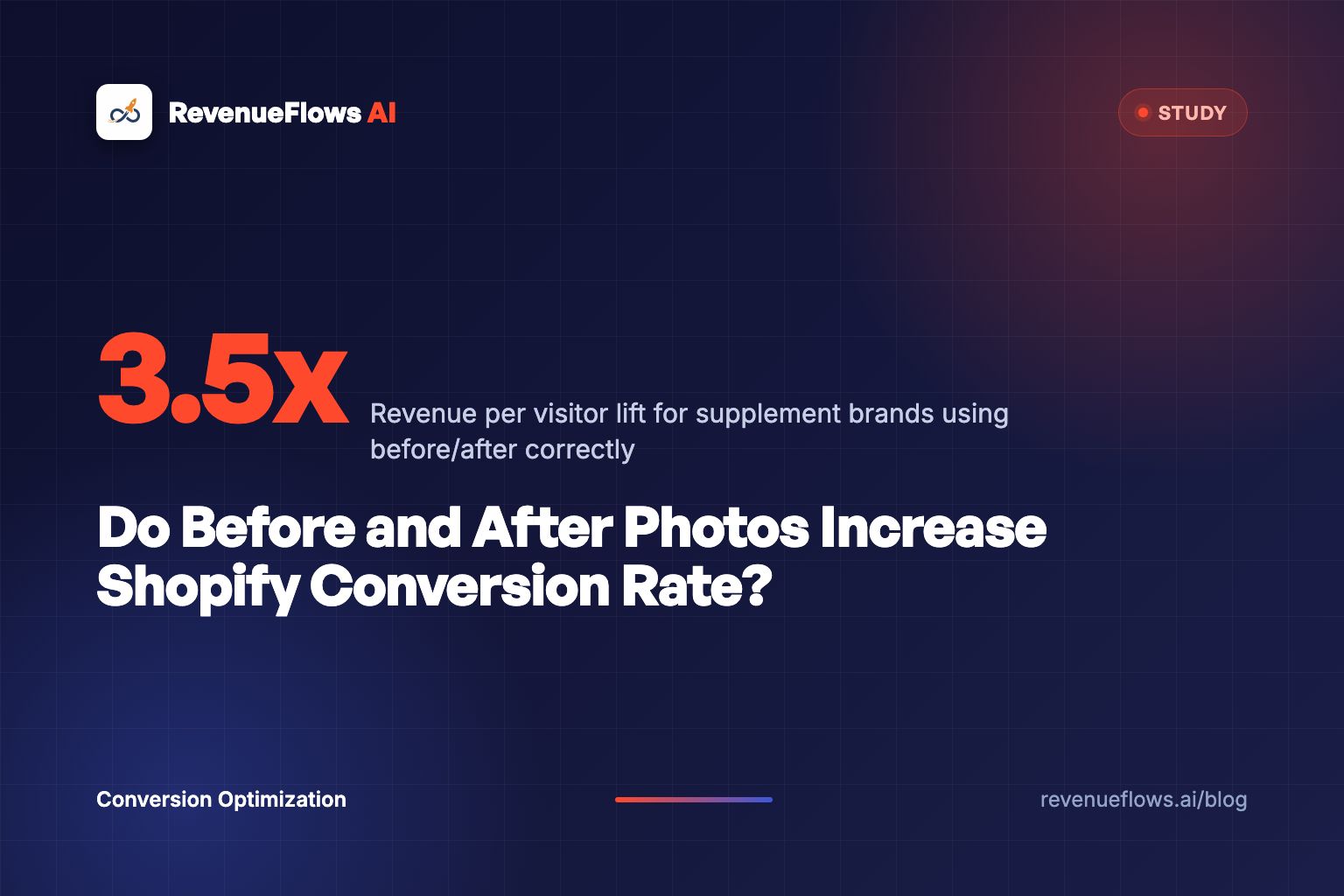
Add a before and after section with four named customers, specific time periods, and visible results. Conversion rate moves to 2.1%. Same $84 average order value. Revenue per visitor: $1.76. On 10,000 visitors, that's $17,640 instead of $5,040, a 3.5x lift on the same traffic. This is the range we observe when transformation content is added correctly to supplement pages.
What makes it work: specificity. The before and after content that converts isn't "real results from real customers." It's "Sarah, 34, Austin TX, used the morning formula for 11 weeks and tracked her skin's appearance weekly. Here's what she looked like at week 1, week 5, and week 11."
The specifics create credibility. Vague transformation claims do nothing.
2. Skincare
Skincare is the second-highest-conversion category for before and after content, and for the same reason as supplements: the buyer is buying a visible outcome.
The nuance in skincare is that the transformation timeline matters enormously for conversion. A buyer considering a $68 vitamin C serum wants to know it works, and more pressingly, how long before she sees results. Transformation content that shows week 2, week 4, and week 8 outcomes sets accurate expectations and pre-empts the return-and-refund cycle that kills skincare brands.
The Baymard Institute has documented that product image quality and proof of results are among the top factors driving product page trust in beauty categories. Transformation content is the highest-impact format for that proof in skincare.
The mistake most skincare brands make is showing the transformation in one dramatic photo with no timeline and no measurements. That reads as possibly doctored. The skincare before and after that converts shows incremental progress with dates.
3. Hair Care and Hair Tools
Hair transformation content converts strongly because hair change is visually obvious, fast-demonstrating, and applies to a large percentage of the buying audience.
The specific types that work: heat styling tools (straight vs. curled, before and after one use), scalp treatments (density and texture over 60 days), hair color systems (before and after one session), and growth supplements (90-day density comparison).
What makes hair transformation content credible is diversity of hair type. A before and after showing one person with fine straight brown hair converts buyers with fine straight brown hair. Add three more with different starting conditions, wavy, coily, thick, fine, and the page converts across a wider audience.
The average order value question matters here too. A hair growth supplement at $48 with a 1.4% conversion rate earns $0.67 per visitor. A page with credible transformation content across four hair types pushes that to 3.1% conversion at the same $48. Revenue per visitor: $1.49. On 20,000 monthly visitors, the difference is $16,400 per month. Same product. Same price. Different proof.
4. Fitness Equipment and Home Gym
Fitness equipment buyers are purchasing capability: the ability to do something they couldn't do before, or to do it more efficiently. Transformation content in this category tends to be process-based (showing the machine in use across different workouts) rather than physical (showing body composition change), because the body composition change takes months while the capability change is immediate.
The conversion-optimized version for fitness equipment: "Before this machine I was running to the gym 4 days a week. Now I do 35 minutes every morning before work." That's a lifestyle transformation, not a physical one. It's faster to demonstrate, easier to believe, and directly addresses the purchase motivation for most at-home fitness buyers.
"The transformation that converts isn't always physical. A lifestyle change, more time, less friction, a new daily routine, is often more convincing than a body composition photo that took 6 months."
The Three Niches Where Before and After Content Consistently Hurts Conversion Rate
1. Fashion and Apparel
Fashion buyers evaluate how a garment looks on a body like theirs, whether it fits a certain aesthetic, and how it works within an existing wardrobe. These are all static-state evaluations.
Before and after content in fashion almost always means "what you looked like before this outfit vs. after," which either sounds condescending or creates an unrealistic lifestyle association. Neither converts well. The buyer isn't looking for a transformation. They're looking for confirmation that this piece works for them.
What works in fashion instead: diverse body type photos showing the garment on different sizes and proportions, styling photos showing the piece in 3 to 4 different outfit combinations, and honest fit notes ("runs small in the waist, true to size in the hips"). That's the proof content that converts fashion buyers. Not before/after.
See the Shopify product page for paid traffic breakdown for how fashion brands should structure proof content when running cold traffic ads.
2. Cookware and Kitchen Equipment
Cookware transformation content suffers from a credibility problem: the "after" state is a cooked meal, and a cooked meal looks like a cooked meal regardless of which pan you used. The transformation isn't visible in the way that a skin improvement or a hair texture change is visible.
What works for cookware instead: durability demonstration photos (the skillet at 6 months versus a competitor's at 6 months), process photography showing the pan during heavy use (temperature distribution, non-stick surface performance), and specific use-case photos for the buyer's most common cooking scenarios.
The transformation a cookware buyer wants is "I'll stop ruining my eggs" or "I won't have to scrub for 20 minutes." That transformation is better demonstrated through product photography and specific performance claims than through a before/after frame.
3. Electronics and Tech
Electronics buyers are evaluating specs, compatibility, and reliability. Transformation content in this category tends to read as either gimmicky or misleading.
"Before: struggling to hear calls. After: crystal clear sound." That's true of nearly every headphone brand selling on Shopify. The claim is so generic it provides zero differentiation and zero trust signal. Buyers know it. The before/after frame in tech reads as marketing copy trying to simulate proof, which is exactly the defensive posture that breaks cold traffic conversion.
What works for electronics: specific benchmark comparisons against named competitors, customer reviews with technical specifics ("the noise cancellation cuts my open-plan office to near silence, tested during a 3-hour call"), and third-party review citations from credible sources.
The Placement Question
Here's the variable most brands get wrong: where on the page the before and after content lives.
Most brands either bury transformation content in a customer review section near the bottom of the page, or they put it in the opening product gallery as slide 3 or 4. Both placements underperform.
The opening product gallery is for product photography. Buyers scrolling the gallery are in evaluation mode, trying to understand what the product looks like. A transformation photo interrupts that evaluation and often confuses the buyer about what they're looking at. Save the gallery for the product.
Buried in reviews, transformation content competes with dozens of text reviews and gets minimal attention. Buyers scroll past.
The highest-converting placement for before and after content is in a dedicated section below the product description and above the customer reviews. Give it a clear header, three to five examples minimum, and put the time period and measurement next to the photo.
Above the fold works only when the transformation is the primary purchase motivation and the product is all but invisible without context, a supplements brand where no one knows what the capsule does, for example. Lead with the outcome. Introduce the product second.
"Most brands bury their best proof at the bottom of the page where nobody reads it. The transformation section belongs above the reviews, not in them."
What Makes Before and After Content Credible (and What Destroys It)
The difference between before/after content that converts and before/after content that reads as hype is specificity in three dimensions: the person, the time, and the measurement.
The person. A named customer with a photo, a location, an age, and enough context that they're clearly a real individual. "Sarah M., Phoenix AZ, 34" converts better than "verified customer." A customer's social media handle, used with permission, is even stronger.
The time. How long did it take? Was it consistent use or intermittent? "Used once a day for 8 weeks" is credible. "After a few weeks" is not.
The measurement. What changed and by how much? For supplements: pounds, inches, percentage. For skincare: inflammation rating, visible texture, breakout frequency. For hair: density, growth length, breakage reduction. For fitness: weight used, time to fatigue, resting heart rate. Vague outcomes ("I felt so much better") don't convert.
The credibility destroyers: photos that look professionally edited, dramatic single-result claims with no supporting customer diversity, transformation timelines that are implausibly short, and stock photos dressed up as customer results. Buyers are more attuned to these signals than most founders realize.
The Legal Question You Need to Resolve Before Publishing
Before and after content in supplements, skincare, and any health-adjacent category carries regulatory consideration.
The FTC requires that testimonials and endorsements reflect the typical experience buyers can expect, not a cherry-picked outlier. If the average customer sees a 10% skin improvement in 8 weeks but your page shows one customer's 60% improvement in 2 weeks, that's a compliance risk.
The practical implementation: add a disclosure near your transformation section. "Results vary. These customers used the product consistently for the stated period." Run your claims through a basic FTC endorsement guide review before publishing.
This isn't a legal warning, it's a conversion note. A visible disclaimer on before and after content actually increases trust for health-category products, because it signals that you're not overclaiming. That signal matters more than most founders expect.
The 4-Element Framework for Before and After Content That Converts
Based on the patterns that show up consistently across supplement, skincare, hair care, and fitness equipment product pages, here's what a high-converting before and after section contains:
Element 1: Minimum three examples, maximum six. Below three, buyers wonder if they're cherry-picked. Above six, the section starts to feel overwhelming. Three to six examples with visual diversity (different body types, skin tones, hair textures, starting conditions) hits the credibility sweet spot.
Element 2: Specific timeline with the outcome. Not "after using this for a while". "after 6 weeks of twice-daily use." Every entry has a time period. Every entry has a measurable outcome stated in one sentence.
Element 3: The starting condition. The buyer reading your page needs to recognize themselves in the "before" state. If the before photo shows a mild skin condition but your buyer has a severe skin condition, they won't see themselves in the transformation and the content won't convert them. The starting conditions across your examples should cover the range of your actual buyer's starting point.
Element 4: A clear connection to the product mechanism. Why did this transformation happen? One sentence, non-scientific, connecting the outcome to what the product does: "The collagen peptides rebuild the skin barrier from the inside, that's why the redness calmed down before the texture improved." This preemptively answers the "but how does this work for me?" question that lives between the transformation and the purchase decision.
How to Test Whether It's Working
Add the before and after section to one variant in a page A/B test. Measure three numbers:
Conversion rate, is more traffic completing purchases? Average order value, are buyers adding more to justify the transformation they're expecting? Return rate over 30 days, are buyers' expectations being met, or is the transformation content creating a gap between promise and reality?
If conversion rate goes up and return rate stays flat, the transformation content is working. If conversion rate goes up and return rate also goes up, the content is attracting buyers with unrealistic expectations, which means your transformation content is overclaiming and your disclosure section needs strengthening.
Both the Shopify product page copywriting framework and a free DTC conversion audit cover how to write the copy that surrounds transformation content for maximum conversion impact. Baymard's research on product images backs why visual proof carries more weight with buyers than written claims.
The Summary
Before and after photos increase Shopify conversion rate in supplements, skincare, hair care, fitness equipment, and home organization. They hurt conversion in fashion, cookware, and electronics.
The placement that performs: a dedicated section below the product description, above customer reviews, with a clear header, three to six examples, specific timelines, measurable outcomes, and a legal disclosure.
The credibility requirement: named customers with enough identifying detail that a skeptical buyer can believe they're real. Vague testimonials and generic results don't move the number.
And if you want to test it before building the full section: start with one strong example. One named customer, one specific timeline, one measurable outcome. Measure that against your current page for 2 weeks with enough traffic to be statistically meaningful. That one example is often enough to see whether the mechanism works for your category before you invest in a full production shoot.
The Briefing Document Your Photographer Needs
Most Shopify brands that decide to shoot before and after content brief their photographer with a vague direction and get photos that don't convert. The briefing has to be specific before the shoot, not after.
Seven things your photographer needs to know before shooting transformation content:
The customer's starting condition in exact terms. Not "her skin was bad" but "moderate acne, primarily on the cheeks and chin, with visible redness." The photographer needs to know what to emphasize in the before image without making it more or less dramatic than the reality.
The time period you're showing. If the product produces results over 8 weeks, you're shooting at week 1 and week 8. Not week 1 and week 4 because that's more convenient. The customer who buys based on an 8-week transformation and sees nothing at week 4 returns the product.
The lighting must match between before and after. Different lighting is the most common reason transformation content reads as manipulated. Same natural light source. Same angle. Same distance. Buyers notice immediately when the lighting shifts.
The customer should be smiling in the after shot and neutral in the before. Not dramatically unhappy. Neutral before, visibly confident after. Overclaiming on the emotional arc damages credibility.
Measurement documentation belongs in the frame or as a caption. A visible measuring tape, a scale reading, a dated photo of the product next to the customer. Anything that anchors the transformation to a real-world reference point.
Multiple takes from the same angle so you can match them precisely in post. The body position, the crop, the zoom level, should be identical between before and after. Even a 10% difference in zoom makes the comparison feel dishonest.
And finally: get written consent that allows you to use the photos on the product page, in ads, and in testimonials. Separately from any review permission. Customers who give a review don't automatically grant ad usage rights, and a regretted usage creates legal exposure you don't want.
"Brief the shoot with the same precision you'd brief a copywriter. Vague input produces vague content. And vague before/after photos don't convert."
Book Your Profit Audit
The RevenueFlows AI page builder includes before and after content frameworks for the categories where transformation content converts. We rebuild your highest-traffic product pages in under 15 minutes, with proof sections, copy structure, and layout built in.
Get your free profit audit and see exactly how much revenue your current page leaves per visitor.
Frequently asked questions
Do before and after photos increase Shopify conversion rates?
Yes, in the right categories. Transformation content increases conversion rate in supplements, skincare, fitness equipment, hair care, and home organization. It backfires in fashion, cookware, and electronics where the 'after' state is either obvious or impossible to demonstrate credibly.
Where should before and after content appear on a Shopify product page?
Above the fold if the transformation is the primary purchase motivation (supplements, skin care). Below the primary product description if the transformation is secondary (fitness equipment, hair tools). Never in the opening product gallery, that slot is for product photography, not proof content.
What makes before and after content credible on a product page?
Specifics. A customer testimonial that says 'I lost 14 pounds in 6 weeks using this twice a day' is credible. A photo captioned 'real results' with no timeline, no measurement, and no customer name is not. The conversion lift comes from specificity: named customer, time period, measurement, and what they actually did.
Do before and after photos work for Shopify fashion brands?
Rarely. Fashion buyers evaluate aesthetics and fit, not transformation. A before/after showing 'what I looked like before this jacket vs after' is usually not the right frame for clothing. Customer styling photos (how one piece works in multiple outfit contexts) work far better for fashion conversions.
How do I measure whether before and after content is helping my Shopify conversion rate?
Add the before/after section to one variant in a page A/B test. Measure conversion rate, average order value, and time on page. If conversion rate increases but average order value stays flat, the transformation content is building desire but not urgency. Add a time-specific proof element (30-day result, 12-week transformation) to create a clearer purchase trigger.