
How to Write Shopify Product Page Headlines That Convert
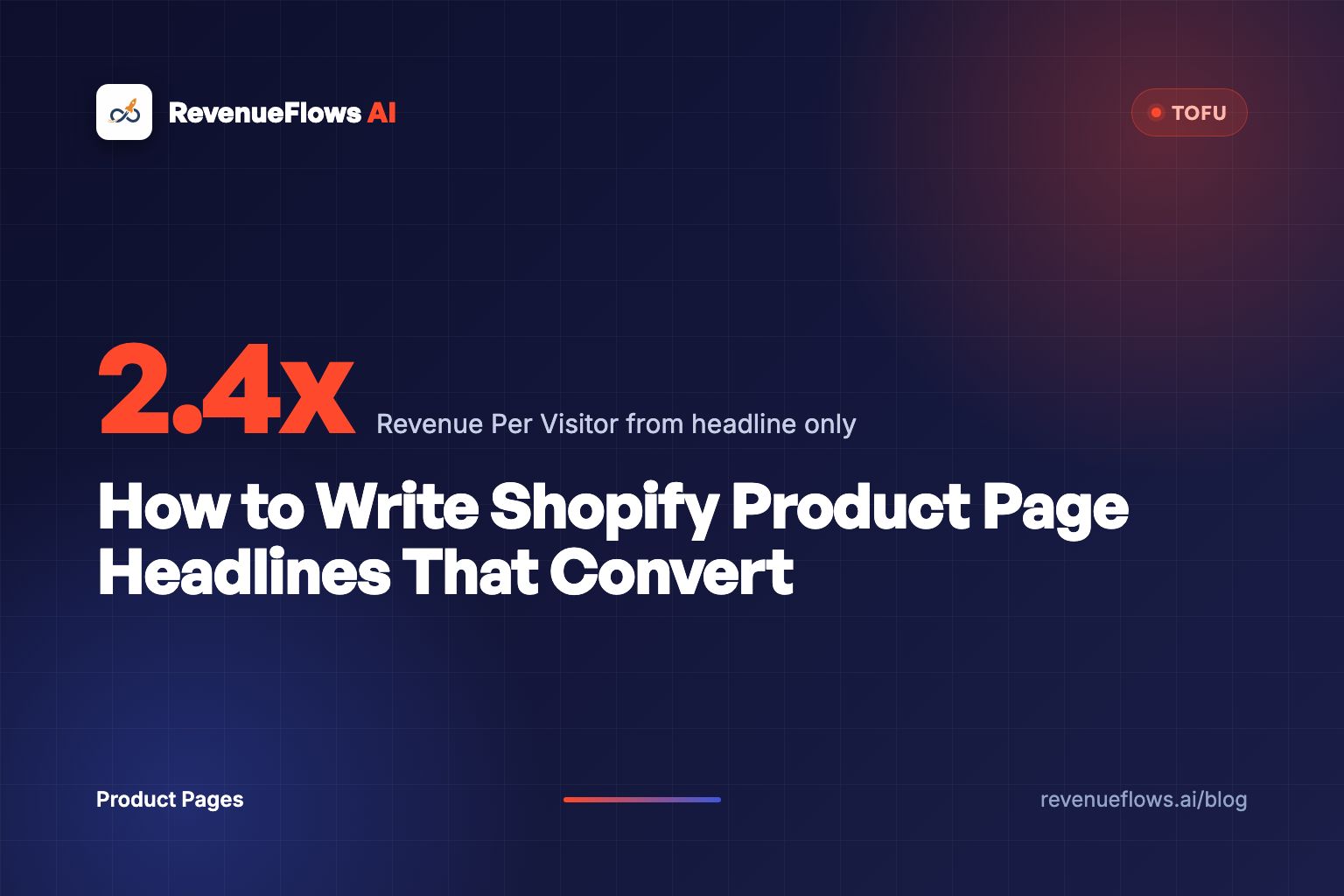
Your Shopify product page headline is decided in 4 seconds. Most founders write spec sheets. Here's the 3-part formula that turns a $1.01 revenue per visitor into $2.44, without touching anything else.

A kitchen accessories brand came to us last March. They were selling an 8-inch chef's knife at $84. Good product. Sharp blade. Beautiful packaging. Terrible headline.
Their product page said: "Pro Series Chef's Knife, 8-Inch German Steel."
Conversion rate: 1.2%. Average order value: $84. Revenue per visitor: $1.01. On 10,000 visitors, that's $10,100.
We changed one thing. The headline.
New headline: "Cut Your Prep Time in Half, Even If You've Never Owned a Proper Knife."
Conversion rate jumped to 2.9%. Average order value stayed at $84. Revenue per visitor: $2.44. On the same 10,000 visitors, that's $24,400.
One line of copy. $14,300 more revenue per 10,000 visitors. Nothing else changed.
Here's the 3-part formula behind that headline, and how to apply it to any Shopify product page.
Why Most Shopify Product Page Headlines Fail
The default behavior for almost every Shopify store owner is to name the product in the headline. "Premium Bamboo Cutting Board." "Stainless Steel Water Bottle, 32 oz." "Organic Cotton Hoodie, Heather Grey."
These aren't headlines. They're inventory labels.
Here's what a spec-sheet headline communicates to the buyer: "This is what the product is. You figure out whether it's relevant to you."
That's a terrible user experience. The buyer lands on your page mid-scroll through a busy feed. They've just seen 40 other things. They have 4 seconds, maybe less, to decide whether to keep reading. A spec headline gives them nothing to grab onto.
The Nielsen Norman Group has documented this for years: users read in an F-pattern, skimming the top line and the first few words of each subsequent line. Your headline is the entire first impression. If it's a product name, you've wasted it.
"The visitor isn't reading your page. They're scanning it for a reason to stay. The headline is the only thing that can give them that reason in the first four seconds."
The fix isn't complicated. But it requires a shift in thinking: stop describing the product and start describing the buyer's life after the product.
The 3-Part Headline Formula
Every high-converting Shopify product page headline we've seen across 200+ store audits follows a version of this structure:
[Outcome the buyer wants] + [Disarm the objection] + [Social proof signal]
You don't need all three in every headline. Even one or two parts dramatically outperform a spec-sheet name. But when you stack all three, the headline does the job of your entire above-the-fold section.
Let's break down the chef's knife example:
- Outcome: "Cut your prep time in half", specific, visceral, and desirable
- Disarm the objection: "Even if you've never owned a proper knife", removes the "I'm not a real chef, this isn't for me" exit thought
- Social proof signal: implied by the confident, authoritative tone, but the next line delivers it explicitly ("Join 8,400 home cooks who switched")
This formula works for physical products, consumables, tools, and apparel. The texture changes by niche. The structure stays the same.
5 Headline Rewrites: Before and After
Here's how the formula looks across different product categories:
Fitness brand, resistance bands:
- Before: "Premium Resistance Bands, Set of 5, 10-50 lbs"
- After: "Get 30 minutes of real strength work without a gym membership, used by 22,000 home athletes"
Pet niche, dog joint supplement:
- Before: "Advanced Hip & Joint Formula, 120 Chews"
- After: "Your dog should still sprint to the door when you grab the leash. Here's what's making that happen for 14,000 pet parents."
Home goods, bamboo cutting board:
- Before: "Organic Bamboo Cutting Board, 18 x 12 Inches"
- After: "Stop replacing cheap boards every 8 months. This one still looks new at year 3 to 11,200 kitchens can confirm."
Beauty, vitamin C serum:
- Before: "20% Vitamin C Brightening Serum, 1 oz"
- After: "Visible dark spot reduction in 14 days. The formula 9,400 women switched to when nothing else worked."
Apparel, heavyweight cotton tee:
- Before: "Classic Heavyweight Tee, 100% Organic Cotton, 280 GSM"
- After: "The last basic tee you'll ever need to buy. Still fits, still looks sharp after 200 washes, 6,800 founders wear it daily."
Notice what all the "after" headlines share: a specific number, a specific outcome, and no jargon. The spec details (GSM, oz, 18x12) move to the body copy where they belong, as confirmation for a buyer who's already decided to keep reading.
The Objection Disarm: The Most Underused Piece
The middle part of the formula, disarming the objection, is where most headline writers leave money on the table.
Every product has a version of "this isn't for me" running in the buyer's head. Your headline can neutralize it in 6 words.
"Even if you've never...", removes expertise barriers. "Without spending $300 on...", removes price anchoring to a higher-cost alternative. "Even on a busy weeknight...", removes the time objection. "Without changing your diet...", removes lifestyle friction.
The objection disarm works because it demonstrates empathy. The buyer thinks: "This brand already knows my hesitation. That means they actually understand customers like me."
That trust signal raises conversion rate before the buyer reads a single word of body copy.
What to Do With Your Existing Headlines
This is a 20-minute exercise. Run it on your top 3 revenue-generating product pages today.
- Read your current H1 headline cold. Ask: does it describe the product or the transformation?
- Write the outcome version: "After buying this, the buyer will ____."
- Identify the #1 objection a new buyer has. Write "Even if..." or "Without..." to neutralize it.
- Pull a specific number from your reviews, how many buyers, how fast the result, how long it lasts.
- Combine: [Outcome] + [Objection disarm] + [Specific number].
If the new headline feels more like a conversation and less like a catalog entry, it's working.
For a deeper dive on the rest of the product page, see our Shopify product page copywriting guide, it covers the full hierarchy from headline through CTA. And if you want to see how the headline interacts with the proof block and bundle offer, the Shopify product page optimization breakdown has a full framework.
The Bigger Picture: One Line, $14,300
The kitchen knife brand didn't run new ads after changing the headline. They didn't redesign the page. They didn't add new photography or hire a developer.
They changed 11 words.
And those 11 words moved the revenue per visitor from $1.01 to $2.44. That's 141% more revenue from the same traffic. On 10,000 monthly visitors, that's $14,300 per month. Every month. From one headline test.
That's what your product page is worth when the headline does its job.
If you want to know what your current headline is costing you, and which specific words would fix it, that's exactly what a profit audit surfaces. We read your top page, run the headline test, and show you the revenue per visitor delta before you write a single new word.
If you want us to do the full product page rewrite, we do that too. Most stores go from audit to live new page in under a week.
Book Your Profit Audit
Your headline is either grabbing buyers or letting them scroll away. Most Shopify founders have no idea which one is happening, because they wrote the headline themselves and can't read it cold anymore.
Get your free profit audit and we'll show you how to rebuild a high-converting product sales page in less than 15 minutes.
Frequently asked questions
What should a Shopify product page headline say?
The headline should describe the transformation the buyer gets, not the product's features. Lead with the outcome, validate the buyer's identity, and signal proof. Spec-sheet headlines (Premium Chef's Knife, 8-inch) convert far below outcome-driven headlines.
How long should a Shopify product page title be?
Your H1 headline (the copy above the Add to Cart button) can be 8 to 18 words, as long as it's specific and outcome-focused. Your SEO title tag stays under 65 characters. These are two different things. Don't write your headline for Google, write it for the human who just landed.
Does changing a Shopify product page headline really increase conversion?
Yes, it's consistently the highest-ROI single change we see across audits. A kitchen accessories brand changed one headline and their conversion rate went from 1.2% to 2.9%, lifting revenue per visitor from $1.01 to $2.44 on the same 10,000 visitors.