
Does a Money-Back Guarantee Increase Shopify Conversion?
Every guru says add a money-back guarantee and watch sales climb. Sometimes true, often not. Here's when a guarantee actually moves your Shopify conversion rate, and when it does nothing at all.

Every marketing guru repeats the same line. Add a money-back guarantee and watch your sales climb. Slap a 30-day badge on the page, they say, and the conversion rate takes care of itself.
So you add it. The little shield icon. "100% Money-Back Guarantee." And then you wait.
Sometimes the number moves. Often it doesn't budge at all. And almost nobody tells you why.
So let's answer it straight. Does a money-back guarantee increase Shopify conversion rate? The honest verdict, then the proof, then the three conditions that decide whether yours will do anything.
The Verdict, In One Breath
Here's the answer before the 3,000 words.
A money-back guarantee increases Shopify conversion rate only when it removes a real, specific fear the buyer already has, placed at the moment of hesitation, on a page that has already earned the click. Under those conditions it works. Outside them, it's a badge that decorates a page nobody was going to buy from anyway.
That's the whole thing. The guarantee is an amplifier, not an engine. It multiplies a page that almost converts. It can't manufacture a sale on a page that doesn't.
Now let me show you why, because the why is where the money is.
Why the Guru Advice Is Half True
The guarantee gospel comes from a real idea. It's called risk reversal, and the logic is sound: every purchase carries a fear of regret, and if you move that fear off the buyer and onto yourself, more buyers say yes. That part is true. Risk reversal is one of the oldest, most reliable moves in selling.
Where the advice goes wrong is treating the guarantee as a switch. Flip it, sales go up. That's not how buyers think.
Here's what actually happens in a buyer's head. They land on your page. In the first few seconds they decide whether this product is even for them. Then they hunt for reasons to say no. The price. The shipping. The "will this actually work for me." A guarantee only matters at the last of those moments, and only if the buyer made it that far.
If your page loses people in the first 8 seconds, no guarantee in the world saves it. They never reach the part of the decision where a guarantee speaks. The badge sits there, unread, doing nothing.
A guarantee answers the question "what if I'm wrong to buy this?" It never gets asked if the buyer already decided the product isn't for them.
This is the part the gurus skip. The guarantee is the last domino, not the first. You have to knock down the others first.
Condition One: The Page Has to Earn the Click First
A guarantee multiplies whatever conversion rate the page already has. So the size of the win depends entirely on how good the page is underneath it.
Run the math on two hypothetical stores selling the same $80 product to the same 10,000 visitors.
Store A has a weak page. Thin copy, stock photos, no clear reason to buy. It converts at 0.6%. Revenue per visitor of $0.48. On 10,000 visitors, $4,800 a month. Add a guarantee and say it lifts conversion to 0.7%. Revenue per visitor of $0.56. On 10,000 visitors, $5,600. A $800 bump. Real, but small, because there was almost nothing to amplify.
Store B has a strong page. Sharp benefit copy, real photos, objections handled, the buyer already nodding by the time they reach the button. It converts at 1.8%. Revenue per visitor of $1.44. On 10,000 visitors, $14,400. Add the same guarantee at the moment of hesitation and say it lifts conversion to 2.2%. Revenue per visitor of $1.76. On 10,000 visitors, $17,600. A $3,200 bump from the identical badge.
Same guarantee. Same words. Four times the lift on the page that earned the click first.
That's the lesson nobody puts on a slide. The guarantee didn't fail on Store A. The page did. The guarantee just had nothing to multiply.
Condition Two: It Has to Remove a Real, Specific Fear
A vague guarantee removes a vague fear, which is to say, none.
"100% Satisfaction Guarantee" is wallpaper. Every store has one. Buyers have learned to scroll past it the way they scroll past "free shipping on orders over $50." It registers as a category of thing, not a promise to them.
A specific guarantee names the exact fear the buyer is sitting with and kills it.
Sell a mattress and the fear is "what if it's uncomfortable and I'm stuck with it." So the guarantee becomes "Sleep on it for 100 nights. If it's not the best sleep of your life, we'll pick it up and refund every dollar, no questions, no restocking fee." That's not wallpaper. That's the buyer's exact midnight worry, answered.
Sell a skincare serum and the fear is "what if it breaks me out or does nothing." So the guarantee becomes "Use the whole bottle. If your skin isn't visibly calmer in 30 days, send back the empty bottle for a full refund." You're inviting them to use it up and still get their money back. The fear evaporates.
A generic guarantee says "trust us." A specific guarantee says "here is the exact bad outcome you're afraid of, and here is why it can't cost you anything." Only the second one moves a conversion rate.
The test is simple. Read your guarantee and ask: could a competitor in a completely different category paste this onto their page unchanged? If yes, it's wallpaper. Rewrite it around your buyer's actual fear.
Condition Three: Placement at the Moment of Hesitation
The right guarantee in the wrong place does almost nothing.
Most stores put the guarantee in the footer, or on a separate "guarantee" page nobody visits. By the time a buyer would scroll to the footer, the decision is already made. The guarantee arrives after the moment it was meant to win.
The moment of hesitation is precise. It's the half-second after the buyer reads the price and before they decide whether to click add-to-cart. That's where the fear spikes. That's where the guarantee has to be.
Put it in two places. Right next to the add-to-cart button, in plain text, short. And again inside the objection section lower down, expanded, for the buyer who needs the full reassurance before they commit. Baymard Institute's checkout research has shown for years that buyers abandon when trust and cost concerns hit at the decision point. Meet the concern at the decision point, not three screens away.
Same words. Different position. The footer version gets ignored. The button version gets read at the exact second it matters.
The Proof: What a Guarantee Does When the Page Is Right
Let me show you what this looks like when all three conditions are met, with real numbers.
We rebuilt the product pages for a bedding brand that was stuck at a $15k a month ceiling. We didn't just add a guarantee. We rebuilt the whole page around the buyer's decision: benefit-first copy, real room photos, objections handled, and yes, a specific guarantee placed at the moment of hesitation. The guarantee was one element inside a page engineered to earn the click first.
Real client numbers, not typical results, and not a promise of what your store will do. Before the rebuild: a 1.0% conversion rate and a $125 average order value, which is a revenue per visitor of $1.25. After: a 3.5% conversion rate and a $231 average order value, which is a revenue per visitor of $8.10. On 10,000 visitors, that's the difference between $12,500 and $81,000 a month, a gap of $68,500. You can see the full case study numbers on our results page.
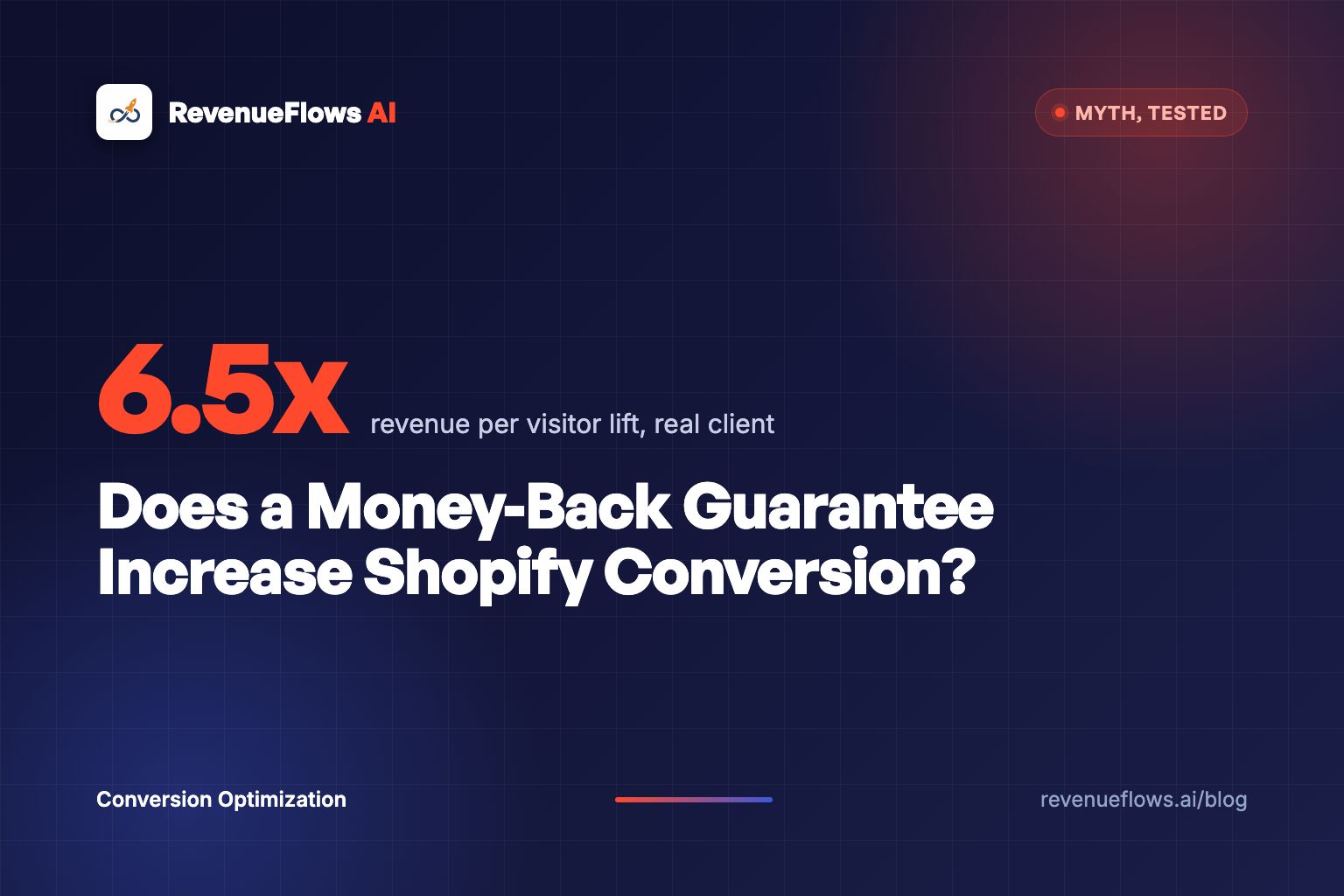
That's a 6.5x lift in revenue per visitor. The guarantee helped. But it helped because it sat on a page that had already done the heavy lifting. Drop that same guarantee onto the old page, alone, and you'd have seen the $800 Store A bump, not the $68,500 swing.
The guarantee is not the lever. The page is the lever. The guarantee is the last bit of grip that turns an almost-yes into a yes.
This is the difference between a brand that obsesses over badges and a brand that obsesses over the math. One adds widgets and hopes. The other rebuilds the page around revenue per visitor and uses the guarantee as the final move, not the first.
Will a Guarantee Increase My Returns?
The fear behind the fear. Founders avoid strong guarantees because they picture a flood of refunds eating the gains.
Here's what we see across stores we rebuild. A specific, honest guarantee on a page that sets accurate expectations attracts more confident buyers and a small rise in returns that the extra sales more than cover. The buyers who needed the guarantee to say yes mostly keep the product, because the page told them the truth about what they were getting.
The refund problem shows up somewhere else: a strong guarantee on a page that overpromises. If the copy oversells and the product underdelivers, the guarantee just makes it easy for disappointed buyers to leave. That's not a guarantee problem. That's a page-honesty problem.
So the rule is: make the page accurate, then guarantee it boldly. The accuracy keeps returns low. The boldness lifts conversion. Reverse the order and you get refunds without the sales.
When You Should Not Add a Guarantee
Contrarian, but earned. There are times a guarantee hurts.
A guarantee that sounds too good triggers suspicion, not trust. "Lifetime money back, keep the product, no questions ever" on a $19 trinket reads like a scam. The buyer's gut says nobody gives that away unless something's wrong. An overblown guarantee can lower trust on low-trust pages.
And on a page that hasn't earned the click, the guarantee is a distraction from the real work. You'll spend a week wordsmithing a badge when the page needs a new headline, real photos, and benefit copy. Fix the engine before you polish the trim.
The honest hierarchy: earn the click with the page, remove the specific fear with the guarantee, place it at the moment of hesitation. In that order. A guarantee is the cherry. You still have to bake the cake.
Three Guarantees, Side by Side
To make the difference concrete, here are three versions of the same promise on the same $80 skincare serum. Watch what changes as the wording gets sharper.
| Guarantee wording | What it removes | Likely effect on conversion rate |
|---|---|---|
| "100% Satisfaction Guarantee" (footer badge) | A vague, unnamed worry | Near zero. Buyers scroll past it. |
| "30-Day Money-Back Guarantee" (near the button) | General buyer's remorse | Small lift. Better placement, still generic. |
| "Use the whole bottle. If your skin isn't visibly calmer in 30 days, send back the empty for a full refund." (next to the button) | The exact fear: it breaks me out or does nothing | The real lift. Names the fear, kills it, at the decision point. |
Same product. Same refund policy underneath. Three completely different effects on the number, because specificity and placement do the work, not the existence of a guarantee.
Notice the third version invites the buyer to use the product up and still get their money back. That sounds risky to the founder and feels safe to the buyer. The asymmetry is the point. You absorb a fear that was stopping the sale, and the confident buyers who needed that nudge mostly keep the product anyway.
The weak guarantee protects your ego. The specific guarantee protects the buyer. Only one of them changes the number on your dashboard.
One more thing the table hides. The third guarantee only works because the page above it already made the buyer want the serum. Strip out the benefit copy and the real photos, and even that sharp guarantee lands on a buyer who never got close to yes. Wording and placement are conditions two and three. Condition one, the page earning the click, sits underneath all of it.
The Bigger Principle
Step back and the guarantee question is really a question about how you think about conversion.
If you believe conversion is a pile of tactics, you'll chase badges, timers, popups, and guarantees, adding one after another, surprised each time the needle barely moves. Each tactic works a little, in the right spot, on the right page. None of them works as a substitute for the page being good.
If you believe conversion is math, you start somewhere else. You ask what your revenue per visitor is, where the page loses people, and which single change moves the most money. The guarantee earns its place only when it's the change that removes the biggest remaining fear. Most of the time, it isn't, and the math tells you that before you waste a week on it.
To go deeper on the broader category, read how to use risk reversal on a Shopify product page, which covers guarantees, free returns, and trials as a system. When you're ready to find the biggest leak instead of guessing, the best DTC conversion audit walks through the diagnosis, and our Shopify product page rewrite service breakdown shows how the page rebuild and the guarantee fit together.
What to Do With This
Don't rip your guarantee off the page. And don't expect it to save a page that isn't pulling its weight. Do three things instead.
First, read your guarantee and ask if a competitor in another category could use it unchanged. If yes, rewrite it around your buyer's real fear. Second, move it next to the add-to-cart button and into the objection section, out of the footer. Third, and most important, check whether the page underneath has earned the click, because that's what decides how much your guarantee is worth.
The guarantee is the last domino. Knock down the others first.
Book Your Profit Audit
If you've added every trust badge and guarantee in the playbook and your conversion rate is still flat, the problem is upstream of the badges. We'll calculate your revenue per visitor, show you exactly where the page loses buyers, and tell you whether the guarantee is even your biggest lever.
Get your free profit audit and we'll show you how to build a high-converting product sales page in less than 15 minutes.
Frequently asked questions
Does a money-back guarantee increase Shopify conversion rate?
Sometimes. A guarantee raises conversion rate when it removes a real, specific fear the buyer already has. It does little when the page hasn't earned the click yet or when the guarantee is vague. The guarantee amplifies a page that almost converts. It cannot rescue a page that does not.
Where should a money-back guarantee go on a product page?
Place it at the exact moment of hesitation: next to the add-to-cart button and again inside the objection section. A guarantee buried in the footer does almost nothing. The same words next to the buy button, at the second of doubt, do the work.
Will a money-back guarantee increase returns?
A specific, honest guarantee usually attracts more confident buyers and a small rise in returns that is more than covered by the extra sales. A vague guarantee on a page that overpromises attracts refund-seekers. The page sets the expectation, the guarantee just backs it.
What is the difference between a guarantee and risk reversal?
A money-back guarantee is one form of risk reversal. Risk reversal is the whole category of moves that shift the fear of a bad outcome off the buyer and onto the seller: guarantees, free returns, free trials, and warranties. The guarantee is the most common one.
Is a stronger guarantee always better?
No. A guarantee that sounds too good triggers suspicion instead of trust. A believable, specific promise beats an extreme one. The goal is to remove the real fear, not to win a contest for the boldest claim on the internet.