
Do Lifetime Warranties Increase Shopify Conversion Rate?
The badge does nothing. The terms do everything. Here's the four-question test a lifetime warranty has to pass before it moves a single order, plus the break-even model.

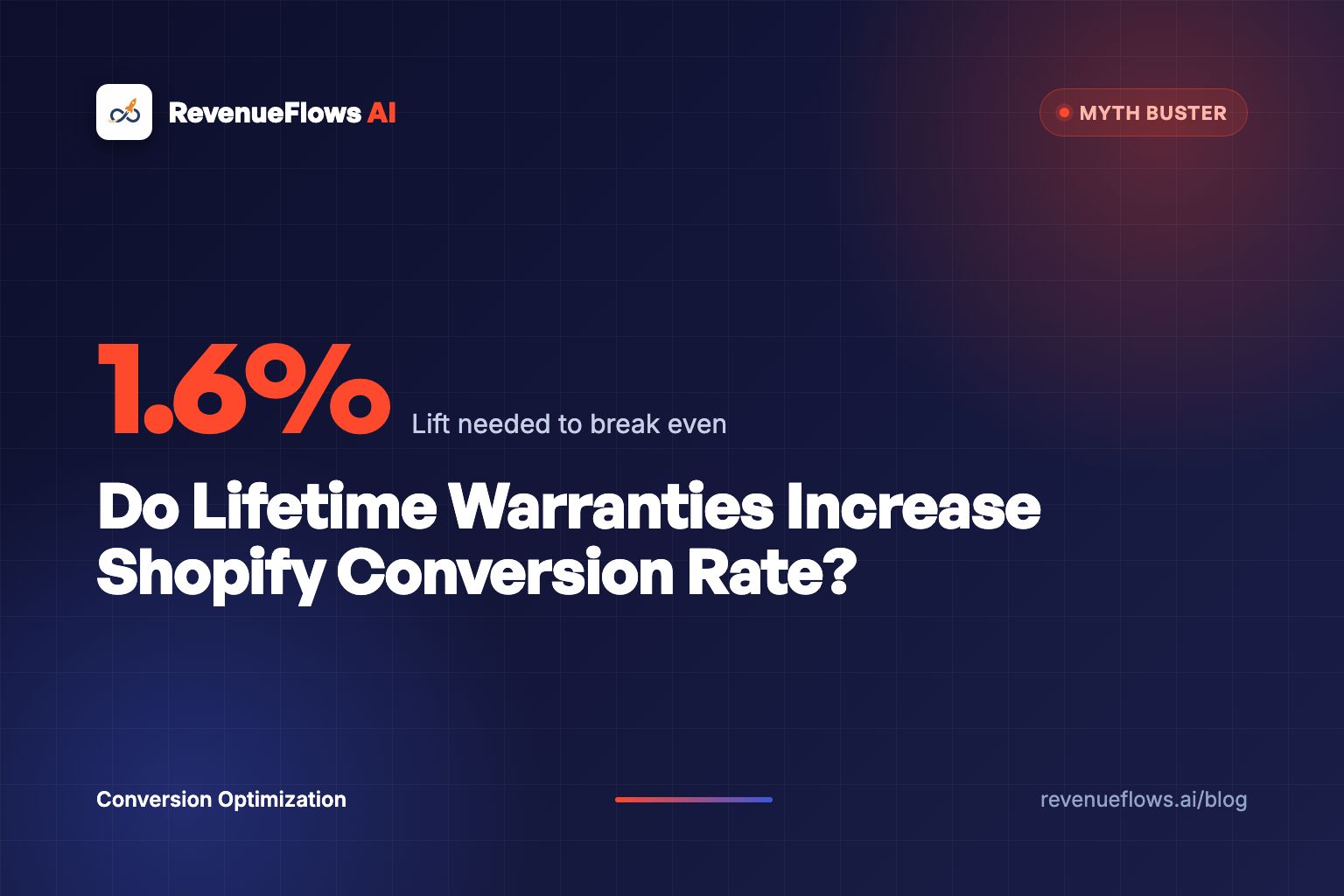
Do lifetime warranties increase conversion rate? The badge doesn't. The terms do.
A grey icon in a trust strip that says LIFETIME WARRANTY next to a padlock and a Visa logo is worth approximately nothing, and I'd argue it's worth slightly less than nothing, because it takes up the space where a real sentence could have gone. A printed promise with a claim process, a timeline, and an honest exclusion list moves orders, raises average order value, and pulls a brand out of the price fight it was losing.
Same three words. Two completely different outcomes. The difference is whether a shopper can predict what happens if the product fails.
That's the whole argument of this piece, and the rest of it is the proof, the break-even model so you can decide whether the promise is affordable, the four questions your warranty copy has to answer, and the two cases where a lifetime warranty makes your conversion rate worse.
A warranty badge is a claim. A warranty procedure is evidence. Buyers have been trained to ignore claims and to read evidence twice.
What does the evidence actually say about warranties and conversion rate?
Here's where I have to be honest with you, because a lot of the content on this topic is not.
There's no clean, public, large-sample study that says "adding a lifetime warranty lifts ecommerce conversion rate by X%." Anybody quoting you a single tidy percentage for that is quoting a number somebody made up in a blog post in 2019, and it got copied forward until it looked like research.
What does exist is more useful anyway.
Uncertainty at the point of decision is one of the best-documented causes of abandonment in ecommerce. The ongoing cart abandonment research keeps landing on the same shape of finding: shoppers leave when a cost, a term, or an outcome is unclear, and they leave at the exact moment the unclear thing surfaces. A warranty is a term. If it's unclear, it does not reduce risk, and a promise that does not reduce risk does not produce orders.
Which reframes the question. Not "do warranties work," but "does this particular warranty copy remove a specific fear a specific buyer has at a specific moment."
Sometimes yes, enormously. Sometimes it does nothing at all. And the variable is never the length of the coverage. It's the specificity.
Why the badge does nothing
Three reasons, and they compound.
The word "lifetime" is the least informative word in the sentence. Whose lifetime? The buyer's? The product's? The model's, until it gets discontinued next spring? Every shopper who has been burned once by a "lifetime" promise on a laptop bag reads that word as marketing, not as terms. The word signals a category of claim, not the claim itself.
Trust icon strips have been trained out of us. Badges cluster near the footer, they're grey, they're small, and they've been used for so long by so many bad actors that shoppers' eyes skip the entire block. Your real warranty is now sitting in the visual position of an SSL seal from 2011.
The claim is unfalsifiable at decision time. A shopper cannot check a lifetime promise before they buy. They can check a shipping speed, a price, a review count, a return window. They can't check a promise about year seven. So they default to discounting it, unless you give them something checkable right now: a procedure, a timeline, a named exclusion.
That third one is the mechanism nobody talks about. Buyers don't believe promises. They believe operational detail, because operational detail is expensive to fake.
The four questions your warranty has to answer
Every high-performing warranty section I've audited answers these four in plain language, on the page, above the fold or one scroll from it. Every low-performing one answers zero of them and links to a policy page instead.
1. Whose lifetime, exactly?
Say it in one sentence. "Covered for as long as you own it." Or "covered for the expected life of the product, which for this pack is 10 years of regular use." Both are fine. What's fatal is leaving it open, because the buyer fills the gap with the most cynical reading available.
2. What counts, and what doesn't?
This is the one that feels dangerous and performs the best.
Print the exclusions. Wear and tear, or not. Accidental damage, or not. Second-hand purchases, or not. Products altered by the customer, or not.
A brand that names three things it won't cover becomes believable about the things it will. A brand that names zero exclusions is either lying or hasn't thought it through, and shoppers can't tell which, so they assume the first.
3. What does it cost me to claim?
Who pays shipping. Whether you need the receipt. Whether there's a form. Whether you get a replacement, a repair, or a credit.
Nobody expects a warranty to be free of effort. They expect to know the effort in advance. "You pay to ship them back, we cover everything else" is a completely acceptable answer, and it converts better than silence, which reads as "we're going to make this hard."
4. How long does it take?
A number of business days. That's it. This one line does more work than the entire rest of the section, because it's the only part of a lifetime promise that can be verified against the internet, where somebody has posted how long it actually took.
What the two brands everyone cites actually print
Darn Tough and Osprey get named in every conversation about lifetime warranties, and it's worth looking at what they actually publish rather than what people remember about them.
Darn Tough's page is headed Unconditionally Guaranteed for Life, and the operative sentence is close to plain speech: if you wear a hole in them, they'll replace them free of charge. Then the procedure. Fill out the form. Clean the socks. Ship them back, on you. Claims processed in 7 to 10 business days, longer in peak season. No registration, no proof of purchase. Seconds and irregulars aren't covered. Socks you've dyed or resized aren't covered.
Osprey's All Mighty Guarantee covers any product from any era for any reason, repair first, replacement if repair isn't possible.
Look at what those two have in common, because it's the actual lesson:
| What a weak warranty page says | What Darn Tough and Osprey say | |
|---|---|---|
| Scope | "Lifetime warranty" | "If you wear a hole in them" / "any reason, any product, any era" |
| Proof required | Unstated | None, no registration, no receipt |
| Who pays | Unstated | You ship it back, we cover the rest |
| Timeline | Unstated | 7 to 10 business days |
| Exclusions | None listed | Seconds, irregulars, dyed or resized items |
| Outcome | "We'll take care of it" | Free replacement pair, or a repair first |
Every row on the right is checkable. That's the trick. Not the generosity, the checkability.
Generosity is what a brand feels. Specificity is what a buyer can act on. Only one of them shows up in your conversion rate.
The break-even model: what a lifetime warranty actually costs
Here's the part I wish more founders ran before they either add a lifetime warranty or reject one, because most of the arguments about this happen on vibes.
The model has three inputs: your claim rate, your cost to service a claim, and your gross profit per order.
Take a $120 product. Landed cost $48. Outbound shipping on a replacement $8. So a claim that ends in a free replacement costs you about $56 in real money, ignoring labour.
Gross profit per order at $120 revenue and $48 landed cost is $72.
Now run the claim rate scenarios per 1,000 orders:
| Annual claim rate | Claims per 1,000 orders | Warranty cost | Extra orders needed to break even | Relative lift required |
|---|---|---|---|---|
| 1% | 10 | $560 | 7.8 | 0.8% |
| 2% | 20 | $1,120 | 15.6 | 1.6% |
| 5% | 50 | $2,800 | 38.9 | 3.9% |
| 10% | 100 | $5,600 | 77.8 | 7.8% |
Read the 2% row, because that's a realistic claim rate for a durable good with a well-written warranty.
The promise costs you $1,120 per 1,000 orders. To pay for itself, it needs to produce 15.6 extra orders on that base of 1,000. That's a 1.6% relative lift in orders. Not 1.6 percentage points of conversion rate. A 1.6% relative improvement, which on a 1.3% conversion rate means moving to about 1.32%.
That is a low bar. Which is the actual finding here: for durable products with genuine claim rates under 5%, a specific, well-printed lifetime warranty is one of the cheapest conversion levers available, and brands reject it for reasons that don't survive contact with the arithmetic.
Now read the 10% row. At a 10% claim rate you need a 7.8% relative lift, which is real work and probably won't happen from copy alone. If your product fails for one in ten buyers, a lifetime warranty is not a marketing decision. It's a product decision wearing a marketing costume.
Run your own version of this before you write a word of warranty copy. If you don't know your claim rate, that number is the first thing to go find.
When a lifetime warranty lowers conversion rate
Two cases, and I've watched both happen.
Case one: cheap consumables. A lifetime guarantee on a $14 item reads as suspicious rather than generous. The buyer's instinct is that the price must be padded to fund it, or the promise is worthless because the company won't exist in five years. Below roughly $40, a clear 30-day return window outperforms a lifetime promise almost every time.
Case two: the promise without the exclusions. This one is worse, because it damages more than the warranty.
If your page says "Lifetime Warranty" with no terms, and a shopper who is halfway convinced goes to check the reviews and finds three people saying the claim was denied for normal wear, you haven't lost the warranty. You've lost the page. Everything else you wrote is now suspect, including the specs, the shipping time, and the five-star average.
An honest exclusion list is defensive infrastructure. It stops your best claim from becoming the thing that discredits you.
There's a third case worth flagging: warranty copy that only exists behind a policy link. That doesn't lower conversion rate so much as waste the money you're already spending on claims. You're paying the cost of a lifetime warranty and getting none of the conversion benefit, which is the worst square on the board.
Where warranty copy belongs on the page
Two places. Both matter, and they do different jobs.
In the buy box, one sentence, next to the price. This is the sentence a scanning buyer sees at the moment they're deciding. It should contain a verb and a consequence: "Wear a hole in them and we replace them free, for as long as you own them."
Full terms, one scroll down, in plain English under a searchable header. Not "Our Promise." Something like "What the lifetime warranty covers, and what it doesn't." Then the four answers: whose lifetime, what counts, what it costs to claim, how long it takes.
This ordering matters more for some audiences than others. On categories where the buyer skews older, the terms have to be readable and on the page rather than one click away, for the same reasons we cover in writing a product page for senior shoppers. And on gear categories where the warranty is the whole positioning, it belongs above the specs, which is one of the standing points in our outdoor gear product page teardown.
High-ticket health categories run the same play with a different fear underneath it. On a hearing aid product page, the trial window is doing the job a lifetime warranty does on a backpack: it's the sentence that tells an anxious buyer what happens if this was a mistake.
What the math looks like on a store like this
Run the math on a gear store, hypothetically, before and after.
Before. A LIFETIME WARRANTY badge in the footer trust strip, terms behind a policy link. Conversion rate 1.3%, average order value $120. Revenue per visitor is $1.56, which is $15,600 on 10,000 visitors.
After. One warranty sentence in the buy box with a verb and a consequence, a plain-English terms section with the four answers, three named exclusions, and a stated 7 to 10 business day claim window. Conversion rate 1.7%, average order value $140. Revenue per visitor is $2.38, which is $23,800 on the same 10,000 visitors.
Same traffic. Same product. Same warranty liability you were already carrying. An $8,200 monthly gap that came from printing the terms you already honour.
Notice the average order value moved further than the conversion rate did, in percentage terms. That's the pattern I see most often with warranty copy, and it makes sense: a covered-for-life promise is how a buyer justifies choosing the $140 version over the $95 one. The warranty doesn't create demand. It relocates it upward.
For a client example with both numbers moving together, our bedding brand went from conversion rate 1.0% and average order value $125, which is revenue per visitor of $1.25, to conversion rate 3.5% and average order value $231, which is revenue per visitor of $8.10. On 10,000 visitors that's $81,000 instead of $12,500. You can see the full case study numbers. Real client numbers, not typical results, and not a promise of what your store will do.
The version of this I got wrong
For a long stretch I treated guarantees as a closing device. Bolt it on at the end, make it bold, make it big, done.
What I missed is that a guarantee is a forecast. The buyer is being asked to believe something about your company's behaviour in a future she can't inspect. And people don't evaluate forecasts by how confident they sound. They evaluate them by how much verifiable detail is attached.
Which is why "unconditional lifetime guarantee, no receipt needed, 7 to 10 business days, we don't cover socks you dyed" beats "LIFETIME WARRANTY" by a distance that has nothing to do with generosity. One of them is a company describing its own operations. The other is an adjective.
If you take one thing from this piece: go read your warranty page out loud and count the checkable facts. Days, dollars, steps, named exclusions. If the count is under four, your warranty is costing you money and earning you nothing.
What to do next
Send us your product page and we'll run a free profit audit on it. We'll show you exactly where your revenue per visitor is leaking, including the guarantee you're already paying for and not selling, then rebuild a high converting product sales page in less than 15 minutes with the terms sitting where the buyer decides.
Frequently asked questions
Do lifetime warranties increase conversion rate on Shopify?
The words on a badge do almost nothing. Specific, printed terms do a lot. A page that says Lifetime Warranty in a footer icon strip is ignored. A page that says we replace them free if you wear a hole in them, you pay return shipping, and it takes 7 to 10 business days moves orders, because it answers what the buyer was silently asking.
How much does a lifetime warranty cost a brand?
Model it as claim rate times replacement cost. On a $120 product with $48 in landed cost and $8 of outbound shipping, each claim costs about $56. At a 2% claim rate that is $1,120 per 1,000 orders. Against a $72 gross profit per order, the warranty needs to produce about 15.6 extra orders per 1,000, which is a 1.6% relative lift in orders, to pay for itself.
Whose lifetime does a lifetime warranty cover?
That is the exact question buyers do not trust you on, and the answer varies. It can mean the lifetime of the buyer, the lifetime of the product as the brand defines it, or the lifetime of the model while it is in production. Print which one you mean in one sentence, because a shopper who suspects the third one discounts the whole promise to zero.
Does a lifetime warranty raise average order value?
Yes, more reliably than it raises conversion rate. A covered-for-life promise is how a brand justifies being the expensive option in the category, so buyers who believe it trade up to the better variant instead of buying the cheapest one as a test.
Where should warranty copy go on a product page?
One sentence in the buy box next to the price, and a full plain-English section further down. Warranty terms buried in a policy page linked from the footer perform as if they were not there at all, because the decision happens at the button and nobody leaves the page to research your legal terms mid-purchase.
Can a lifetime warranty lower conversion rate?
Yes, in two cases. On low-priced consumables where an unbelievable promise triggers suspicion about the price, and on any page where the warranty is stated but the exclusions are not, because a shopper who finds the exclusions in the reviews instead of on the page stops believing everything else you wrote.